VANCOUVER — The federal government and the province of Alberta have finalized a landmark agreement to construct a major new oil pipeline to Canada’s West Coast, pairing the massive energy infrastructure project with billions of dollars in economic guarantees to secure the cooperation of British Columbia and coastal First Nations.
Prime Minister Mark Carney and Alberta Premier Danielle Smith announced the joint initiative, which commits more than C$150 billion in public and resource investments. The multi-billion-dollar framework aims to dramatically expand Pacific export capacity while implementing rigid environmental safeguards designed to withstand inevitable legal and political challenges.
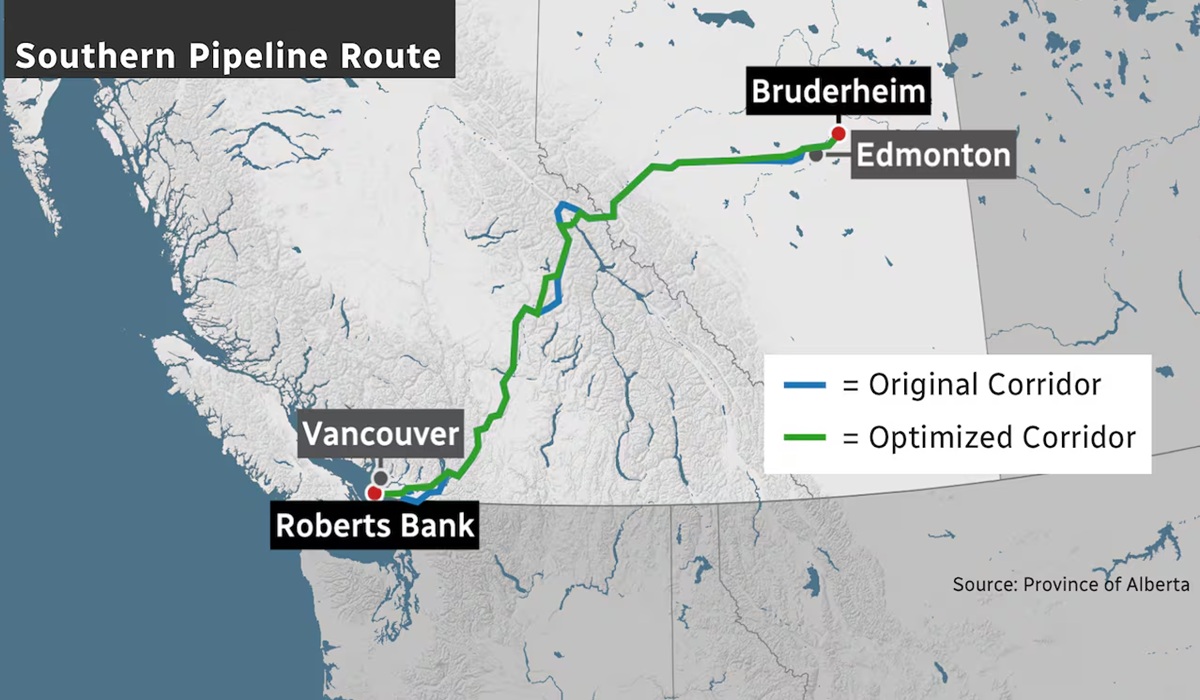
The marquee project will follow the geographic corridor of the existing Trans Mountain pipeline before splitting off to a newly constructed marine terminal at Roberts Bank. As shown in the route map, the “optimized corridor” runs from the Edmonton region across the Rocky Mountains, bypassing the northern coast entirely. Once fully operational, the infrastructure is projected to transport an estimated 1 million barrels of crude oil per day to overseas markets.
Carney, speaking from Vancouver during a domestic tour ahead of an upcoming NATO summit, framed the corridor as a strategic necessity to shield the Canadian economy from volatile international markets and growing trade frictions south of the border.
“In a more dangerous and divided world, Canada needs to move faster, build bigger and work together,” Carney said, emphasizing the need to diversify trade partners amid global market uncertainty.
To secure provincial and Indigenous cooperation—and avoid the exhaustive court battles that severely delayed previous pipeline expansions—the federal framework includes massive structural concessions. Ottawa has pledged billions for a major port expansion in Vancouver, upgraded electrical power grids for a separate liquefied natural gas terminal, and dedicated funding to protect the endangered southern resident killer whale population.
Crucially, Carney affirmed that a long-standing federal ban on oil tankers loading or unloading along British Columbia’s northern coast will remain fully intact. The decision represents a major victory for coastal Indigenous leaders, who had previously threatened to withdraw support for other multibillion-dollar energy projects if the environmental safeguard was compromised.
“British Columbians, Canadians and the First Nations who call this place home want this region to remain protected,” said Marilyn Slett, president of the Coastal First Nations and elected chief of the Heiltsuk Nation. “There is no technology that can clean up an oil spill at sea, and a single oil spill could destroy our way of life.”
The alignment represents a significant policy shift for Alberta. Smith had previously lobbied heavily for a northern pipeline route, which would have required overturning the tanker ban. However, the premier conceded that the southern alignment represents the fastest, most certain path forward. Under the new agreement, the federal and Alberta governments will act as equal partners, and local Indigenous communities along the route will be offered a meaningful equity ownership stake in the pipeline infrastructure.
British Columbia Premier David Eby indicated his province would not legally contest the development, noting that regional governments learned the limits of such battles during the original Trans Mountain expansion dispute.
The announcement drew immediate, sharp criticism from environmental organizations. Critics argued that expanding fossil fuel production directly undermines federal emissions targets at a time when Canadian communities are increasingly vulnerable to extreme summer weather and climate volatility. The Climate Action Network noted that while geopolitical stability is a valid economic concern, continuing to expand oil infrastructure creates severe long-term risks.
Formal consultations with local municipalities and affected First Nations are scheduled to begin immediately to finalize the construction timeline and regulatory oversight frameworks.
About The Author