The Fine Print in the Poultry Aisle: What is Legally Hiding on Your Chicken’s Back Label?
- Kingston Bailey
- Tiger's Eye Advisory Group - Trending News
- Food
- July 8, 2026
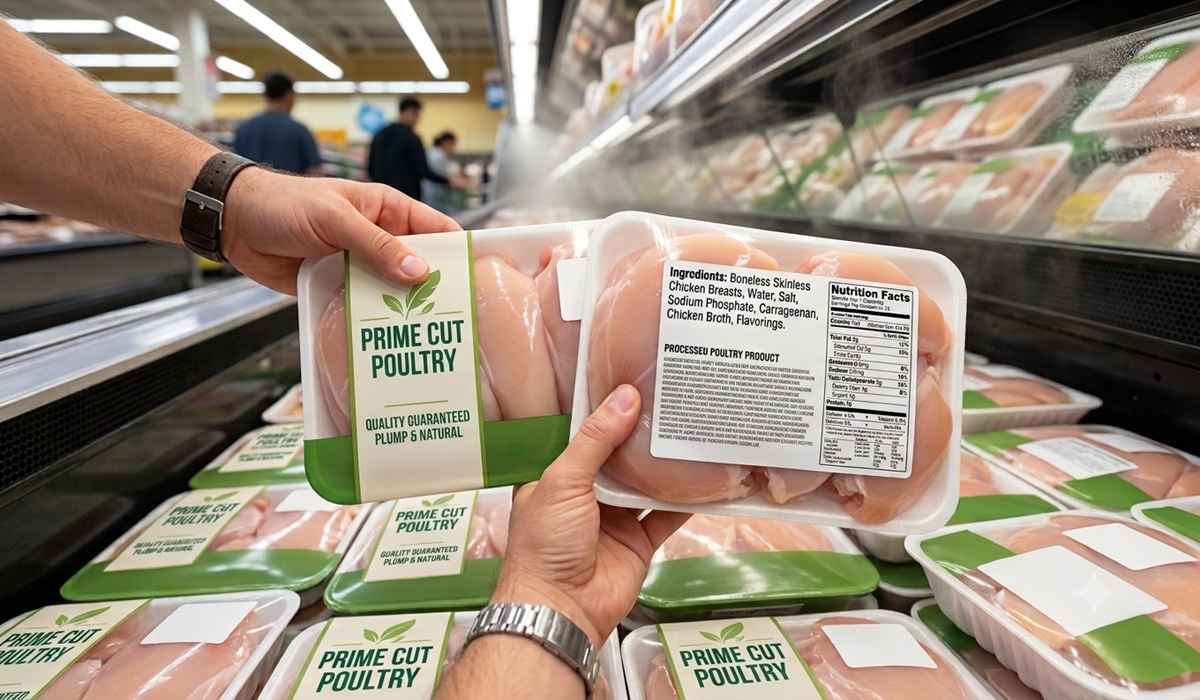
TORONTO — For shoppers browsing the poultry aisle, the large bold lettering on the front of a prepackaged chicken breast often promises an idyllic product: “All Natural,” “100% Chicken,” or “Premium Fresh.”
However, regulatory standards mean the most accurate description of what is actually inside that plastic wrap requires turning the package over to read the fine print on the back.
An industry-wide practice known as “enhanced processing” or “plumping” means that a significant portion of the weight of conventional raw poultry consists of an added liquid solution. Industry data and regulatory guidelines show that conventional chicken sold in grocery stores can be injected with or soaked in a mixture of water, sodium phosphate, and binding agents like carrageenan—a stabilizer derived from red seaweed.
While these additives meet all government food safety and inspection standards, the practice has raised questions among consumers about what exactly they are paying for at the checkout counter. Because poultry is priced and sold by weight, a portion of the price per pound pays for added water and minerals rather than meat.
The mechanics of the process are built into the high-volume nature of modern meat processing. Ingredients like sodium phosphate help the meat retain moisture during shipping and cooking, while carrageenan binds tightly with meat proteins to form a gel network that traps water inside the muscle tissue. This prevents the product from drying out on grocery shelves and ensures it remains visually plump.
Regulations mandate that raw, single-ingredient meat products must declare their retained water percentage on the label if water is absorbed during processing. Processed or multi-ingredient poultry must display a full ingredient list in descending order of weight, legally identifying the presence of water, salts, or seaweed extracts on the back label.
The prevalence of these techniques stems in part from consolidation within the agricultural sector. The North American poultry industry is largely dominated by a small handful of massive corporate producers that manage extensive networks of subsidiaries, leading some market analysts and consumer advocates to question the competitive landscape of the market. These large-scale supply chains rely heavily on automated, high-yield processing methods to keep consumer costs predictable and profit margins stable.
This corporate drive for hyper-efficiency has also triggered structural changes in the meat itself, most notably an abnormality known as “woody breast.” As modern commercial broilers are bred to grow significantly larger and faster than they did a few decades ago, the birds’ circulatory systems struggle to keep pace with rapid muscle development. The resulting oxygen deprivation causes muscle fibers to die and degrade, replacing healthy tissue with tough, fibrous connective tissue and fat.
While woody breast meat is entirely safe to eat, it leaves the consumer with a distinct, unappealing texture often described as gummy, hard, or even “crunchy”. To avoid consumer rejection, major processors frequently screen for the defect, diverting severely knotted fillets into discounted secondary markets for ground poultry or pet food.
The divergence in chicken quality is also evident in how the birds are cooled immediately after slaughter. The industry utilizes two primary methods: water chilling and air chilling.
Conventional water-chilled poultry is immersed in massive tanks of ice-cold chlorinated water to quickly drop its temperature to meet food safety guidelines. During this immersion, the meat naturally absorbs a percentage of the water. Air-chilled chicken, by contrast, is cooled by circulating cold, purified air. Because it never touches a communal water bath, air-chilled chicken retains no added water weight, leading to sharper browning, crisper skin, and a more concentrated flavor when cooked.
However, air chilling requires specialized equipment, significantly more facility space, and longer processing times, which drives up production costs. Ultimately, these processing variations have created a tiered market where product integrity is closely tied to retail price. High-end grocers and organic chains typically source air-chilled poultry that is entirely free from added sodium solutions, texturizers, or the structural defects of hyper-accelerated growth.
For the average consumer, navigating the poultry aisle requires looking past the marketing claims on the front of the box. As corporate agricultural practices continue to prioritize high volume and low margins, checking the back label for the exact water retention percentage or seeking out an “air-chilled” designation remains the only definitive way to know exactly how much actual chicken is making it from the grocery cart to the dinner plate.
About The Author