The Hubris of the Unseen: Why Canadian Municipal Campaigns Are Built to Lose
- TDS News
- Tiger's Eye Advisory Group - Trending News
- July 7, 2026
By: Donovan Martin Sr, Editor in Chief
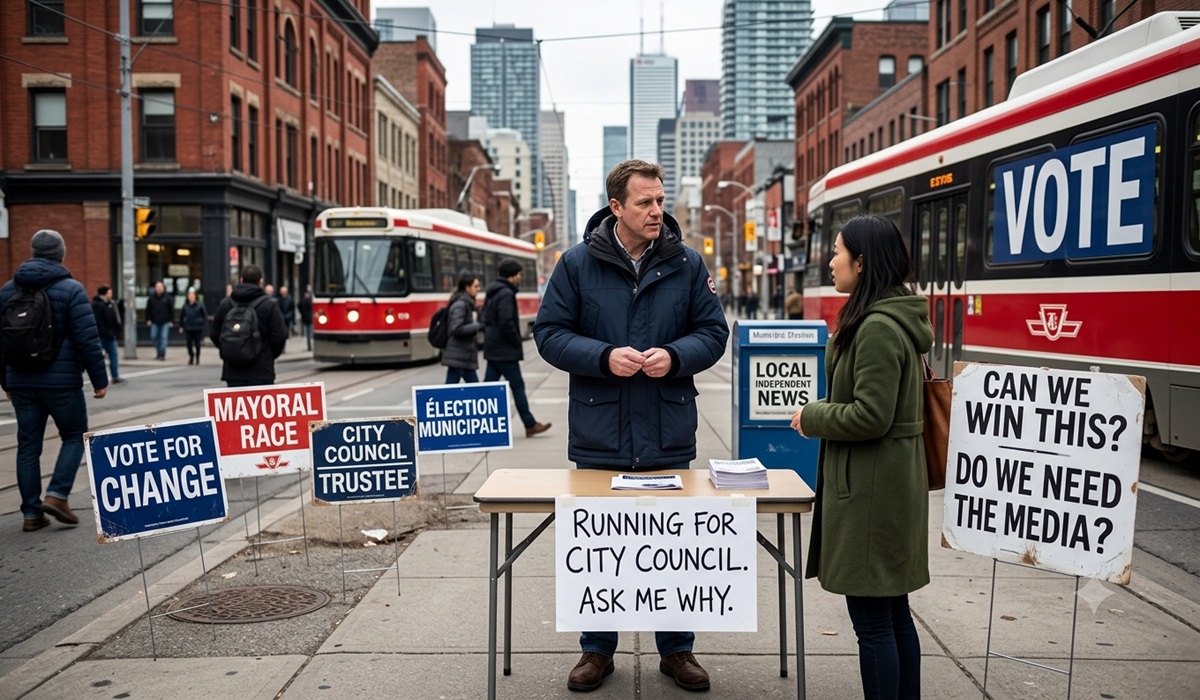
There is a quiet, comfortable delusion that settles over Canadian municipal politics every election cycle. You see it in every city hall race, every school trustee campaign, and every ward contest from coast to coast. It is the unearned hubris of the political novice, paired with the stubbornness of the perennial loser, both stepping into the arena believing that a good heart, a handful of lawn signs, and a Facebook page managed by a well-meaning relative is enough to secure a victory. It is a spectacular exercise in self-deception, and it is a fast track to absolute irrelevance.
If you are running for mayor, city council, or school trustee, let’s strip away the polite Canadian filters and face the brutal math of the ballot box. If nobody knows your name, and nobody knows why you are running, your campaign is a waste of everyone’s time. Yet, year after year, municipal candidates treat their runs for public office like a backyard hobby, entirely blind to the reality that a campaign you keep to yourself is not a campaign at all—it is a vanity project. To understand how to actually win a local election in the modern era, Canadian candidates need to stop looking at their traditional, polite playbooks and start looking south to see how American campaigns view the media landscape.
Say what you will about the nature of American politics, but their candidates understand a foundational truth that Canadians routinely ignore: elections are a brutal battle for human attention. An American campaign does not make excuses about a lack of budget or whine about the cost of outreach; they simply find a way to get the job done. If there was a neighborhood lemonade stand selling advertising space, a serious American candidate would buy it. They treat media like oxygen—vital, non-negotiable, and required everywhere. They spend heavily on major networks, dominate social media algorithms, buy placements inside video games, and wrap city buses, but their real genius lies in their refusal to overlook the smaller corners of the market. They aggressively utilize local independent media, community newsletters, and ethnic press because they understand that a voter is a voter, regardless of where they consume their information. They treat every single microphone as a direct pipeline to a living room, leaving absolutely no stone unturned in their quest to reach everyone.
Contrast that relentless drive with the average Canadian municipal candidate, who routinely falls into the twin traps of arrogance and amateur hour. The hubris in our local races usually manifests in candidates who go into the process thinking they already know everything. They refuse to listen to experts, ignore the people who have been in the trenches, and hand the keys of their political future over to family members who have never so much as picked up a campaign manual. This reliance on well-meaning amateurs isn’t charming; it is disqualifying. These amateur-led campaigns operate under the false assumption that legacy media is too expensive and that smaller, independent media isn’t worth the trouble. Instead, they rely on “organic” social media posts that only ever reach their existing circle of friends, essentially talking to themselves in an expensive echo chamber while expecting the general public to magically discover their genius. When the results come in and they inevitably lose, they comfort themselves by blaming voter apathy, completely oblivious to the fact that the electorate didn’t ignore them out of spite—they ignored them because they were entirely invisible.
The candidates who are actually ahead of the game right now are the ones who recognize that the media landscape has fractured. The days of relying on a single nightly newscast or one major daily newspaper to sweep a city are completely gone. Modern communication requires a hyper-localized, multi-angled strategy, and this is exactly where independent and community-focused media outlets have become the ultimate secret weapon. Smaller, independent publications and local digital networks offer deep, trusted, and highly concentrated community engagement that massive corporate networks can never replicate. When you couple the authentic connection of an independent outlet with modern digital boosting, an ad spend that would be swallowed whole by a legacy network suddenly punches drastically above its weight class, delivering precise, targeted saturation to the exact demographics that actually show up to vote. Smart candidates know that advertising with independent and ethnic media isn’t just about buying impressions; it is about buying immediate credibility and name recognition within highly active voting blocks at a fraction of the cost.
Let’s be entirely direct: if you are running for local office and you are refusing to invest in a serious, aggressive media strategy across all angles, you are not genuinely in it to win. You are running to feel important, to check an item off your bucket list, or to show off to your immediate peers. If you do not have the courage or the strategic foresight to leverage independent local media to its full advantage, then save your family the exhaustion and save yourself the public embarrassment. Pull your name off the ballot. But if you are truly serious about earning a seat at the table and serving your community, it is time to put down the amateur playbook, cast aside the unearned hubris, and start treating media like the indispensable power tool that it is. Spend the money, utilize every local and independent outlet available, and ensure that by the time election day arrives, the voters have no choice but to know exactly who you are and why you deserve their vote.
About The Author