Velvet Glove, Iron Fist: Why the Conservative Bench is Shrinking at the Hands of Carney
- TDS News
- Breaking News
- July 7, 2026
By: Donovan Martin Sr, Editor in Chief
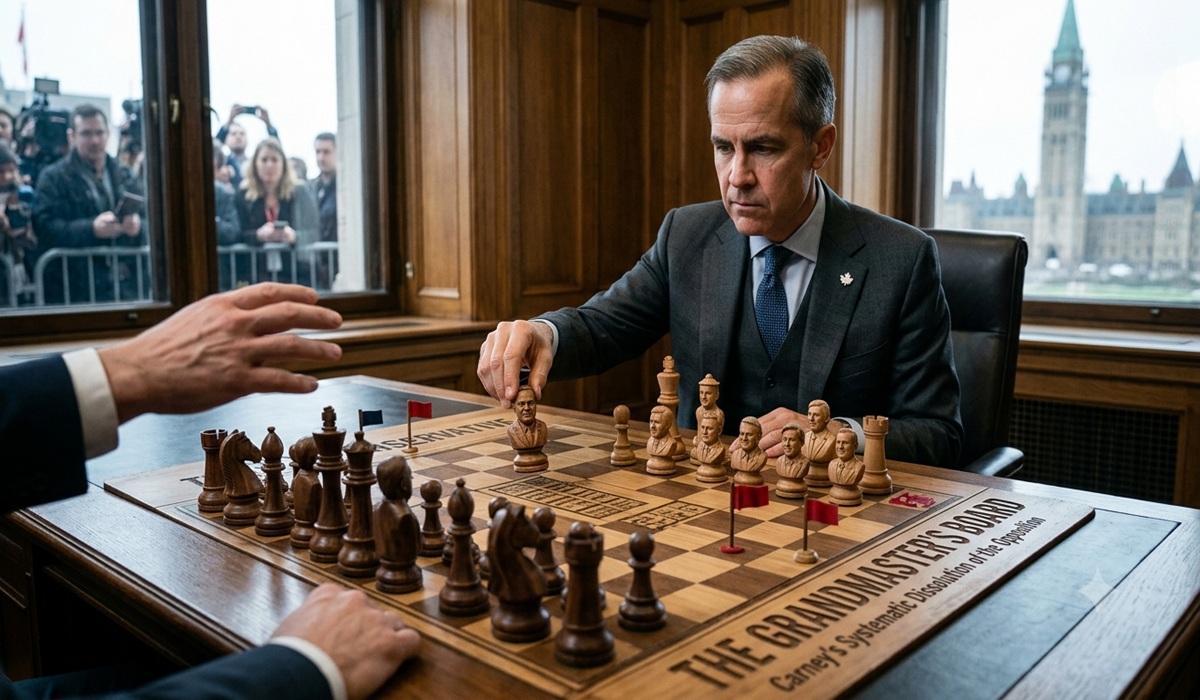
Politics is a blood sport, but Mark Carney is treating it like a clinical exercise in Grandmaster chess. While the talking heads spend their days hyper-focusing on standard-issue partisan bickering, the government has been quietly, systematically dismantling the Conservative benches from behind a curtain of backroom pragmatism.
The latest piece to fall on the board is Richard Martel, the Conservative MP for Chicoutimi—Le Fjord. By plucking Martel out of the House of Commons and dropping him into the comfortable, unelected cushion of a lifetime Senate appointment, the Prime Minister didn’t just execute a routine patronage pivot—he delivered a masterclass in political subtraction.
This isn’t an isolated incident or a lucky break. Martel represents the fifth Conservative MP the current administration has successfully peeled away from the official opposition. Four others crossed the floor entirely to sit with the government; Martel took the golden parachute. Call it diabolical, call it unfair, or call it completely ruthless—but you cannot call it accidental. It is straight, unadulterated tactical warfare. While Pierre Poilievre relies on loudest-in-the-room rhetoric, his opponent is turning the Conservative leader into a legislative punching bag by simply altering the geometry of the House.
Look at the board from an objective, cold-blooded perspective. Nobody crosses the aisle, and nobody resigns a hard-fought seat, without a sweet deal or an immense amount of leverage on the table. It just doesn’t happen. Carney knows exactly how to identify vulnerable or weary targets, assess their price, and offer an exit strategy they can’t refuse. For Martel, swapping the exhausting, endless cycle of campaigning in a razor-thin riding for a secure, influential seat in the upper chamber is a massive personal upgrade. For the Liberals, it’s a multi-layered strategic win.
First, this sudden vacancy triggers a by-election in Chicoutimi—Le Fjord within the next six months. Martel only narrowly held that riding in the last election, squeaking by in a tight three-way race where the Bloc Québécois and the Liberals were hot on his heels. Without his incumbent name recognition on the ballot, the government stands an incredibly strong chance of flipping the seat, turning a Conservative stronghold into a red pickup.
Second, it buys the government crucial breathing room. Rumors have been swirling for months about a handful of Liberal MPs quietly indicating they won’t seek re-election or might step down before the current term wraps up. By forcing by-elections in soft Conservative territory early, a buffer is created. The party can offset potential future losses before they even happen, keeping the parliamentary math stable and dictating the timing of the news cycle.
We often hear people talk about Donald Trump as the ultimate, aggressive “dealmaker,” operating on raw bluster and public leverage. Carney’s method is the exact inverse: quiet, corporate, and devastatingly precise. You don’t need to win an argument on a debate stage when you can just buy the other team’s players out from under them before the debate even starts.
Going deeper, this move signals a fundamental structural shift in how Ottawa operates. By dropping the strict non-partisanship criteria for Senate picks to install political operators and targeted opposition members, the upper house has essentially been weaponized into a tactical toolshed. It cuts right through the theoretical high-ground of independent appointments and treats the Senate exactly like what it has always been in the hands of a realist: a leverage point. It tells every frustrated backbencher on the opposition benches that there is an escape hatch, provided they are willing to yield a piece of territory in return.
To understand why this works, you have to look at the PM’s background. You do not get to be the head of a global financial empire, spend years navigating the cutthroat corridors of British governance, and hold the levers of institutional power without knowing how to twist arms. Ascent to this level doesn’t happen by playing nice or begging for consensus. The fundamental rule of high-stakes power is simple: polite smiles on camera, but absolute, unrelenting coercion behind closed doors.
There is an underlying mentality at play here that translates simply to “do what I say, or fuck around and find out.” The soft-spoken, polished technocrat persona is just the velvet glove. Inside it is a hot iron fist strapped with a stick of dynamite, ready to blow up an opponent’s caucus structure if they refuse to play ball. Whether it requires a sweetheart deal like a lifetime Senate seat to coax a weary incumbent away, or a forceful behind-the-scenes squeeze play to isolate a troublemaker, Carney does what needs to be done.
It is a calculation entirely stripped of sentimentality. While Poilievre plays to the cameras, his rival is rewriting the structural math of the House by offering exits to the exhausted and penalties to the stubborn. It’s an exercise in raw, unapologetic power. Like the tactics or hate them, this is how real politics is played at the highest altitude—bloodless, systematic, and entirely unforgiving. Right now, the alliance behind Poilievre is running out of squares to move to.
In the end, this isn’t about ideology; it’s about predatory instinct. High-level power doesn’t wait for permission or consensus—it actively sniffs out the weak, the weary, and the politically malleable. Every opposition caucus has its cracks, full of backbenchers who are tired of the grind or unsure of their own futures, and that is exactly where the pressure gets applied. You don’t ask nicely for compliance at this altitude; you find the fracture points, you offer the golden parachute or the heavy arm, and you pounce. It is the ultimate realization of a cutthroat political truth: you don’t bargain for what you want—you simply take it.
About The Author