By: Donovan Martin Sr, Editor in Chief
Part 1: Revocation
“The Lost Canadians deserve answers.” Those were Prime Minister Mark Carney’s words when he was recently questioned about one of the most serious citizenship controversies now confronting his government. On that point, there should be no disagreement. The affected families deserve answers, Parliament deserves answers, and the public deserves answers. After two detailed media inquiries from The Daily Scrum News containing more than forty questions directed to the federal government, those answers have still not arrived.
The Lost Canadians issue arose because outdated citizenship laws and historical legislative flaws left thousands of people either stripped of their citizenship or denied recognition altogether. Parliament eventually acknowledged those injustices and, through Bill C-3, corrected many of the most significant deficiencies in the law. While Bill C-3 did not resolve every outstanding issue, it was intended to restore certainty to people who had spent years living in legal limbo through no fault of their own. Parliament’s objective was straightforward: correct the government’s mistakes, recognize those entitled to citizenship, and finally allow affected families to move forward.
That certainty has now been thrown back into question. After receiving citizenship certificates and believing the matter had finally been resolved, some individuals later received official correspondence from Immigration, Refugees and Citizenship Canada advising that their passports had been revoked while their citizenship status was under review. For those affected, the letters reopened questions they believed Parliament had already answered through Bill C-3. They are not rumours or second-hand accounts but official government documents carrying immediate legal and practical consequences for the people who received them.
The significance of this controversy extends well beyond the affected families because of the department at its centre. IRCC is one of the federal government’s largest and most consequential institutions, responsible for citizenship, immigration, refugee protection, permanent residence, passports, and family reunification. It is also a department that has spent years under intense public scrutiny. Processing backlogs, lengthy delays, operational challenges, inconsistent service, and recurring controversy have repeatedly placed IRCC at the centre of national debate regardless of which government has been in office. More recently, the portfolio has experienced significant ministerial turnover, with three different immigration ministers since Prime Minister Mark Carney assumed office. Leadership changes alone do not explain departmental performance, but they inevitably raise questions about continuity, oversight, and whether meaningful reform is taking hold inside one of the federal government’s most important departments.
Against that backdrop, this controversy carries even greater significance. This is not an isolated issue unfolding inside a department with an otherwise uneventful record. It is another major controversy emerging from a portfolio that has repeatedly been called upon to explain its performance, reassure the public, and restore confidence in one of government’s most important responsibilities. That context makes transparency, consistency, and accountability not simply desirable—they are essential.
The government’s handling of this matter has only intensified those concerns. People reasonably expect consistency between official government correspondence and the public statements made by the Minister responsible for the department. Instead, they were presented with two materially different descriptions of the same government action. The department’s official correspondence described one course of action, while the Minister later described the situation differently in public. The gap between those two explanations deserves a clear and complete answer.
More than a week passed between the correspondence becoming public and the Minister’s national television explanation. That timeline matters. This was not a rapidly unfolding situation where officials were responding before the facts were known. The department’s letters had already circulated publicly, been examined by lawyers, reported by media organizations, and discussed extensively by affected families. The Minister had ample opportunity to receive a detailed briefing, review the department’s own correspondence, consult senior officials, and ensure that her public explanation accurately reflected the actions taken by the department she leads.
Yet the government’s public explanation did not resolve the central inconsistency. The issue is not whether officials continued reviewing the files. The issue is whether the department’s official correspondence and the Minister’s subsequent public explanation describe the same government action. They do not use the same language, and the government has yet to explain why. Members of the public should never be left trying to determine which description reflects the government’s official position.
That leaves several legitimate questions. If the Minister was fully briefed before speaking publicly, why did her explanation differ from the department’s written correspondence? If she was not fully briefed, how did the minister responsible for one of the federal government’s largest and most consequential portfolios address a national controversy without first confirming the facts with the officials responsible for administering it? Neither scenario strengthens confidence in the administration of one of Canada’s most important departments.
Government ministers are accountable for the departments they lead. When a minister addresses an issue of this magnitude, the expectation is that the explanation reflects a complete understanding of the department’s actions. Where official correspondence and subsequent public statements cannot be readily reconciled, the government owes the public a clear and comprehensive explanation. Until that explanation is provided, reasonable questions about the department’s decision-making and communications will remain.
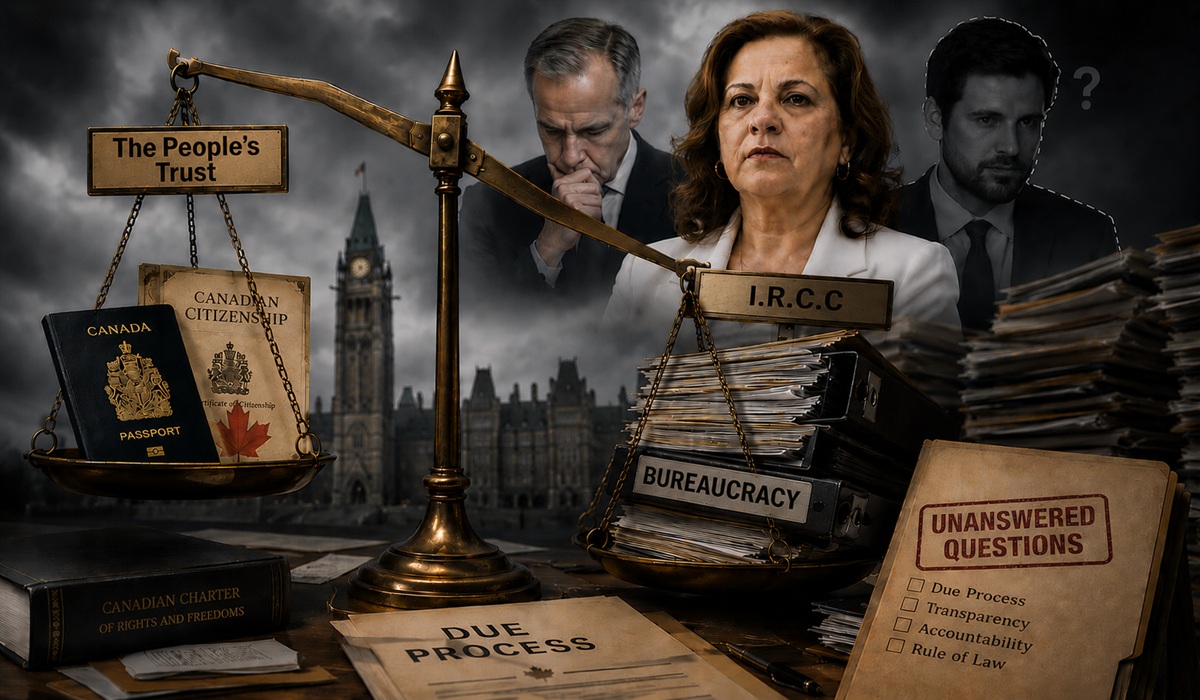
This controversy has become about due process. It asks whether government can recognize someone as a citizen, issue official documentation confirming that recognition, and later take administrative action affecting that recognition without fully explaining the legal authority, the decision-making process, and the procedural safeguards that were followed. Carefully crafted talking points are no substitute for a transparent accounting of how these decisions were made.
Section 7 of the Canadian Charter of Rights and Freedoms guarantees everyone the right to life, liberty, and security of the person except in accordance with the principles of fundamental justice. Courts determine how those protections apply in individual cases, but the underlying principle is clear. When governments make decisions carrying significant consequences for legal status, mobility, and individual rights, the expectation is fairness, lawful authority, procedural safeguards, and transparency. Those principles are fundamental to confidence in Canada’s constitutional democracy.
The central contradiction remains. If the affected individuals were legally entitled to Canadian citizenship, why were official government documents later called that status into question? If they were not legally entitled to citizenship, why were citizenship certificates and passports issued in the first place? One of those decisions was wrong. The outstanding questions are which decision was incorrect, what legal authority supported it, and how the government intends to ensure the same uncertainty does not arise again.
Part 2: Due Process
At some point, this controversy stops being about letters, passports, or administrative procedures and becomes about something much larger: the rule of law. Governments possess significant powers, but those powers are not unlimited. They are exercised within legal boundaries established by Parliament, interpreted by the courts, and constrained by the Canadian Charter of Rights and Freedoms. Those principles are not abstract constitutional ideals. They are the foundation upon which public confidence in government is built.
That is why due process matters. Due process is not a technical legal phrase reserved for courtrooms or constitutional scholars. It is the safeguard that ensures governments exercise their powers according to law before making decisions that significantly affect people’s rights and legal status. It requires lawful authority, procedural fairness, meaningful notice, and, where the law provides, an opportunity for affected individuals to understand and challenge government decisions. Those protections exist because governments are expected to justify the exercise of their powers, not simply announce the outcome after the fact.
That naturally leads to the central question in this controversy. If officials believed there were legitimate concerns surrounding these citizenship files, what legal process was followed? The country already has legislation governing citizenship, an established body of administrative law, and an independent judiciary to review government action where appropriate. If the actions described in IRCC’s correspondence were supported by lawful authority, the government should explain precisely what process was followed, what statutory authority it relied upon, and how that process complied with the legal safeguards the public has every reason to expect. Those answers should not require repeated media inquiries.
Another important question sits at the very beginning of this story: what triggered the review in the first place? Government departments do not randomly reopen citizenship files. Something prompted this process. An internal review may have identified a concern. A legal opinion may have raised questions. New information may have come to light. A complaint may have been received. An audit may have uncovered an issue, or an automated system may have identified files for further examination. Whatever the catalyst was, someone, somewhere, made the decision that these files required another review.
That raises a series of legitimate questions. What event triggered the review? Who first identified the issue? Was the review initiated through human decision-making, an internal audit, legal advice, external information, or an automated process? Who authorized moving from identifying a concern to issuing official correspondence advising affected individuals that administrative action had been taken? Until those questions are answered, it is impossible to properly evaluate whether the government’s response was proportionate, lawful, or justified.
The government’s continued silence has created another unavoidable question: how many people were actually affected? That should not be difficult to answer. The government knows how many files were reviewed, how many letters were issued, and how many cases have since been reconsidered or resolved. Yet despite sustained public interest and repeated media inquiries, the overall scope of the issue has never been clearly explained. That absence of basic information naturally invites further questions.
The size of the affected group matters for reasons that extend well beyond public curiosity. If the number is relatively small, transparency should be straightforward. If the number is significant, the public deserves to know because the scope of the review has direct implications for confidence in government, departmental resources, and the government’s own assessment of what occurred. Clear numbers would reduce speculation, while continued silence only encourages it.
The practical consequences extend beyond those directly affected. Every file that must be reopened, reviewed, or corrected requires public servants to divert time and resources away from thousands of other people already waiting for citizenship decisions, passport applications, permanent residence files, refugee claims, and immigration processing. Every review requires legal, administrative, and operational resources. Every effort devoted to correcting one problem inevitably affects the department’s ability to process other applications that have already been delayed for months, and in many cases, years.
Another institution has remained largely absent from the public discussion: the Department of Justice. That absence deserves careful examination because the Department of Justice exists for more than defending government decisions once litigation begins. Its lawyers advise departments before decisions are implemented, identify legal risks, and help ensure government action remains within the limits established by Parliament and the Constitution. The Attorney General also carries an independent responsibility to uphold the rule of law and the proper administration of justice.
That naturally gives rise to another series of questions. Was the Department of Justice consulted before IRCC issued its correspondence? If so, what legal advice was provided? Did government lawyers conclude the proposed process complied with the Citizenship Act, administrative law, and the Charter? Were concerns raised about procedural fairness, and if they were, how were those concerns addressed? If no concerns were raised, why not? If legal advice supported the process, will the government explain the legal reasoning so the public can understand the basis upon which these decisions were made?
These are not accusations directed at the Department of Justice. They are questions about whether the legal safeguards expected in a constitutional democracy were fully engaged before decisions affecting citizenship and travel documents were implemented. If those safeguards functioned exactly as intended, there should be no hesitation in explaining how. If they did not, the public deserves to know why.
This controversy has also become a test of accountability. Large government departments do not make significant decisions through the actions of one individual alone. Major decisions typically move through legal review, management, senior executives, departmental leadership, and ministerial accountability. If mistakes occurred, the public deserves to understand where they occurred, how they occurred, and what changes will be implemented to prevent similar situations from arising again. Accountability should involve more than identifying a single official after the fact. It should include a complete explanation of how the decision-making process unfolded from beginning to end.
Prime Minister Mark Carney publicly stated that the Lost Canadians deserve answers. That statement established a clear expectation against which his government’s response will inevitably be measured. People are no longer waiting for general assurances that the matter is being reviewed. They are waiting for a complete explanation of what triggered the review, how many people were affected, what legal authority supported the decisions, whether the Department of Justice was consulted, and what reforms will follow if deficiencies are identified.
Bill C-3 represented Parliament’s effort to correct historical injustices that had left people in legal uncertainty through no fault of their own. Its purpose was to restore certainty, not create new uncertainty. That is why this controversy cannot simply be dismissed as another administrative dispute. It raises broader questions about due process, transparency, accountability, and confidence in the administration of citizenship.
Governments often outlast controversies, but unanswered constitutional questions rarely disappear. They remain until they are answered with facts rather than assurances, transparency rather than silence, and accountability rather than ambiguity. Prime Minister Carney said the Lost Canadians deserve answers. Ultimately, his government’s response will be judged not by those words alone, but by whether it provides the answers that have been sought and restores confidence in one of the country’s most important public institutions.
The Prime Minister’s reputation now faces a critical test as this unfolding domestic citizenship issue challenges Canada’s global message of stability and reliability. Foreign nations will logically question how they can trust a government whose own citizens cannot rely on its word—especially when the Prime Minister himself maintains that “The protection of citizens is the most fundamental responsibility of government.”
Stay tuned.
About The Author