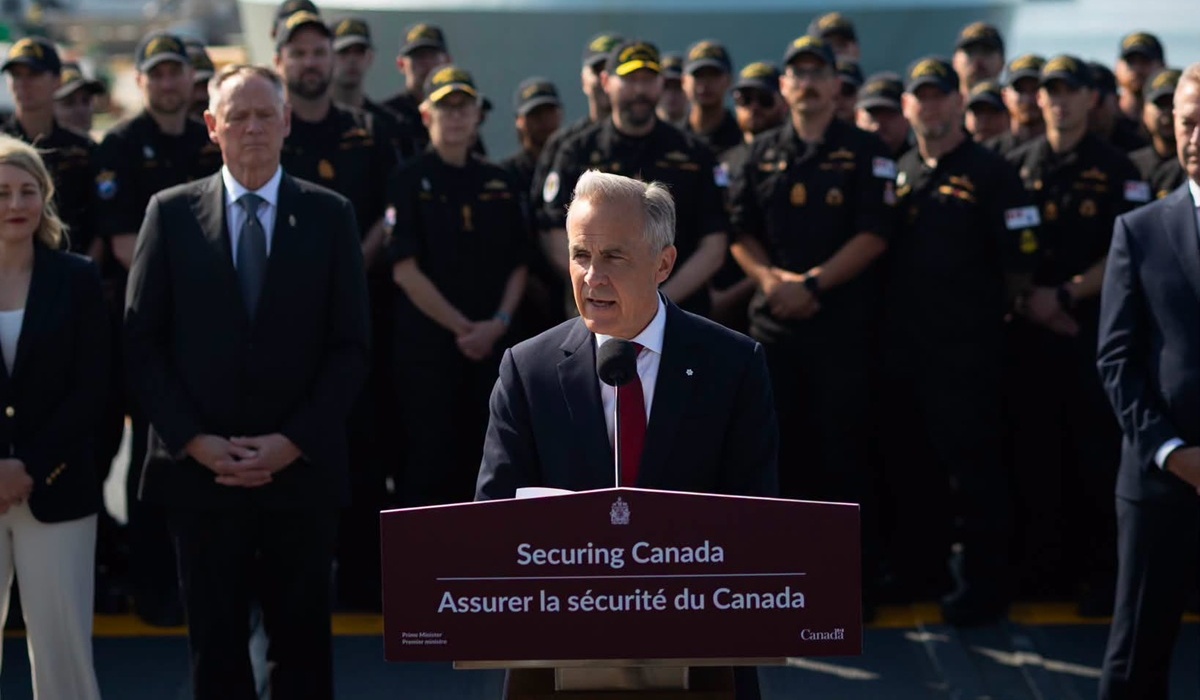
Image credit, Government of Canada
For decades, replacing the Royal Canadian Navy’s aging submarine fleet has been a conversation filled with delays, political debate, and mounting costs. This week, that discussion finally shifted from speculation to action as the federal government selected German defence manufacturer ThyssenKrupp Marine Systems (TKMS) as the preferred supplier for what will become the largest military procurement in Canadian history.
The decision launches formal negotiations for a fleet of up to 12 next-generation submarines that will eventually replace the Victoria-class vessels, many of which have struggled with age, maintenance challenges, and limited operational availability. If negotiations proceed as planned, the first boats are expected to enter service in 2034, marking the beginning of a transformation that will shape the Royal Canadian Navy well into the second half of this century.
The announcement is about far more than replacing old equipment. It represents a fundamental shift in how Ottawa views national security at a time when geopolitical tensions continue to rise and the Arctic is rapidly becoming one of the world’s most strategically important regions. Melting sea ice is opening new shipping lanes, increasing military activity, and drawing renewed attention from countries such as Russia and China, making northern sovereignty no longer a theoretical discussion but an operational reality.
For a nation bordered by the Atlantic, Pacific, and Arctic oceans, underwater surveillance has become one of the most valuable military capabilities available. Submarines operate quietly, gather intelligence, monitor foreign naval activity, and serve as a powerful deterrent simply by being present. Their greatest strength often lies in the fact that potential adversaries rarely know exactly where they are.
That capability has steadily eroded over the past two decades. The existing Victoria-class fleet, purchased second-hand from the United Kingdom, has reached the point where keeping the boats operational has become increasingly difficult. Maintenance schedules have frequently sidelined multiple submarines at the same time, leaving the navy with only limited underwater capability despite Canada’s responsibility for the world’s longest coastline.
The vessels proposed by TKMS are among the most advanced conventional submarines currently in production. Based on the 212CD design being acquired by Germany and Norway, they feature exceptionally low acoustic and magnetic signatures, making them extremely difficult to detect. Designed for Arctic operations, intelligence gathering, anti-submarine warfare, special forces deployment, and long-range patrols, they will provide a capability that the current fleet simply cannot match.
Equally important is the partnership behind the project. Rather than operating a unique class of submarines, Canada would join Germany and Norway in using a common platform, allowing closer cooperation on training, logistics, maintenance, technology upgrades, and future modernization. In an era where NATO interoperability has become increasingly important, sharing equipment with trusted allies offers advantages that extend well beyond the submarines themselves.
The economic implications are equally significant. Federal officials have made it clear that this is not intended to be a simple overseas purchase. Through Canada’s Industrial and Technological Benefits Policy, the project is expected to generate substantial work for domestic manufacturers, engineering firms, technology companies, and suppliers. Thousands of highly skilled jobs could be created over the life of the program, while Canadian businesses are expected to participate in everything from advanced manufacturing and systems integration to long-term maintenance and sustainment.
The procurement also signals a broader change in defence policy. After years of criticism over lengthy procurement timelines and repeated project delays, the government has placed greater emphasis on accelerating military acquisitions while strengthening the domestic defence industrial base. Completing a competitive evaluation of this magnitude in less than a year suggests officials are attempting to move major projects forward far more quickly than has traditionally been the case.
There is still important work ahead before construction begins. Negotiations with TKMS must be completed, contracts finalized, industrial commitments secured, and production schedules confirmed. The government has identified South Korean shipbuilder Hanwha Ocean as a reserve supplier should negotiations fail, providing an additional measure of certainty that the procurement can continue without returning to square one.
Questions surrounding the final price tag will inevitably dominate political debate in the years ahead. Large defence projects rarely remain within their original budgets, and taxpayers will rightly expect strong oversight, transparency, and accountability as negotiations progress. At the same time, defence planners argue that delaying replacement any longer would ultimately prove even more expensive while leaving the country increasingly vulnerable during a period of growing global instability.
For years, replacing the submarine fleet remained an objective that successive governments acknowledged but struggled to deliver. This week’s announcement suggests that chapter may finally be coming to a close. If negotiations are successful, the project will not simply replace aging vessels; it will redefine the Royal Canadian Navy’s capabilities, strengthen Canada’s defence industry, deepen cooperation with key NATO allies, and reinforce the country’s ability to defend its interests from coast to coast to coast for decades to come.
About The Author