From JF-17 to J-35 : Pakistan’s Expanding Air Superiority Vision over India
- Naveed Aman Khan
- Pinpoint
- May 11, 2026
South Asia is entering a new phase of aerial competition where technology, network-centric warfare, electronic dominance, and pilot training are becoming more decisive than numerical superiority alone. The brief but intense Pakistan-India military confrontation of May 2025 fundamentally altered regional perceptions regarding airpower in the subcontinent. During those engagements, the Pakistan Air Force (PAF) demonstrated a level of operational coordination, beyond-visual-range combat capability, and electronic warfare integration that surprised many global defense observers. Pakistan claimed that its Chinese-origin J-10C fighters and JF-17 Thunder aircraft successfully outperformed several Indian Air Force assets during the conflict, including advanced platforms and air defense systems. Independent international reporting later acknowledged that at least some Indian aircraft losses likely occurred during the engagement, although the full extent of losses remains disputed between the two countries.
The aerial battle of May 2025 was not merely a tactical episode; it became a strategic turning point. It highlighted how a smaller but technologically integrated air force can challenge a larger adversary through superior doctrine, faster decision-making, and advanced missile systems. The combat use of the PL-15 beyond-visual-range missile drew particular attention because it demonstrated Pakistan’s growing ability to engage hostile aircraft at long ranges while remaining outside traditional engagement envelopes. Analysts across international defense circles began reassessing the balance of power in South Asia after the conflict.
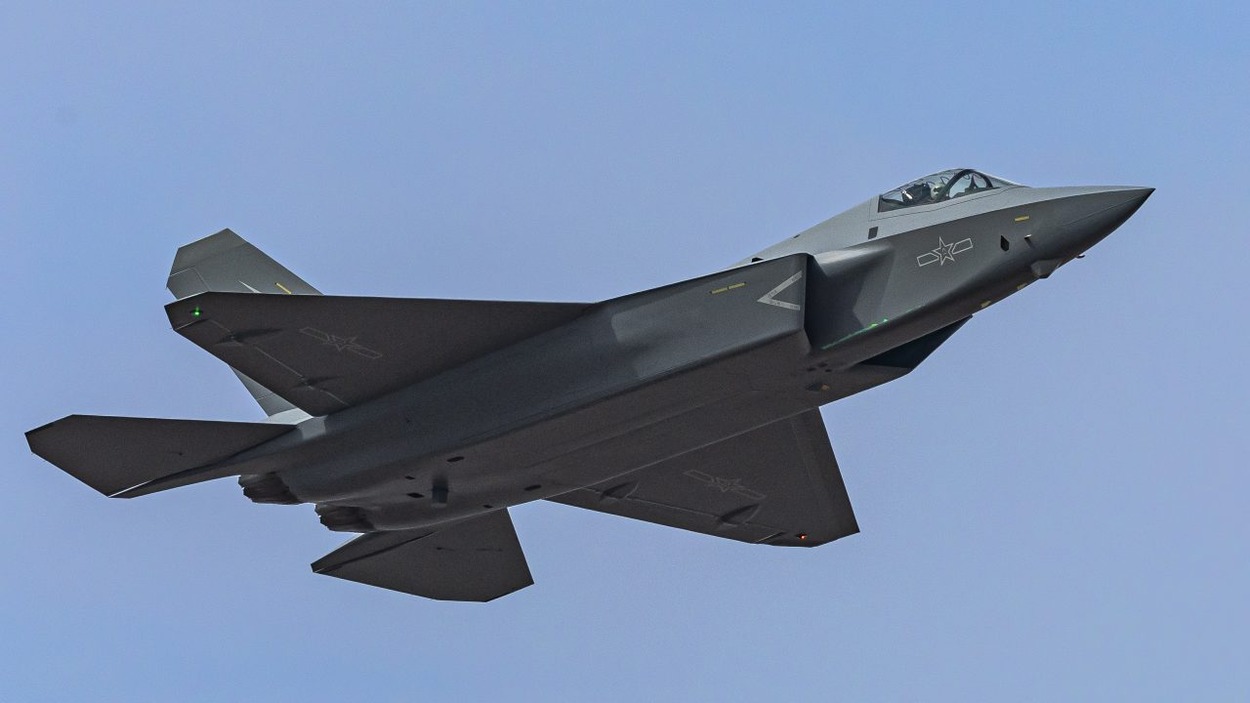
Now, with growing reports and speculation regarding Pakistan’s future acquisition of the Chinese fifth-generation J-35 stealth fighter, the regional military equation could shift even more dramatically. If inducted into the PAF in meaningful numbers, the J-35 would represent not just another fighter aircraft, but the arrival of stealth-era warfare in South Asia under Pakistan’s operational doctrine. Such a development would significantly strengthen Pakistan’s deterrence posture and potentially widen the technological gap between the PAF and the Indian Air Force in several critical domains.
The J-35 is widely viewed as China’s emerging fifth-generation export-oriented stealth fighter, designed to combine low radar observability, advanced avionics, sensor fusion, electronic warfare capability, and long-range precision engagement. Unlike fourth-generation aircraft that rely heavily on speed and maneuverability, fifth-generation platforms emphasize information dominance, stealth penetration, real-time battlefield networking, and first-shot capability. In modern warfare, the side that sees first, shoots first, and remains undetected usually gains a decisive advantage.
For Pakistan, the strategic significance of the J-35 would be immense. First, it would enhance survivability against advanced Indian air defense systems, including long-range radar and missile networks. Stealth technology reduces radar cross-section, making detection and interception far more difficult. This would allow Pakistan to conduct precision operations, surveillance, and defensive patrols with greater confidence during periods of crisis.
Second, the J-35 would strengthen Pakistan’s layered air combat doctrine. The PAF has gradually built an interconnected ecosystem involving airborne early warning aircraft, electronic warfare systems, data-linked fighters, and long-range missile platforms. The addition of stealth fighters into this network could allow Pakistan to integrate J-10C fighters, JF-17 Block III aircraft, and future unmanned systems into a more lethal combat architecture. Instead of functioning as isolated platforms, these systems could operate collectively through real-time data sharing and coordinated engagement strategies.
Third, the psychological and strategic impact on regional deterrence would be enormous. India has long sought to establish conventional military superiority through large-scale acquisitions from Western and Russian suppliers. However, the May 2025 conflict exposed the limitations of relying solely on expensive platforms without achieving complete operational integration. Several defense analysts argued after the conflict that the PAF’s doctrine, training standards, and combat coordination were more decisive than raw numerical strength.
Pakistan’s air force has historically emphasized precision, discipline, and operational efficiency. From the Cold War era to modern network-centric warfare, the PAF has maintained a reputation for high pilot standards and tactical adaptability. The introduction of modern Chinese systems has accelerated this transformation. Unlike fragmented procurement models, Pakistan’s growing defense cooperation with China allows for interoperability across aircraft, radars, missile systems, and electronic warfare platforms. This compatibility reduces logistical complexity and improves combat readiness.
The Indian Air Force, despite possessing larger numbers and diverse aircraft fleets, continues to face structural challenges related to maintenance, procurement delays, fleet diversity, and modernization gaps. Operating Russian, French, Israeli, indigenous, and other systems simultaneously creates integration challenges that become more visible during high-intensity combat scenarios. Furthermore, India’s ambitious fifth-generation fighter ambitions remain under development and may require years before operational maturity is achieved.
If Pakistan successfully acquires and operationalizes the J-35 before India fields a fully mature equivalent stealth capability, Islamabad could temporarily gain a significant technological edge in aerial warfare. This would not necessarily mean Pakistan seeks offensive confrontation. Rather, it would strengthen deterrence by increasing the potential cost of aggression against Pakistan.
Another important aspect is the evolving role of electronic warfare and artificial intelligence in modern combat. Future aerial battles will not be decided solely through dogfights but through radar suppression, cyber warfare, communication disruption, satellite integration, and AI-assisted targeting. The PAF’s increasing alignment with Chinese military technology gives it access to systems designed specifically for integrated information warfare. In this environment, stealth aircraft like the J-35 become force multipliers rather than standalone fighters.
Pakistan’s security environment also demands credible deterrence. The country faces a geographically larger adversary with significantly greater defense spending. Under such circumstances, Pakistan has historically relied on strategic balance rather than numerical competition. The acquisition of advanced aircraft helps maintain equilibrium and reduces the risk of miscalculation. When both sides understand the cost of escalation, the chances of full-scale conflict decrease.
However, it is also important to avoid exaggerated triumphalism. Air superiority is never permanent. Military balances evolve continuously through technology, alliances, doctrine, and economic capacity. India will undoubtedly continue modernizing its air force, expanding indigenous production, and strengthening its integrated air defense systems. Regional stability therefore depends not only on military capability but also on diplomatic maturity and crisis management mechanisms.
At the same time, the May 2025 conflict delivered an important lesson to the world: modern warfare increasingly favors integrated ecosystems over isolated prestige platforms. Pakistan’s reported success with J-10C fighters and JF-17 Thunder aircraft demonstrated how strategic coordination, missile technology, pilot skill, and electronic warfare can collectively challenge even advanced opponents. The conflict also elevated the global reputation of Chinese defense technology, particularly in the export market.
The future induction of the J-35 would likely deepen this transformation. It could make the Pakistan Air Force one of the most technologically capable air forces in the Muslim world and potentially one of the strongest in Asia outside the major global powers. More importantly, it would reinforce Pakistan’s ability to defend its airspace, protect strategic infrastructure, and maintain deterrence in an increasingly volatile regional environment.
The emergence of the J-35 in Pakistan’s future defense planning symbolizes more than an aircraft purchase; it represents the evolution of Pakistan’s military doctrine toward stealth-based, network-centric, and information-dominant warfare. The aerial engagements of May 2025 already altered strategic perceptions.
About The Author