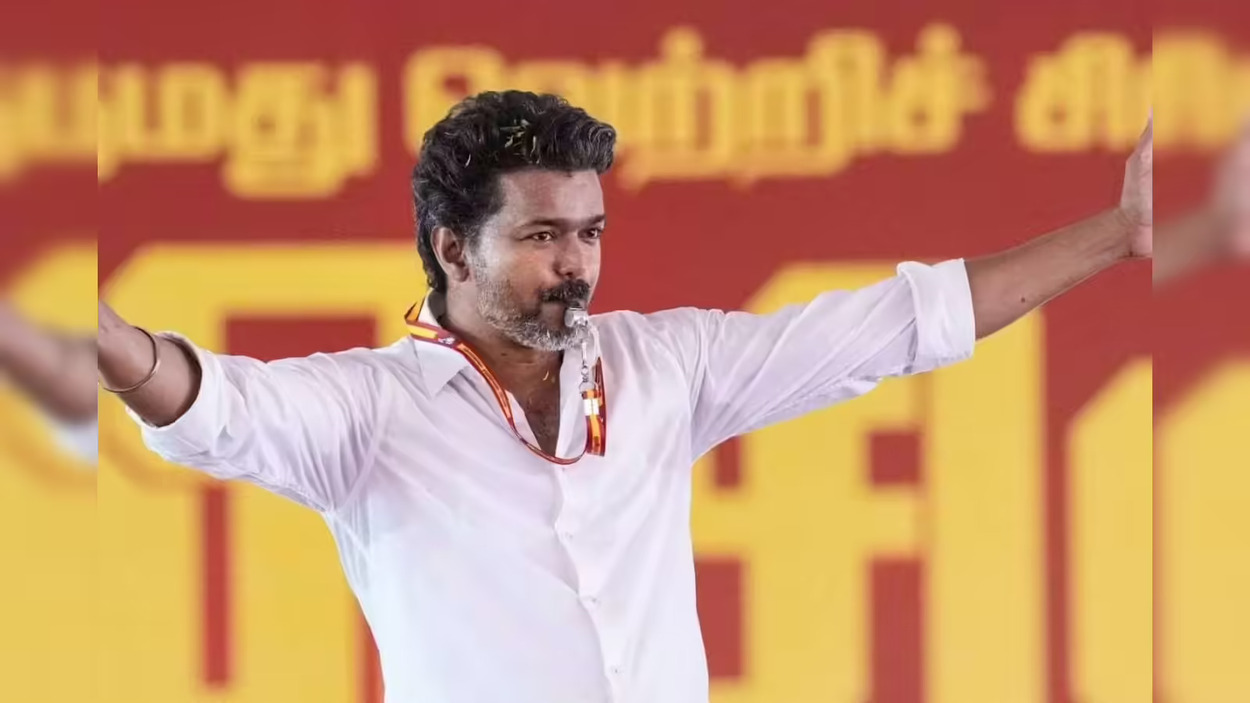
The 2026 Tamil Nadu Assembly elections will be remembered as one of the most dramatic political upheavals in modern Indian history. For more than five decades, the politics of Tamil Nadu revolved around two dominant Dravidian giants — the Dravida Munnetra Kazhagam (DMK) and the All India Anna Dravida Munnetra Kazhagam (AIADMK). Yet in a stunning political transformation, actor-turned-politician Thalapathy Vijay shattered this decades-old structure and emerged as the new face of Tamil Nadu politics through his party, Tamilaga Vettri Kazhagam (TVK).
What initially appeared to be a celebrity experiment evolved into a full-scale political revolution. Vijay’s rise to the Chief Minister’s office has drawn comparisons with legendary actor-politicians M. G. Ramachandran and J. Jayalalithaa, but many argue that Vijay’s victory is even more extraordinary because he entered an intensely competitive political environment dominated by deeply entrenched parties.
The most symbolic aspect of this political earthquake was Vijay’s defeat of the ruling DMK led by M. K. Stalin. The election results dealt a devastating blow to the DMK establishment, with Stalin losing his stronghold constituency of Kolathur to a TVK candidate. The AIADMK under Edappadi K. Palaniswami also failed to regain lost ground despite entering the contest with significant expectations. Vijay’s TVK emerged as the single largest political force in the state, fundamentally altering Tamil Nadu’s political landscape.
Several crucial factors contributed to Vijay’s historic triumph. Foremost among them was the enormous popularity he enjoyed as a film superstar. However, unlike many celebrities who unsuccessfully ventured into politics, Vijay carefully transformed his fan clubs into a disciplined grassroots political network over several years. The TVK systematically converted cinema fandom into an organized cadre-based movement capable of booth-level mobilization. This strategic groundwork gave Vijay an operational advantage that many established parties initially underestimated.
Equally significant was the growing anti-incumbency sentiment against the DMK government. After years in power, many voters appeared frustrated with allegations of corruption, administrative inefficiency, unemployment, and rising economic pressures. Vijay successfully projected himself as a fresh and corruption-free alternative to traditional Dravidian politics. His campaign capitalized on public exhaustion with dynastic political structures and appealed particularly to first-time voters and the youth.
Another decisive factor behind TVK’s victory was its carefully crafted manifesto. The party’s 40-point manifesto focused heavily on employment generation, women’s welfare, farmers’ security, industrial revival, and transparent governance. The manifesto resonated strongly with ordinary voters because it combined welfare politics with promises of administrative reform. The TVK’s proposals for MSME support, youth skill development, and police reforms broadened its appeal beyond Vijay’s fan base.
The youth vote proved particularly critical. Tamil Nadu’s younger generation increasingly sought a political alternative outside the traditional DMK-AIADMK rivalry. Vijay’s communication style, digital outreach, and social media presence helped TVK dominate online political discourse throughout the campaign. His speeches blended emotional appeal with anti-establishment rhetoric, creating a direct emotional connection with young voters.
Women voters also emerged as a major support base for TVK. The party’s emphasis on women’s safety, welfare programs, and inclusive governance generated considerable support among female voters across urban and semi-urban regions. In addition, Vijay’s relatively clean public image helped attract middle-class voters who were searching for stability without ideological extremism.
One of the most remarkable aspects of Vijay’s victory was his ability to transcend caste and regional barriers. Tamil Nadu politics has historically been influenced by caste alignments and regional loyalties. Yet TVK managed to attract support from diverse communities, including urban middle classes, rural youth, minorities, and even sections traditionally loyal to DMK and AIADMK. Vijay’s appeal centered less on rigid ideology and more on the promise of political change and clean governance.
The collapse of the AIADMK as a strong opposition force also indirectly helped Vijay. Since the deaths of J. Jayalalithaa and M. Karunanidhi, Tamil Nadu politics has struggled with a leadership vacuum. Vijay successfully positioned himself as the charismatic leader capable of filling that void. His campaign carefully invoked emotional symbolism associated with Tamil pride, social justice, and regional identity while avoiding excessive ideological rigidity.
Nevertheless, Vijay’s road to power was not entirely smooth. TVK fell slightly short of a simple majority and had to seek external support to stabilize government formation. Congress eventually extended conditional support, enabling Vijay to stake claim to the government. Even this post-election uncertainty, however, did little to diminish the magnitude of his achievement. For the first time in decades, Tamil Nadu witnessed the rise of a genuinely new political force capable of dismantling the traditional Dravidian monopoly.
The broader significance of Vijay’s victory extends beyond Tamil Nadu. His success reflects a growing trend in Indian politics where personality-driven movements, combined with digital mobilization and anti-establishment sentiment, can rapidly reshape established political equations. It also demonstrates the increasing political influence of younger voters who are less attached to traditional party loyalties and more responsive to leadership image, governance promises, and social media engagement
Thalapathy Vijay’s rise to the Chief Minister’s office is not merely an electoral victory; it is a transformational moment in South Indian politics. By defeating both the DMK establishment under M. K. Stalin and sidelining the AIADMK challenge, Vijay has rewritten Tamil Nadu’s political history. His triumph emerged from a combination of meticulous organizational planning, public dissatisfaction with traditional parties, youth mobilization, digital campaigning, and a powerful promise of change. Whether his government succeeds in fulfilling public expectations remains to be seen, but one fact is undeniable: the 2026 Tamil Nadu elections have inaugurated a new political era, with Vijay standing at the center of a historic democratic realignment.
About The Author