Running to Serve, Fighting to Win: Why Civic Campaigns Break Unprepared Candidates—and How to Get It Right
- TDS News
- Breaking News
- Elections
- May 3, 2026
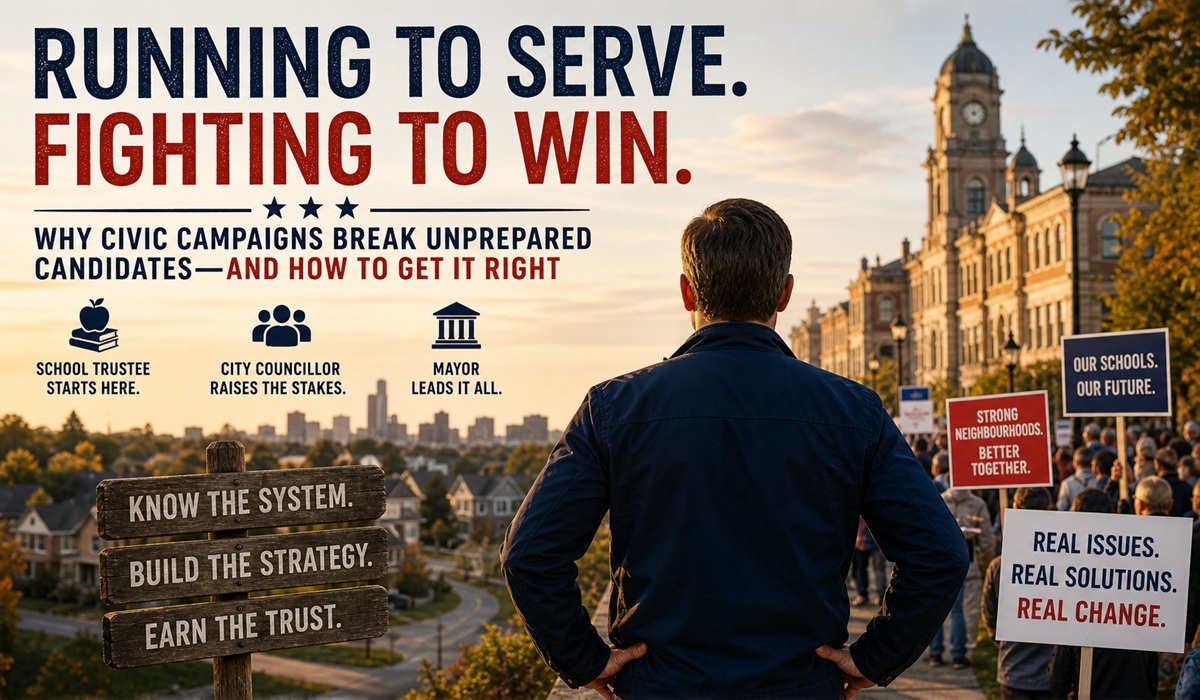
By: Donovan Martin Sr, Editor in Chief
There comes a point for many people who care deeply about their community when frustration turns into something more serious. It is no longer enough to complain about decisions being made at City Hall or within the school system, and it is no longer satisfying to sit on the sidelines watching the same issues cycle through year after year. That is when the idea begins to take hold, not as a passing thought but as a real consideration, that maybe it is time to step forward and run for office.
At the civic level, the path into public service appears, at least on the surface, to be the most accessible. You are not trying to break into federal politics or navigate the complexity of provincial party structures. Instead, you are looking at positions like school trustee, city councillor, and ultimately mayor, roles that are rooted in the everyday lives of residents and tied directly to the decisions that shape neighborhoods. In theory, this is where someone with genuine intent and community backing should be able to step in and make a difference.
That belief, while understandable, is where many candidates begin to misjudge the reality they are about to enter. The process of filing nomination papers, registering a campaign, and getting your name on a ballot is relatively straightforward, and that simplicity creates a false sense of accessibility. What is not visible at that stage is the complexity beneath the surface, the systems, the relationships, the expectations, and the discipline required to run a campaign that has any real chance of succeeding.
Even at the level of school trustee, which many view as the easiest entry point, there are layers of challenge that are rarely discussed openly. Voter turnout is often low, which means every vote carries more weight, and small shifts in support can determine the outcome. That might sound like an advantage, but it also means that organization, timing, and targeted outreach matter far more than most first-time candidates expect. Without a clear strategy, even a small race can become unwinnable.
When candidates move toward city council, the landscape shifts significantly. The issues become broader, the scrutiny becomes sharper, and the competition becomes more structured. You are no longer speaking to a narrow set of concerns but to a wide range of priorities that include infrastructure, taxation, safety, development, and quality of life. Each of these areas brings its own set of stakeholders, and those stakeholders often have competing interests that cannot all be satisfied at the same time. Navigating that environment requires more than passion; it requires an understanding of how to balance competing demands while maintaining a consistent message.
At the mayoral level, everything intensifies. The role becomes a focal point for the entire city, and every decision, statement, and misstep is amplified. The expectation is not only that you understand the issues, but that you can lead across all of them simultaneously. The scale of the campaign grows, the financial requirements increase, and the margin for error narrows. It is often described as the hardest position to win at the civic level, and that is not simply because of visibility, but because of the level of coordination required to run a campaign that can reach across the entire electorate.
What ties all of these levels together is the reality that civic campaigns are not as simple as they appear. They are not casual exercises in community engagement, and they are not won by good intentions alone. They are structured, disciplined efforts that operate within a framework that many candidates do not fully understand when they begin.
This is where the concept of the “machine” becomes important, not in the sense of a single organization controlling outcomes, but as a way to describe the network of systems and expectations that shape a campaign. There are established patterns of how campaigns are built, how messages are delivered, how funds are raised, and how voters are reached. There are individuals and groups who understand these patterns and operate within them effectively, and there are newcomers who step in without that understanding and quickly find themselves overwhelmed.
The gap between those two groups is often the deciding factor in an election. Candidates who believe they can rely on name recognition or general goodwill frequently discover that those factors are not enough. Campaigns require structure, and structure requires planning. Without it, even the most well-meaning effort can fall apart under pressure.
One of the most common mistakes candidates make is assuming that visibility alone will carry them through. They invest heavily in signs, social media posts, and appearances without understanding how those elements fit into a broader strategy. They focus on being seen rather than being positioned effectively, and as a result, their message becomes scattered and inconsistent. Voters are left without a clear understanding of what the candidate stands for or why they should be supported.
Another critical area where candidates struggle is financial management. Campaigns cost money, and those costs add up quickly. Printing, advertising, events, and logistics all require funding, and without a clear plan for how that money will be raised and spent, candidates can find themselves in a difficult position very early in the process. It is not uncommon for individuals to invest significant personal funds into a campaign without a realistic assessment of their chances, only to realize too late that the path to victory was never clearly defined.
This is not a reflection of their commitment, but of their preparation. Many candidates enter the race believing they understand what it takes, only to discover that there are layers of complexity they had not considered. They do not know what they do not know, and that lack of awareness becomes a liability as the campaign progresses.
This is precisely the problem that “Running to Win” was created to address. The purpose of the book is not to discourage people from running, but to provide a clear, honest look at what a campaign actually involves. It is meant to bridge the gap between intention and execution, giving candidates the tools to evaluate their readiness before they commit fully to the process.
The reality is that campaigns are fought in stages, and each stage requires a different set of skills. Early momentum must be built carefully, resources must be allocated strategically, and messaging must be consistent and adaptable. There are moments when a campaign can gain ground quickly, and there are moments when it can lose that ground just as fast. Understanding how to navigate those shifts is what separates prepared candidates from those who are simply reacting.
Serving your community through elected office remains one of the most direct and meaningful ways to create change. The decisions made at the civic level have immediate and visible impacts on daily life, from the quality of schools to the safety of neighborhoods to the development of local economies. That proximity to real-world outcomes is what makes these roles so important and so appealing to those who want to contribute.
At the same time, that importance is exactly why preparation cannot be overlooked. The desire to serve must be matched by the ability to operate within a system that is more complex than it first appears. Candidates who take the time to understand that system, to study it, and to prepare for it are the ones who give themselves a real chance to succeed.
For those considering stepping forward, the question is not simply whether you want to run, but whether you are ready to run in a way that gives your campaign a legitimate path to victory. That distinction matters, because the cost of getting it wrong is not only measured in dollars, but in time, energy, and the opportunity to make a meaningful impact.
The opportunity to serve is real, and the pathway exists, but it is not as simple as it looks from the outside. Those who recognize that early, and prepare accordingly, are the ones who move from wanting to serve to actually being in a position to do so effectively.
About The Author