Gunfire at the White House Correspondents’ Dinner Leaves Washington Shaken but Disaster Averted
- TDS News
- Breaking News
- April 26, 2026
By: Donovan Martin Sr, Editor in Chief
What was meant to be one of Washington’s most controlled and ceremonial nights quickly unraveled into a scene of panic, confusion, and raw vulnerability when gunfire erupted at the White House Correspondents’ Dinner on April 25, 2026. Inside the Washington Hilton, more than two thousand guests, including the sitting president, senior cabinet officials, journalists, and lawmakers, were gathered in a ballroom that is typically secured to near–national security standards. Within seconds, that sense of control collapsed.
The incident began just after dinner service was underway, at approximately 8:40 p.m., when a man armed with multiple weapons approached a security screening area near the ballroom entrance. According to law enforcement accounts and witness testimony, the suspect forced his way past a checkpoint and opened fire in the lobby area just outside the main event space. The sound of gunfire, described by witnesses as sharp, echoing bursts, immediately triggered a full-scale emergency response.
Inside the ballroom, confusion spread rapidly. Guests were ordered to get down, some diving beneath tables while others froze momentarily, unsure if the threat had breached the room itself. One eyewitness described people shouting for others to duck as Secret Service agents surged into action. Several journalists and lawmakers later said the moment felt surreal, a high-profile gathering of power and press suddenly reduced to instinct and survival.
Donald Trump, who was in attendance alongside the First Lady and Vice President JD Vance, was immediately surrounded by Secret Service agents and rushed out of the ballroom. In the chaos, witnesses reported the president briefly stumbling before being lifted and moved quickly to safety. The vice president was also evacuated within moments, as agents secured what they refer to as “protectees” in layered extraction procedures designed for precisely this kind of threat.
Outside the ballroom, the confrontation was already unfolding. The suspect, described by authorities as carrying a shotgun, handgun, and multiple knives, had fired several rounds while attempting to advance deeper into the secured area. Law enforcement officers and Secret Service agents engaged immediately, tackling and subduing him before he could reach the main gathering. The response was swift enough to prevent mass casualties, but not without consequence.
One law enforcement officer was struck by gunfire during the confrontation, though the bullet was stopped by a protective vest. Officials later confirmed the officer was expected to recover, a detail that became central to early briefings as authorities sought to reassure both attendees and the public. No guests inside the ballroom were physically injured, a fact repeatedly emphasized as the scale of what might have happened began to sink in.
The suspect was taken into custody at the scene. Early reporting identified him as a lone individual, with no confirmed accomplices, though investigators have not yet publicly detailed a clear motive. Some accounts suggest he may have assembled or prepared part of his weaponry in a less-secured area of the venue before launching his attack, raising immediate and serious questions about how such a breach could occur at an event with one of the most extensive security footprints in the country. He was transported for medical evaluation following his arrest, and federal charges tied to firearms offenses and assault on a federal officer are expected.
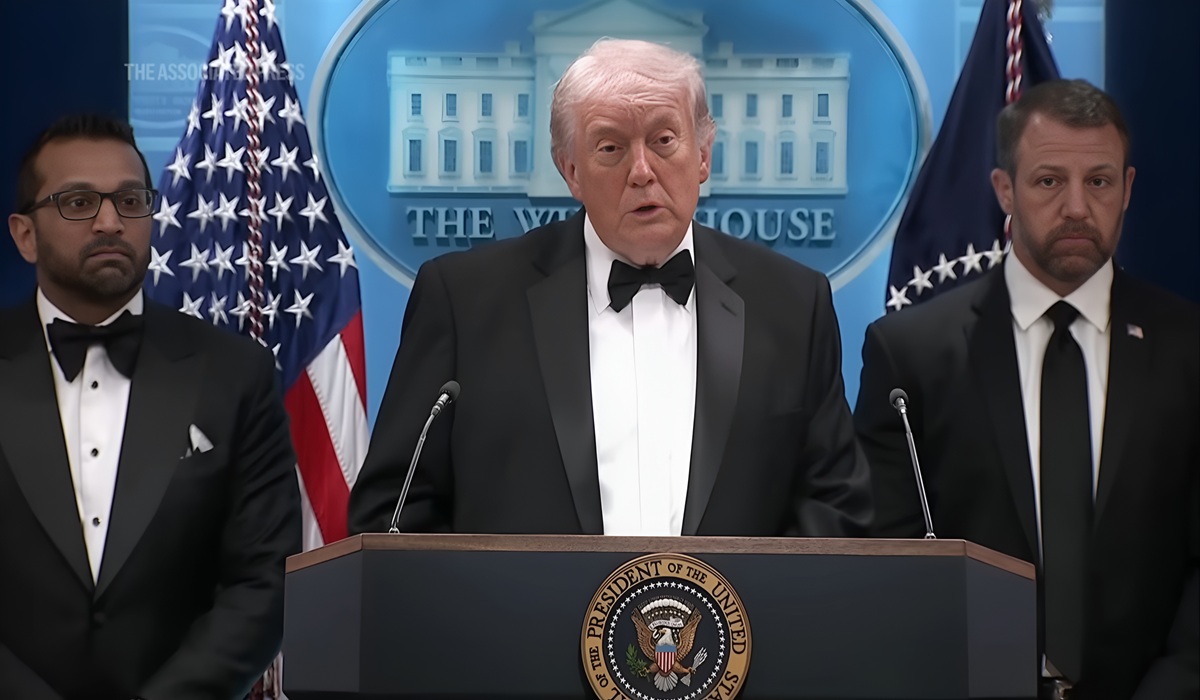
In a statement delivered shortly after returning to the White House, President Trump struck a tone that combined reassurance with praise for the response. He said law enforcement “acted quickly and bravely” and confirmed that all senior officials were safe, adding that the injured officer was “doing great” after being struck in protective gear. He also described the suspect as heavily armed and credited the Secret Service with stopping him before the situation escalated into something far more catastrophic.
While there was no lengthy public address from Vice President Vance in the immediate aftermath, officials indicated he remained secure throughout the incident and was involved in post-incident briefings alongside national security leadership. His office later conveyed that the response demonstrated the effectiveness of protective protocols, even as questions mounted about how the breach occurred.
What remains most striking is not only the speed of the response but the breach itself. The White House Correspondents’ Dinner is one of the most tightly secured civilian events in the United States, often compared in security intensity to major international summits. Yet this attacker was able to approach, arm himself, and discharge a weapon within feet of one of the most protected gatherings in the country. Security analysts and lawmakers are already demanding a full review, with some privately describing the lapse as deeply concerning given the concentration of national leadership present.
The evening ended not with speeches or celebration, but with evacuation orders and an empty ballroom. The event was effectively cancelled, with organizers indicating it would be rescheduled at a later date. In the hours that followed, one fact remained constant across every account, from journalists who hit the floor to agents who rushed toward the gunfire: the outcome could have been far worse. The difference between a contained incident and a national tragedy came down to seconds, and to the actions of those who moved toward danger while everyone else was told to get down and stay alive.
About The Author