Tijuana River Crisis: A Cross-Border Failure That Continues to Poison Communities
- TDS News
- Breaking News
- April 21, 2026
By: Donovan Martin Sr, Editor in Chief
What has been unfolding along the banks of the Tijuana River is no longer just an environmental issue. It is a public health emergency that has quietly escalated for years, affecting thousands of residents on both sides of the border while exposing the limits of political will between two neighboring countries that depend on each other more than they admit.
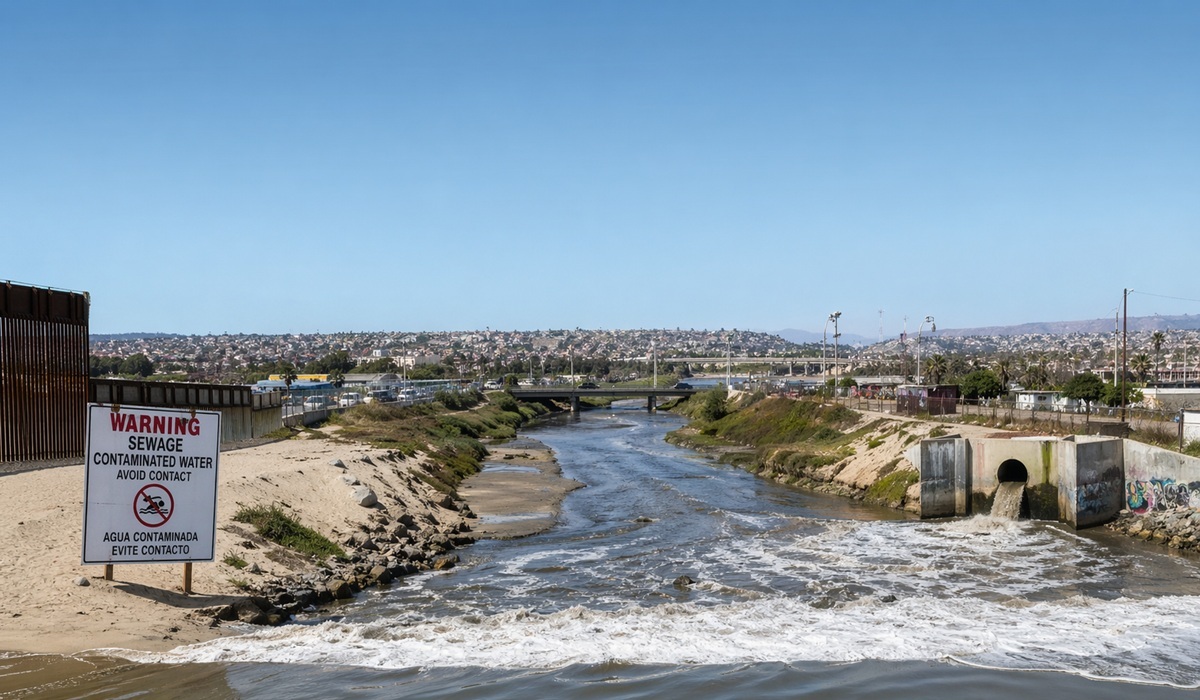
The river begins in Tijuana, a rapidly growing urban center where population expansion has outpaced infrastructure. By the time it crosses into the United States and reaches San Diego County, it carries with it a toxic mix of untreated sewage, industrial runoff, and debris. What should be a natural waterway has effectively become a conveyor belt of contamination, flowing straight into coastal waters that were once central to community life and economic stability.
At the heart of the crisis is a failing wastewater system. Tijuana’s infrastructure was never designed to support the scale of growth the city has experienced. Aging pipes, insufficient treatment capacity, and frequent system breakdowns have created a situation where sewage spills are no longer rare incidents, but routine occurrences. When rainfall intensifies, the system is overwhelmed entirely, pushing millions of gallons of untreated waste into the river and, inevitably, across the border.
The consequences are visible and measurable. Beaches in communities like Imperial Beach have faced repeated closures as bacteria levels surge far beyond safe thresholds. Shorelines that once attracted visitors are now lined with warning signs. The contamination does not just linger in the water; it becomes airborne through sea spray, raising concerns that exposure is happening even without direct contact.
Residents have been living with the fallout. Reports of respiratory irritation, skin conditions, and persistent illness are no longer isolated complaints but part of a broader pattern. For many, this is not an occasional inconvenience but a daily reality. Windows stay shut. Outdoor activity is limited. The sense of normalcy that coastal living once provided has been replaced with uncertainty and frustration.
Economically, the damage runs deep. Tourism has long been a lifeline for this stretch of coastline, with destinations like Coronado Beach and Silver Strand State Beach drawing visitors year-round. When water quality warnings go up, visitors stay away. Local businesses feel it immediately, and over time, the cumulative effect reshapes entire communities that depend on steady seasonal traffic.
Yet the most troubling aspect of this crisis is not the pollution itself, but the inability to resolve it. The issue sits at the intersection of infrastructure, politics, and diplomacy. The United States has pushed for action and funding, while Mexico has faced internal challenges that complicate large-scale upgrades. Meanwhile, coordination between the two governments has been inconsistent, often slowed by broader tensions unrelated to the river itself.
This is where the problem becomes harder to ignore. Environmental crises do not respect borders, and the Tijuana River is proof of that. What begins as a municipal infrastructure failure in one country quickly becomes a public health concern in another. Despite years of awareness, studies, and proposed solutions, progress remains incremental at best.
There is no shortage of ideas on how to fix it. Expanding wastewater treatment capacity, modernizing sewage systems, and improving cross-border coordination have all been identified as necessary steps. Funding has been discussed repeatedly. Commitments have been announced. Yet on the ground, the river continues to carry the same contaminants, and communities continue to deal with the same consequences.
For residents, patience has worn thin. The sense that this issue has been studied more than it has been solved is difficult to shake. People are not asking for new reports or long-term promises. They are asking for tangible results that improve their daily lives.
The reality is that this crisis will not resolve itself. Without sustained investment, clear accountability, and genuine cooperation between both countries, the Tijuana River will continue to be a source of contamination rather than a shared resource. The longer action is delayed, the more entrenched the damage becomes, both environmentally and economically.
What is happening here is not complicated in its essence. It is a matter of infrastructure meeting responsibility. Until both sides treat it that way, the river will keep flowing exactly as it has been, carrying with it the consequences of inaction.
About The Author