BURKINA FASO BETS ON AFRICAN KNOWLEDGE: Traditional Medicine Moves Toward the Heart of Healthcare
- Emma Ansah
- Africa
- September 7, 2026
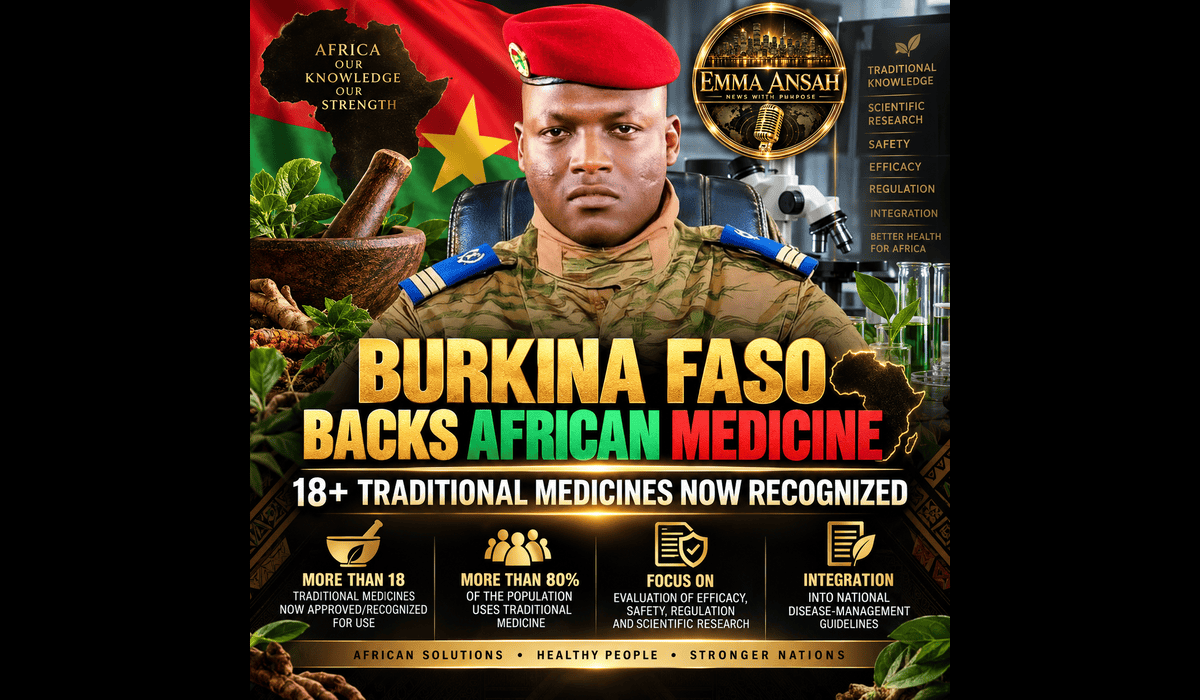
Burkina Faso is making a major move to elevate traditional African medicine, and this is about much more than herbs sitting in somebody’s grandmother’s kitchen. The country now has more than 18 traditional medicines officially approved and recognized for use, as Burkina Faso works toward giving traditional medicine a greater role within its healthcare system.
The development comes as traditional medicine continues to play a significant role in the lives of people across Burkina Faso. Government officials have reported that more than 80 percent of the population uses traditional medicine, which raises an obvious question: if the overwhelming majority of your population is already using these treatments, why not invest in studying them, regulating them and determining which ones actually work?
And that appears to be exactly what Burkina Faso is trying to do. Rather than simply accepting every traditional remedy because it has been used for generations, authorities are emphasizing authorization, scientific evaluation, safety and efficacy. Traditional practitioners and researchers are also being encouraged to work together so that African knowledge can be studied, improved, protected and potentially incorporated into the country’s broader healthcare system.
Now, there is an important correction to the viral claim circulating online. The information available indicates that more than 18 traditional medicines have been approved and recognized, not necessarily that Burkina Faso “just approved 18 more.” That may sound like a small difference, but when we are talking about news, facts matter, especially when social media graphics have a habit of turning one sentence into a completely different story.
What makes this particularly interesting is the larger conversation surrounding African knowledge. For generations, African medicinal practices have often been dismissed as primitive or unscientific, while plants, remedies and knowledge originating on the continent have simultaneously attracted the attention of researchers and pharmaceutical industries around the world. Burkina Faso appears to be saying that African knowledge does not have to remain outside the scientific establishment simply because it originated with African people.
The country’s National Week of Traditional and Alternative Medicine has focused on how improved traditional medicines could potentially be incorporated into national disease management guidelines. The initiative has also brought together traditional practitioners, researchers and exhibitors to examine the opportunities and challenges involved in expanding traditional medicine while maintaining standards for safety and effectiveness.
And this is where the conversation gets bigger than Burkina Faso. Embracing African knowledge does not mean rejecting modern medicine, hospitals, doctors or science. It means asking why traditional African knowledge cannot be scientifically studied, tested and developed by Africans themselves. If a treatment proves safe and effective, why should the knowledge behind it automatically be treated as inferior simply because it came from an African village instead of a Western laboratory?
There is also an economic question that cannot be ignored. Africa possesses extraordinary biodiversity and generations of knowledge surrounding medicinal plants, yet the continent has historically struggled to capture the full economic value of its own natural resources and intellectual knowledge. Developing African medicines responsibly could potentially create research opportunities, strengthen local pharmaceutical industries, support traditional practitioners and reduce dependence on imported treatments, provided that safety and rigorous scientific standards remain at the centre of the process.
Burkina Faso’s approach therefore represents something larger than traditional medicine. It is part of a growing conversation about health sovereignty, African research and who gets to own, develop and profit from African knowledge.
Africa has the plants, Africa has generations of knowledge, Africa has researchers capable of studying that knowledge, and Africa has millions of people already using traditional medicine. The real opportunity is making sure that what works is scientifically validated, what does not work is rejected, what is dangerous is regulated, and what belongs to Africa is not simply extracted, repackaged and eventually sold back to Africans at a premium.
That is where African tradition and modern science do not have to compete. They can meet at the same table, with Africa finally having a seat at the head of it.
About The Author