Targeted for Doing Their Jobs: Online Violence Against Women Journalists Is Escalating
- Emma Ansah
- Canada
- September 6, 2026
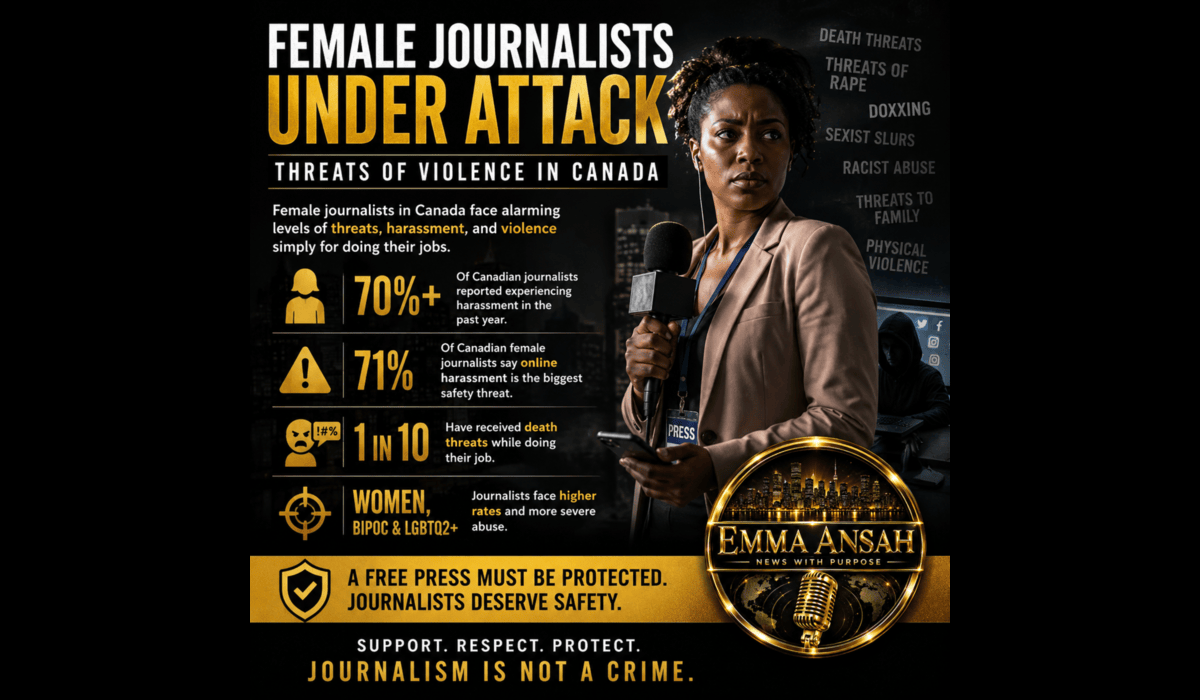
Women journalists are supposed to worry about deadlines, sources and getting the story right. Increasingly, they are also being forced to worry about threats, harassment, doxxing, sexualized attacks, racism and whether something posted online could follow them into the real world.
New global research developed by the Information Integrity Initiative for UN Women, in partnership with UNESCO and other organizations, shows just how serious the problem has become.
In 2025, 75% of surveyed women journalists reported experiencing online violence while doing their jobs, compared with 73% in the comparable 2020 research.
But perhaps the most disturbing finding is what happens when online violence doesn’t remain online.
In 2020, 20% of surveyed women journalists linked online attacks to offline abuse, harassment or assault. By 2025, that number had jumped to 42%.
That’s more than double.
Women Are Being Pressured Into Silence
Online attacks can have another consequence that should concern anyone who values a free press: journalists changing what they say because they fear what will happen to them.
According to the newer research, 45% of surveyed women journalists and media workers reported self-censoring on social media because of online violence, compared with 30% in 2020. Another 22% reported self-censorship at work.
That’s not simply a women’s issue. That’s a press freedom issue.
When harassment becomes effective enough to make a journalist think twice about covering a controversial story, challenging someone powerful or expressing herself publicly, the attackers have accomplished part of their objective.
Racism Can Compound the Abuse
Women journalists don’t necessarily experience online violence in the same way.
UNESCO has previously warned that attacks against women journalists can intersect with other forms of discrimination, including racism. For Black women and other racialized women working in public-facing media, that can mean attacks targeting not only their journalism or gender, but their race and identity as well.
The abuse can become intensely personal, designed to humiliate, discredit and intimidate rather than challenge the actual journalism.
AI Has Added Another Weapon
Artificial intelligence is also changing the landscape.
The research found women journalists confronting AI-assisted abuse, including manipulated images and videos. Among surveyed women journalists and media workers, 5% reported being targeted with deepfakes or manipulated imagery, while nearly one-quarter reported receiving unwanted sexual advances or cyberflashing through direct messages.
That creates an entirely different level of vulnerability. A journalist no longer has to actually say or do something for damaging material involving her likeness to circulate online.
The Mental Health Toll Is Real
The consequences aren’t limited to someone’s social media feed.
One-quarter of surveyed women journalists reported having been diagnosed with or treated for anxiety and/or depression linked to online violence, while 13% reported experiencing post-traumatic stress disorder.
More women are also turning to authorities. Twenty-two percent reported online violence to police, double the 11% reported in the earlier research, while 14% initiated legal action.
This Should Concern Everyone
There is a dangerous tendency to dismiss online harassment with some version of, “Just turn off your comments,” “Block them,” or “Get off social media.”
For journalists in 2026, social media is often part of the newsroom. It’s where stories are distributed, sources are found, audiences interact and journalists build their professional presence.
Women shouldn’t have to disappear from those spaces to remain safe.
And when threats are sexualized, racialized or potentially capable of moving from a screen into someone’s physical life, calling it “just trolling” minimizes what is actually happening.
Protecting women journalists isn’t about shielding journalists from criticism.
Criticism comes with journalism.
Threats, racism, sexual harassment, doxxing and intimidation should not.
Because when fear succeeds in silencing a journalist, the public loses a voice too.
About The Author