By: Donovan Martin Sr, Editor in Chief
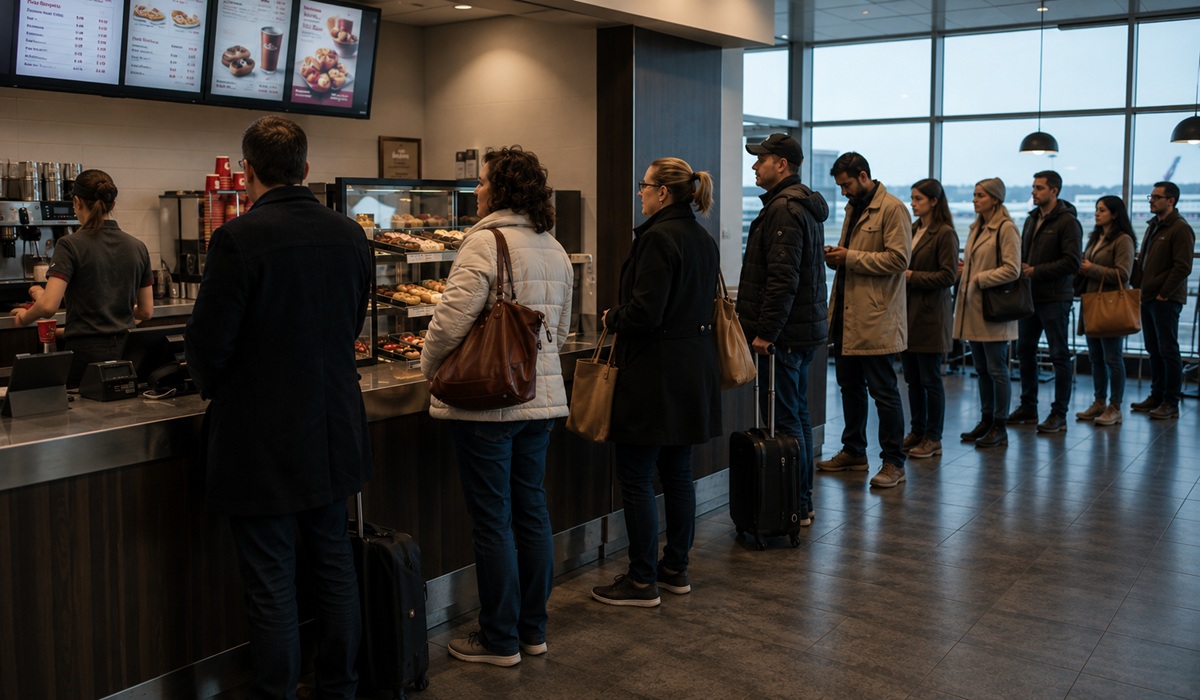
“AI-generated illustration depicting a typical airport coffee shop lineup. This image is for illustrative purposes only and does not depict any specific airport, restaurant, employee, or customer.”
After travelling through airports across Canada, I have come to expect delays at security checkpoints, weather disruptions, and the occasional gate change. What I did not expect to encounter so consistently was the same frustrating experience at airport coffee counters: long lineups that often make it difficult to grab a quick meal before a flight.
This is not a criticism of the food itself. Millions of Canadians visit Tim Hortons every year, and the brand remains one of the most recognizable names in the country. The issue I have repeatedly observed while travelling is the customer experience at some airport locations, particularly during busy travel periods when lineups can become substantial.
On multiple occasions, I have found myself standing in a line that appeared unlikely to move quickly enough to allow me to comfortably make my flight. In several cases, I eventually left without ordering because I was not prepared to risk missing a boarding call. Judging by the number of travellers checking watches, looking toward departure screens, and leaving the line, I suspect I am not the only person who has faced that decision.
Part of the frustration comes from expectations. When people visit a quick-service restaurant, they expect convenience. That expectation becomes even stronger inside an airport, where travellers are often operating on tight schedules and limited time. A delay of ten or fifteen minutes may not seem significant in a normal setting, but inside an airport it can feel much longer.
Another challenge is menu availability. Airport restaurant locations frequently operate with modified offerings, which is common throughout the industry and not unique to any one brand. However, it can still be disappointing when travellers arrive expecting familiar menu items only to discover they are unavailable. Anyone looking forward to a breakfast wrap, a bowl of chili, or a hot soup before a flight understands that feeling.
The pricing experience can also add to customer frustration. Airport food outlets generally charge higher prices than many off-airport locations, a reality most travellers understand. However, when higher prices are combined with long waits and fewer menu choices, some customers may feel they are receiving less value than they expected.
To be fair, airport food-service operations face challenges that traditional restaurants do not. Passenger traffic can fluctuate dramatically throughout the day, security requirements create operational limitations, and airport facilities often operate under unique logistical constraints. These realities undoubtedly affect the way airport restaurants function.
The employees serving customers should not be overlooked either. From my observations, staff members often appear to be working hard in a fast-paced environment while attempting to serve a continuous stream of travellers. The concerns expressed in this article relate to the customer experience rather than any individual employee.
What makes the issue noteworthy is the role Tim Hortons plays in Canadian culture. For many visitors arriving in Canada, it is one of the first brands they encounter after stepping off a plane. For many Canadians, it remains a familiar stop before heading to work, school, or the hockey rink. That familiarity naturally creates expectations.
Technology and operational improvements may help address some of these challenges. Mobile ordering, dedicated pickup areas, expanded service capacity during peak travel periods, and greater visibility regarding menu availability could potentially improve the experience for travellers trying to grab a meal before boarding.
At its core, this is not really a story about coffee. It is a story about convenience and expectations. When travellers enter a quick-service restaurant inside an airport, they are looking for a fast and reliable experience. Based on my own observations while travelling through Canadian airports, that expectation is not always being met.
As air travel continues to recover and passenger volumes remain strong, improving the customer experience at airport food outlets would likely be welcomed by travellers. Sometimes the most frustrating delay in an airport is not on the runway. It is the one that happens while waiting in line for a coffee.
About The Author