The FIFA Circuses: Straining Taxpayer Pockets While Hypocritically Ignoring the Toll on Our Environment
- Nick Kossovan
- Sports
- June 11, 2026
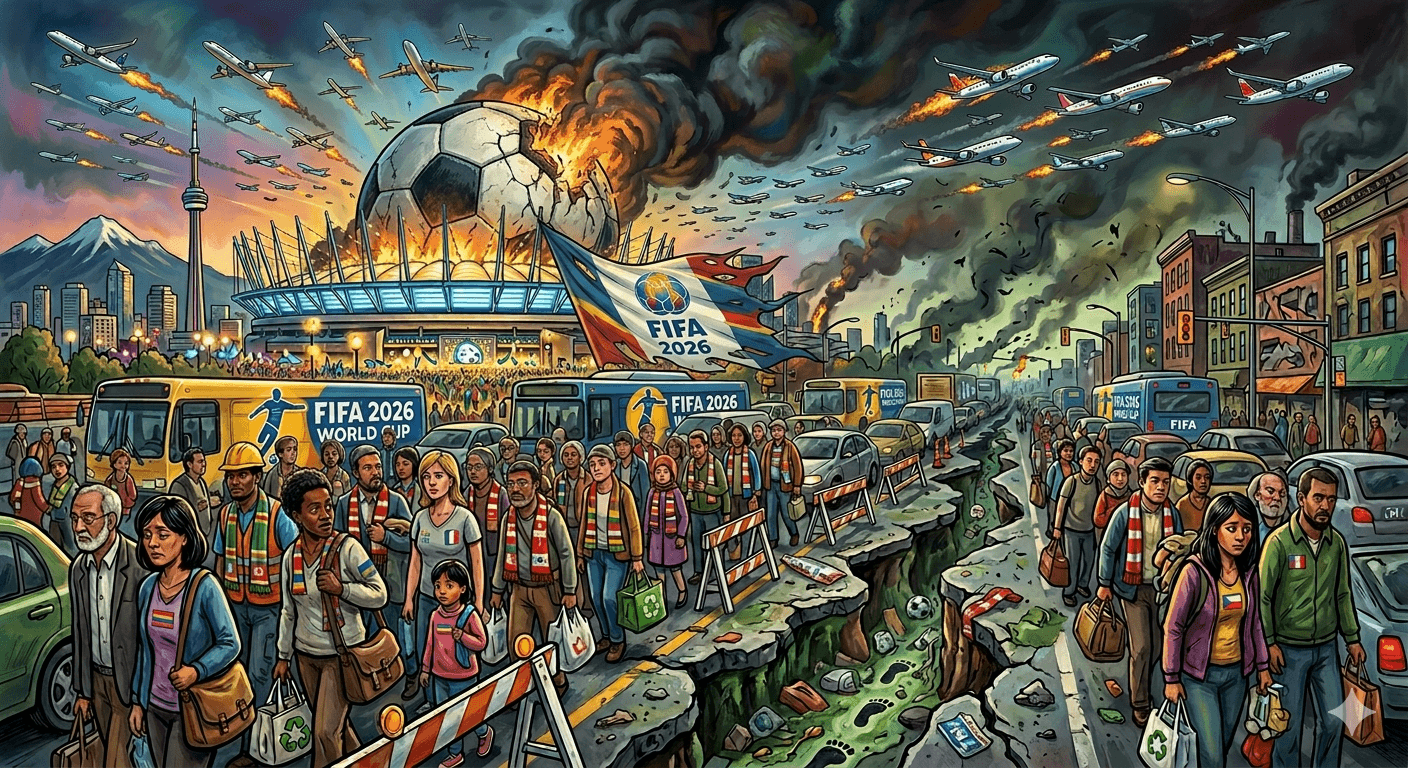
The corporate cheerleaders at FIFA are out in full force, aggressively beating the marketing propaganda drum, trying to condition us to ignore the “negativity” of the naysayers and focus on dreaming big. Vancouver Mayor Ken Sim shamelessly pitched his city’s seven matches as the equivalent of “30 to 40 Super Bowls,” while Toronto’s “FIFA World Cup 2026 Community Activation Toolkit” coaxes residents to focus on “billions of impressions.” Apparently, we’re supposed to view this massive circus of sports entertainment as a trade mission strategically hidden inside a soccer match.
These are seductive pitches. They’re also entirely detached from reality.
Dismissing public anxiety, regardless if it’s small or large, over hosting FIFA games as mere “being negative” is an insult to the intelligence of Canadian taxpayers. The concerns being raised about cost, chaos, displacement, and environmental fallout aren’t minor grievances to be swept under the rug in the name of corporate “brand activation.” They’re legitimate anxieties rooted in a practical understanding of how our cities actually function—or fail to function—on a daily basis. Worse, we’re expected to tolerate the massive environmental damage caused by FIFA games, all to accommodate an event that only those with the financial privilege can afford to attend.
Let’s look at the fiscal math, which marketing pitches tend to ignore. Hosting the 2026 World Cup will cost governments across Canada an estimated $1.066 billion. According to the Parliamentary Budget Officer, that puts the cost to host games in Vancouver and Toronto at a staggering $82 million per match. Toronto’s budget alone has ballooned to $380 million—a grotesque leap from the original 2018 estimate of $30 million to $45 million.
When the average face-value ticket price across the entire 2026 FIFA World Cup tournament is around $500 USD, the rank-and-file resident isn’t a participant; they’re an involuntary financier. Taxpayers are funding a spectacle they can’t afford to attend, while local communities face gentrification and displacement to make room for temporary tourist infrastructures.
Then there’s the structural reality of the cities themselves. Anyone who navigates Toronto or Vancouver on a weekday morning knows our infrastructure is already stretched to its absolute limit. Commutes are a daily exercise in patience, and transit systems are chronically under-resourced. Dropping a global sports circus into this existing gridlock won’t create a magical “buzz,” it’ll paralyze the urban core. To accommodate FIFA’s rigid, corporate demands, cities are shutting down local community staples like the Dragon Boat Festival, banning buskers, and closing kids’ soccer fields. For a month, the simple act of getting to work or operating a small business becomes a costly nightmare.
The environmental argument is equally impossible to ignore, no matter how much corporate greenwashing is applied. Experts estimate this North American edition will be the most polluting World Cup in history, generating up to 70 million tonnes of carbon emissions when factoring in qualifiers, broadcasts, and merchandising. Jetting 48 teams and hundreds of thousands of fans across massive continental distances leaves an indelible carbon footprint. It makes you wonder: is anyone actually concerned about climate change, or are they just virtue-signalling? It’s hypocritical to ask residents to meticulously sort their recycling and pay carbon taxes while our cities roll out the red carpet for an event sponsored by the Saudi Arabian Oil Company (Aramco).
The marketing professionals tell us to focus on the lifetime impressions left on global executives. But what about the impression left on the people who actually live here?
Ultimately, the concerns about FIFA come down to priorities. When municipal budgets are strained, housing is scarce, and basic services are slipping, spending over a billion dollars to chase “impressions” isn’t a strategic investment, it’s an expensive indulgence which doesn’t offer a guaranteed return on investment.
The negative financial and environmental impacts of these games aren’t abstract concepts on a spreadsheet; they’re real, tangible, and deeply felt by the public. Instead of telling concerned citizens to stop dwelling on the downside of hosting FIFA games, political leaders should have spent a lot more time listening to them before signing the cheque. Spectacle, within reason, does have it’s occasional place, but it should never come at the expense of the people who keep the city running long after the circus leaves town.
When FIFA leaves town and the stadiums become empty and the corporate banners come down, it’s the taxpayers who’ll be left paying the bill and breathing the exhaust. If our leaders want us to dream big, they need to stop treating our cities like a playground for global elites and start treating the people, including the naysayers, who live here like they actually matter.
About The Author