Spanish Premier Pedro Sanchez: Europe’s Strongest Voice for Palestine
- Naveed Aman Khan
- Pinpoint
- July 28, 2026
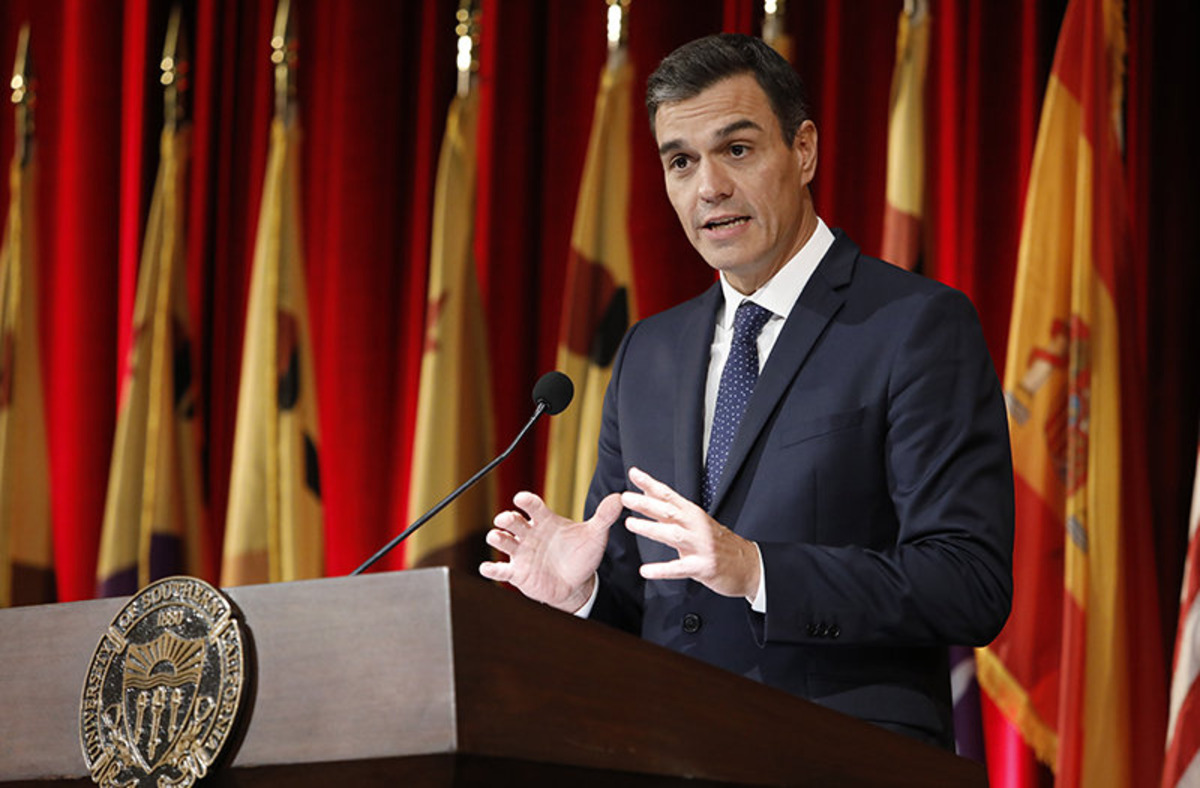
In an era when many Western leaders have been criticized for remaining5 cautious over the humanitarian catastrophe in Gaza, Spanish Prime Minister Pedro Sanchez has emerged as one of Europe’s most outspoken advocates for international law, civilian protection, and Palestinian rights. His approach has earned him widespread admiration across the Muslim world, where millions regard him as a rare Western leader willing to challenge political orthodoxy in defense of humanitarian principles. Whether one agrees with every aspect of his foreign policy or not, Sanchez has undeniably reshaped Spain’s international image by placing human rights and international legality at the center of its Middle East policy.
Since the outbreak of the Gaza war, Sánchez has consistently called for an immediate ceasefire, unrestricted humanitarian access, and the protection of innocent civilians. Unlike many European leaders who initially aligned closely with Israel’s military objectives, the Spanish Prime Minister repeatedly emphasized that the fight against terrorism must never justify collective punishment or violations of international humanitarian law. His government has maintained that lasting peace can only be achieved through justice, diplomacy, and the internationally recognized two-state solution.
Spain’s recognition of the State of Palestine marked one of the most consequential diplomatic decisions taken by a major European nation in recent years. The move reflected Madrid’s belief that recognizing Palestinian statehood contributes to peace rather than undermining it. Although the decision attracted criticism from Israel and some Western allies, it significantly enhanced Spain’s standing throughout the Middle East, Africa, and the broader Muslim world. Many governments viewed the recognition as an affirmation of international legitimacy rather than a symbolic political gesture.
Pedro Sánchez’s position also demonstrated that Europe is not monolithic in its approach to the Israeli-Palestinian conflict. Spain showed that democratic governments can support Israel’s right to security while simultaneously demanding accountability for civilian casualties and adherence to international law. This balanced but principled stance distinguished Sánchez from leaders who were perceived as reluctant to criticize Israeli military operations despite mounting humanitarian concerns.
Equally significant has been Sánchez’s insistence that diplomacy should prevail over military escalation. During periods of heightened regional tensions, Spain consistently advocated de-escalation and dialogue instead of expanding conflicts into a wider regional war. Such policies resonated strongly with Muslim-majority countries that feared broader instability across the Middle East. Spain positioned itself not merely as an observer but as a constructive diplomatic actor seeking peaceful solutions.
Spain was reluctant to facilitate military operations that could further intensify regional conflicts. Madrid has generally maintained that Spanish territory and military facilities should be used in accordance with national law and international obligations, reflecting Sanchez’s preference for diplomatic engagement over military confrontation. This cautious approach has reinforced his image among Muslims as a leader who prioritizes peace over geopolitical confrontation.
Pedro Sanchez’s greatest diplomatic achievement has been transforming Spain into one of Europe’s most credible advocates for humanitarian values. While Spain is neither a military superpower nor a permanent member of the United Nations Security Council, Sanchez has demonstrated that moral authority can sometimes carry greater international influence than military strength. By speaking consistently on behalf of civilian protection, he has enhanced Spain’s diplomatic credibility across regions where Western governments often struggle to build trust.
The Spanish Prime Minister’s popularity among Muslims extends beyond diplomacy. in Muslim-majority societies, Sanchez has become associated with compassion, justice, and political courage. Although public perceptions naturally differ across countries and communities, there is little doubt that his statements regarding Gaza have resonated with audiences who believe that humanitarian suffering deserves greater international attention regardless of political alliances.
The influence of political leadership often extends into popular culture, particularly in sports. Spain’s young football sensation, Lamine Yamal, has become one of the world’s most recognizable athletes. Yamal’s public display of solidarity with Palestinians have generated widespread discussion across international media and social networks. Sanchez’s foreign policy has undoubtedly contributed to an environment in which expressions of solidarity with Palestinian civilians receive considerable public attention within Spain.
Spain’s evolving foreign policy also carries broader implications for European politics. Traditionally, the Middle East policies of major European states have been heavily influenced by transatlantic considerations. Sanchez has demonstrated that European governments can pursue independent diplomatic positions while remaining committed members of NATO and the European Union. This strategic autonomy may influence future debates within Europe regarding foreign policy, humanitarian intervention, and international conflict resolution.
Critics, of course, argue that symbolic diplomacy alone cannot resolve one of the world’s most enduring conflicts. Recognition of Palestine, public statements, and diplomatic initiatives must ultimately be accompanied by sustained international negotiations capable of delivering a viable political settlement. Others contend that Spain’s positions have occasionally complicated relations with Israel and some strategic partners. These criticisms deserve consideration, yet they do not diminish the fact that Sánchez has consistently framed his arguments within the language of international law rather than ideological confrontation.
The broader significance of Pedro Sánchez’s leadership lies in demonstrating that humanitarian principles can remain central to foreign policy even amid intense geopolitical pressures. His willingness to challenge prevailing narratives has elevated Spain’s diplomatic profile far beyond its traditional influence in Middle Eastern affairs. For many observers across the Muslim world, Sánchez symbolizes a Western leader prepared to defend universal human rights regardless of political costs.
Ultimately, Pedro Sanchez’s legacy will not be determined solely by Spain’s domestic achievements but also by whether his principled diplomacy helps encourage a more balanced international conversation on peace, justice, and accountability. His advocacy for Palestinian rights, support for humanitarian relief, and commitment to a negotiated two-state solution have earned him respect among millions who seek fairness in international affairs. Whether future European leaders embrace similar policies remains uncertain. What is clear, however, is that Pedro Sanchez has established Spain as one of the strongest European voices calling for peace, human dignity, and respect for international law. In a deeply polarized world, that stance has given Spain renewed global relevance and has made its Prime Minister one of the most admired Western political figures across the Muslim world.
About The Author