If Lying to Congress Can Lead to Criminal Charges, Why Isn’t Lying to the Public Treated the Same Way?
- Ingrid Jones
- U.S.A
- June 23, 2026
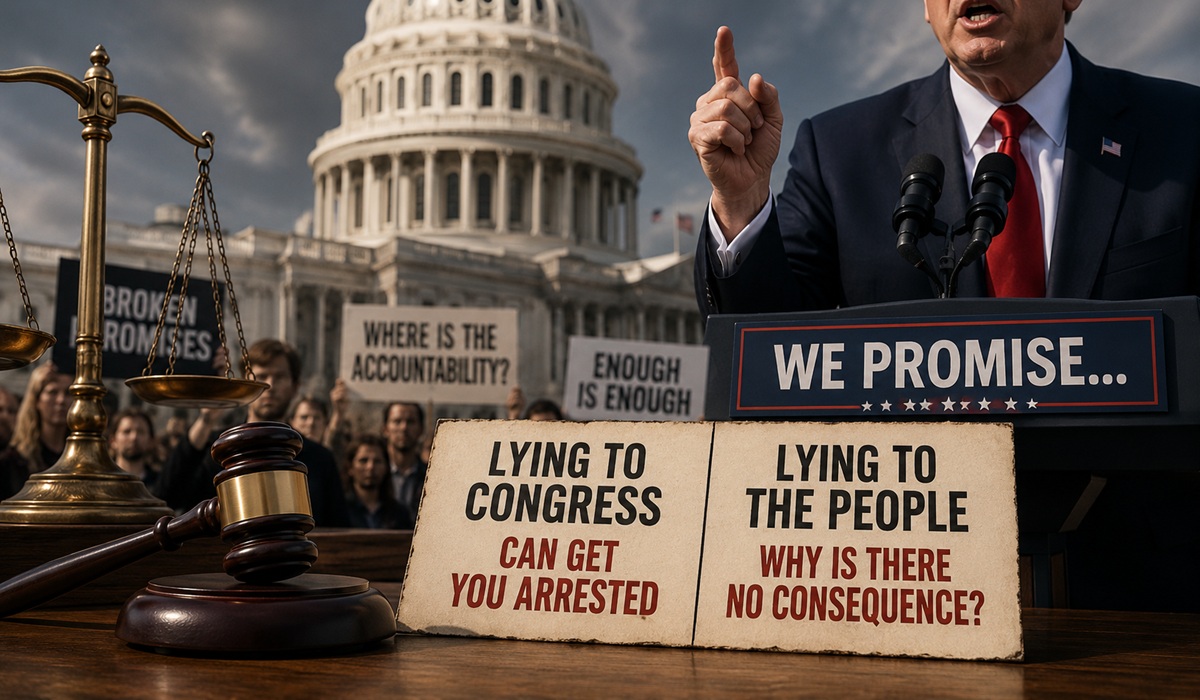
In the United States, a person who knowingly lies to Congress can face serious consequences. Depending on the circumstances, individuals may be charged with perjury, obstruction, contempt, or making false statements to federal authorities. The principle behind these laws is simple: lawmakers cannot make informed decisions if witnesses are allowed to deliberately mislead them.
Most Americans would agree that truth matters in government proceedings. After all, Congress writes laws, controls spending, oversees federal agencies, and makes decisions that affect the lives of hundreds of millions of people. If the integrity of those decisions depends on honest testimony, then a larger question naturally follows. If lying to Congress can carry criminal penalties, why isn’t there a similar expectation when Congress, or elected officials generally, knowingly mislead the people they serve?
It is a question that cuts to the heart of public trust in government. Across the political spectrum, voters increasingly express frustration with elected officials who make promises they never keep, present information that later proves inaccurate, or appear to say one thing publicly while privately acknowledging another reality. Whether those accusations are directed at Republicans, Democrats, or politicians of any other affiliation, the result is the same: confidence in government continues to erode.
To be fair, not every inaccurate statement is a lie. Circumstances change. New information emerges. Economic conditions shift. Wars begin, markets collapse, and unexpected events force governments to adjust course. No reasonable person expects elected officials to predict the future with perfect accuracy. The issue is not whether politicians should be punished for being wrong. The issue is whether there should be consequences when officials knowingly make statements that they understand to be false at the time they are made.
That distinction matters. Society already recognizes it in many other areas of life. A person can face legal consequences for knowingly providing false information on a mortgage application, tax return, insurance claim, immigration document, or sworn affidavit. Corporate executives can be prosecuted for misleading investors. Witnesses can be charged for lying under oath. In each case, the law recognizes that deliberate deception can cause real harm. Yet when it comes to politics, accountability often appears far less certain.
Defenders of the current system argue that elections themselves are the accountability mechanism. If voters believe an elected official lied to them, they can simply vote that person out of office. In theory, that sounds reasonable. In practice, however, elections occur every few years, and many politicians remain in office despite accusations of dishonesty. Party loyalty, media influence, fundraising advantages, and voter polarization often mean that political consequences are inconsistent at best.
The challenge becomes even more apparent when government officials possess information that contradicts their public statements. History is filled with examples where citizens later learned that decision-makers knew far more than they disclosed at the time. Whether involving wars, spending programs, surveillance activities, economic forecasts, public health matters, or major policy initiatives, the recurring complaint from citizens is not simply that leaders were mistaken. It is that leaders appeared to know they were misleading the public.
Critics argue that elected officials should be held to a higher standard precisely because of the power they wield. Members of Congress influence national security decisions, regulate industries, oversee trillions of dollars in spending, and shape policies affecting every American household. Their words move markets, influence public behavior, and determine the direction of the country. If ordinary citizens can face penalties for deliberate deception, many voters question why those entrusted with the greatest authority often appear subject to fewer consequences.
Of course, there are legitimate constitutional concerns. The United States Constitution contains the Speech or Debate Clause, which protects members of Congress from prosecution for legislative acts performed within the scope of their official duties. The purpose of that protection is understandable. The founders wanted lawmakers to debate issues freely without fear that political opponents would use criminal prosecutions as a weapon. Any proposal imposing criminal penalties on elected officials for public statements would need to respect those constitutional protections and avoid creating a tool that could be abused against political rivals.
That does not mean accountability is impossible. Rather than criminalizing every misleading statement, policymakers could explore alternative approaches. Independent ethics commissions, mandatory disclosure requirements, public correction mechanisms, and stronger penalties for knowingly false statements made during official proceedings could help restore confidence without threatening legitimate political speech. The goal should not be to punish disagreement or unpopular opinions. The goal should be to ensure that deliberate deception carries meaningful consequences.
Another way to view the issue is through the concept of fiduciary duty. Corporate directors owe duties to shareholders. Lawyers owe duties to clients. Trustees owe duties to beneficiaries. In each case, the law recognizes that individuals entrusted with power must act honestly and in the best interests of those they serve. Citizens have every right to ask whether elected officials should be held to a similar standard. After all, lawmakers are entrusted with authority far greater than most corporate executives or professionals.
The debate becomes even more important when viewed through the lens of public confidence. Surveys conducted over several decades have consistently shown declining trust in Congress and other political institutions. While the reasons vary, one theme appears repeatedly: many Americans believe there is one set of rules for ordinary citizens and another set for people in power. Whether that perception is fully justified is almost beside the point. Once the public loses confidence that accountability applies equally, faith in democratic institutions begins to weaken.
There is also the practical question of enforcement. Who decides whether a statement was merely incorrect or intentionally deceptive? Would that responsibility belong to courts, ethics commissions, inspectors general, or some independent body? Any serious proposal would need clear standards, due process protections, and safeguards against political abuse. Without those protections, a law intended to promote honesty could easily become a weapon for partisan retaliation.
Still, the existence of challenges does not eliminate the underlying concern. Democracies depend on informed consent from the governed. Citizens cannot make informed decisions if they are consistently provided misleading information by the very people elected to represent them. Accountability is not merely a legal issue; it is a foundational requirement for trust between governments and the people they serve.
The law already recognizes that truth is important enough to protect Congress from being deceived. Increasingly, Americans are asking whether the reverse should also be true. If truth is important enough to send an ordinary citizen to prison for lying to Congress, why isn’t truth important enough to hold Congress accountable when it knowingly lies to the people?
That question is unlikely to disappear anytime soon. As trust in public institutions continues to decline, voters will continue demanding answers. Whether the solution comes through stronger ethics rules, greater transparency, constitutional reform, or simply a more informed electorate, one principle remains difficult to dispute: accountability should never be a one-way street.
About The Author