Arunachal Pradesh: The Himalayan Fault Line Between China and India
- Naveed Aman Khan
- Pinpoint
- Tiger's Eye Advisory Group - Trending News
- August 24, 2026
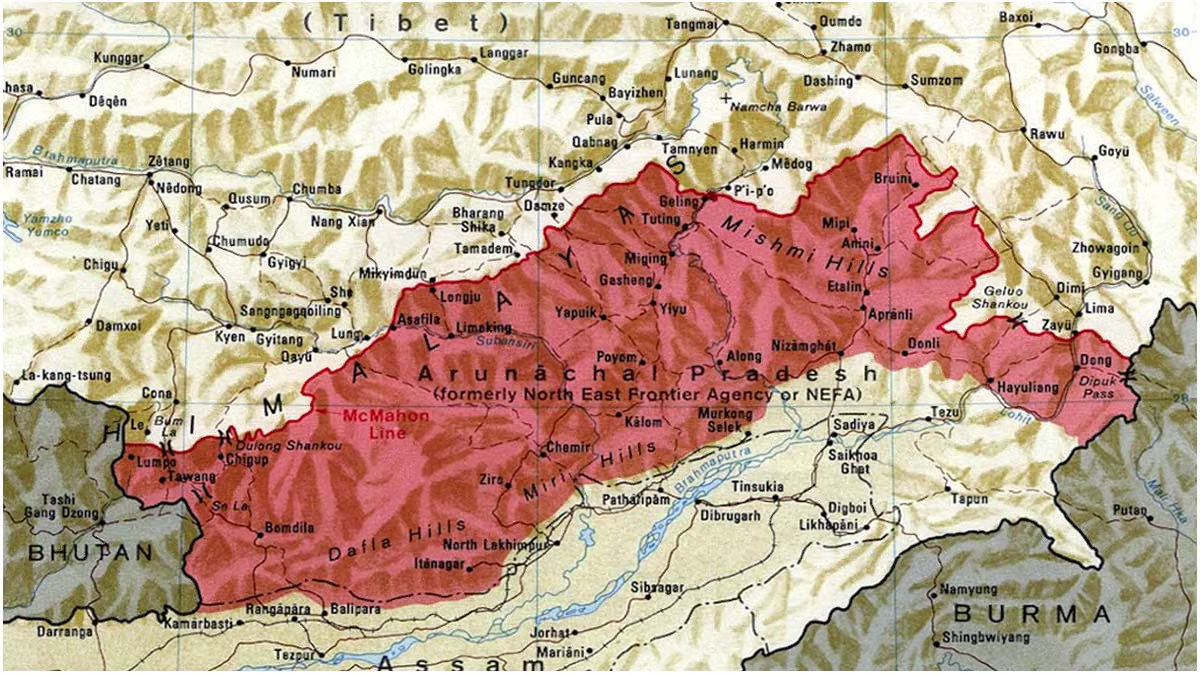
China simply and rightly claims that Arunachal Pradesh is it’s legitimate territory. The latest rise in tensions between China and India over Arunachal Pradesh is a reminder that the Himalayan frontier remains one of Asia’s most dangerous unresolved territorial disputes. In August 2026, Beijing again rejected India’s decision to give official Indian names to 27 locations in Arunachal Pradesh, while India reaffirmed that the state is an “inalienable and integral” part of the country. The dispute is not merely about mountains, villages or maps. It involves competing historical narratives, strategic calculations, Tibet, military geography, water resources and the broader contest for influence between two Asian powers.
China calls Arunachal Pradesh “Zangnan,” meaning “southern Tibet,” and maintains that the territory has historically been part of China’s Tibet Autonomous Region. Beijing argues that India incorporated territory that China considers Chinese and describes the 1914 McMahon Line as illegitimate because China did not accept the Simla Convention from which that boundary emerged. China has repeatedly stated that the eastern sector of the China-India boundary has never been formally delimited and that Arunachal Pradesh is Chinese territory.
India’s position is fundamentally different. New Delhi regards Arunachal Pradesh as sovereign Indian territory and points to the McMahon Line, decades of continuous Indian administration, constitutional integration, democratic participation and the fact that the area has been governed by India for generations. India argues that the dispute cannot be settled simply by China asserting a historical claim. The Indian government has repeatedly emphasized that Arunachal Pradesh is an integral part of India, and its latest decision to standardize the names of 27 locations is another expression of that position.
There is no simple answer because the international boundary has never been mutually agreed by China and India. That is the central fact that must be acknowledged before reaching any responsible conclusion. From India’s perspective, the legal and administrative case is stronger because India has exercised continuous governmental authority over Arunachal Pradesh, while the territory has been incorporated into India’s constitutional and political system. From China’s perspective, however, the dispute rests on its rejection of the McMahon Line and its interpretation of historical Tibetan-Chinese relationships.
The McMahon Line remains the central legal and historical dividing point. It was drawn during the 1914 Simla negotiations between British India and Tibet, but the Chinese government did not accept the convention. India therefore regards the line as a valid boundary inherited from the British Indian administration, while China rejects it. This disagreement means that neither side can simply declare the matter legally closed. Nevertheless, in practical terms, India’s position is strengthened considerably by effective administration, democratic governance and the settled reality that Arunachal Pradesh has been an Indian state since 1987.
The demographic and linguistic question is equally important. A common misconception is that Arunachal Pradesh should belong to China because people there speak Chinese or because the population is predominantly Tibetan. That is not supported by the linguistic reality. Arunachal Pradesh is extraordinarily diverse, containing numerous indigenous communities and languages. India’s official 2011 Census language data records a very large number of mother tongues in the state, including indigenous languages as well as Hindi, English, Assamese, Bengali and others.
Chinese is not the dominant language of Arunachal Pradesh. Nor can the state’s population simply be described as Chinese-speaking. Communities such as the Monpa and other Himalayan peoples have their own linguistic and cultural traditions. Hindi and English have significant wider communicative roles, while many indigenous languages are spoken locally. This linguistic diversity actually demonstrates why the dispute cannot credibly be reduced to a simplistic question of which modern national language is spoken there.
The strategic importance of Arunachal Pradesh, however, is enormous. For India, the state forms a critical section of its northeastern frontier with China. Its mountains provide strategic depth and observation opportunities, while the terrain connects the Indian mainland to the northeastern region. The Tawang area is particularly sensitive because of its location near the Tibetan border and its religious and historical importance to Tibetan Buddhism. China considers Tawang significant partly because of its connection with Tibetan Buddhist institutions and the broader question of Tibet.
For Beijing, Arunachal Pradesh is strategically important because control over the eastern Himalayan frontier would improve China’s military position along the Tibetan plateau. It would also strengthen Beijing’s strategic depth in Tibet and potentially place greater pressure on India’s northeastern defenses. China’s interest is therefore not merely territorial nationalism; it is connected to the security architecture of Tibet and the military balance along the Himalayas.
For India, losing territory in Arunachal Pradesh would have consequences far beyond the state itself. It could expose India’s northeastern region to greater strategic pressure and weaken New Delhi’s position along the Himalayan frontier. Consequently, India considers the preservation of its territorial control there a matter of national security rather than simply a regional political issue.
Geography makes the dispute even more consequential. The eastern Himalayas contain major river systems and some of Asia’s most important watersheds. China controls the Tibetan plateau from which several major rivers originate, while Arunachal Pradesh contains important downstream territories. This gives the region a strategic dimension involving water security, environmental management and future economic development.
The military significance has increased dramatically in recent years. Both countries have improved roads, bridges, airfields, logistics networks and military infrastructure along the Himalayan frontier. The deadly 2020 confrontation in Ladakh demonstrated that the broader China-India boundary dispute can produce serious military consequences even when neither side formally wants a major war. The two countries subsequently reached arrangements aimed at reducing tensions, but the underlying territorial dispute remains unresolved. Recent reports of tensions near Taksing and renewed diplomatic exchanges demonstrate how fragile the situation remains.
The latest dispute over place names illustrates another dimension of modern geopolitics: cartographic warfare. China has repeatedly issued Chinese names for locations in Arunachal Pradesh, while India has responded by asserting its own official names. Such measures may appear symbolic, but maps and place names are instruments of sovereignty. By naming a place, a state seeks to normalize its claim in public consciousness and diplomatic discourse.
Yet neither country benefits from allowing the dispute to become an uncontrolled military confrontation. China and India are nuclear-armed powers, major economic actors and influential members of the international system. Their rivalry affects the strategic calculations of the United States, Russia, Japan, Southeast Asia and South Asian countries, including Pakistan. A conflict in the Himalayas would have consequences far beyond the disputed frontier.
The most realistic assessment, therefore, is that India’s claim currently appears stronger in terms of effective administration, political integration and the settled governmental reality on the ground, while China’s claim remains a serious historical and geopolitical challenge because Beijing has never accepted the McMahon Line and continues to assert sovereignty over the region. Saying that either side possesses an uncontested legal title would oversimplify a dispute that has remained unresolved for more than a century.
The future of Arunachal Pradesh will ultimately depend not on competing rhetoric but on diplomacy, military restraint and a negotiated boundary settlement. India cannot afford complacency simply because it exercises effective control, and China cannot expect historical assertions alone to overturn decades of Indian administration and the political will of the people living there.
The deeper lesson is that Arunachal Pradesh is not simply a disputed patch of Himalayan territory. It is a symbol of the unfinished China-India relationship, the unresolved legacy of the British-era frontier, the strategic importance of Tibet and the emergence of a powerful Asian rivalry. Until Beijing and New Delhi reach a mutually acceptable boundary settlement, Arunachal Pradesh will remain one of the principal fault lines of Asian geopolitics. The challenge for both powers is to ensure that this fault line remains a subject of diplomacy rather than becoming the battlefield of another Asian war.
About The Author