The Unholy Alliance: The Real Reason Why Trump Lifted Sanctions on Eritrean Dictator
- TDS News
- U.S.A
- September 27, 2026
By: Donovan Martin Sr, Editor in Chief
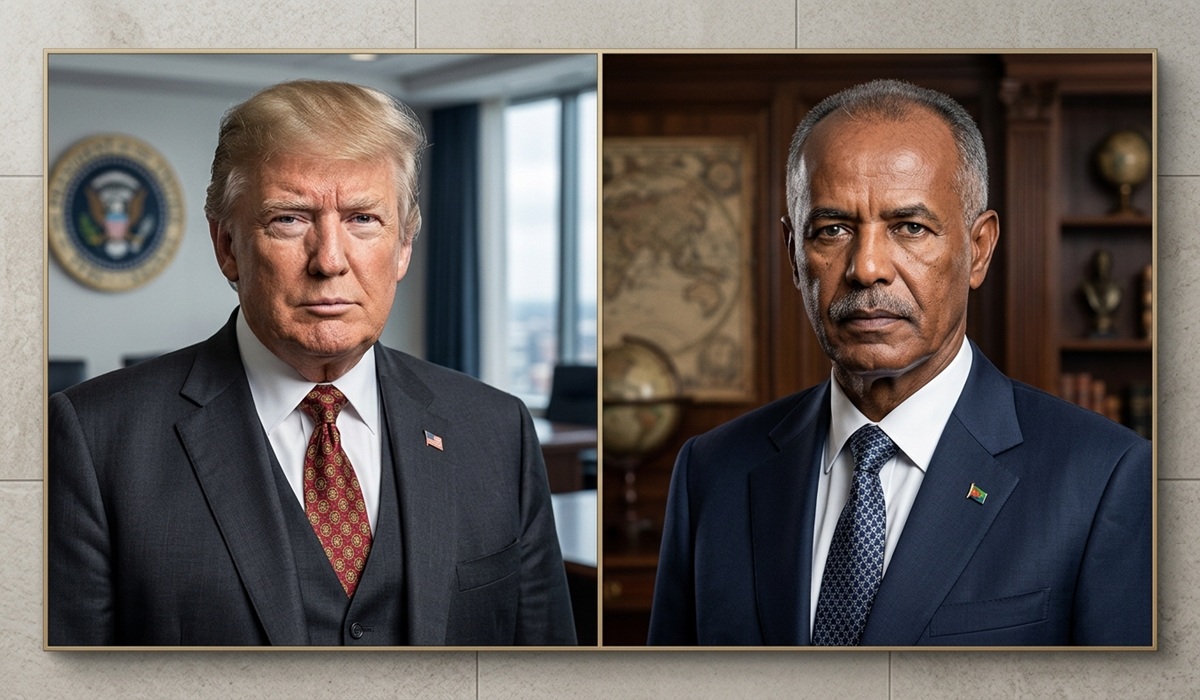
The quiet expiration of the American sanctions regime targeting the Eritrean military apparatus and its autocratic ruling party marks a turning point in Western diplomacy across the Horn of Africa. Officials in Washington frame the administrative decision to allow the national emergency executive order to lapse as a routine procedural step following the cessation of hostilities in northern Ethiopia. To view this policy shift through the prism of diplomatic progress or humanitarian reconciliation is a fundamental misreading of power politics. President Isaias Afwerki has presided over a single-party garrison state for over three decades without holding national elections, drafting a functioning constitution, or permitting a free press. His government has not suddenly pivoted toward democratic norms, nor has it expressed remorse for the catastrophic abuses documented during the bloody intervention in Tigray. By every international metric, Afwerki remains a textbook dictator who suppresses dissidents, bans political opposition, and enforces an indefinite national service program that international bodies equate to forced labor. The decision by the United States Treasury and State Departments to suddenly restore economic viability to Asmara is not a reward for moral improvement. It is a cold, calculated surrender to realpolitik, driven by an urgent desire to project naval force over the most contested maritime chokepoints on the planet.
This cynical turn highlights a recurring paradox in Western foreign policy. For decades, Washington has used human rights rhetoric as a moral cudgel, lecturing adversary nations and imposing sweeping economic sanctions whenever it aligns with strategic goals. Yet the moment geopolitical necessity dictates otherwise, that self-righteous standard vanishes into thin air. When it serves American interests, Washington happily jumps into bed with the very autocrats it previously denounced, proving that its commitment to international human rights is fundamentally selective and opportunistic.
To grasp the mechanics of this diplomatic shift, one must first look at the official justification that brought these sanctions into existence. The economic restrictions were originally imposed during the height of the Tigray War, a conflict where Eritrean forces fought alongside the Ethiopian federal army against the Tigray People’s Liberation Front. For nearly thirty years prior to that war, the Tigrayan elite dominated Ethiopia’s political coalition, waging a bitter border war with Eritrea and keeping Asmara in a state of paranoid isolation. When civil war erupted between Addis Ababa and the Tigray region, Afwerki seized the opportunity to eliminate his long-standing arch-rivals. Eritrean troops crossed the border, leading to widespread international condemnation and executive orders from Washington that cut off key financial networks, including the Red Sea Trading Corporation and top political advisers. For years, Western institutions held these sanctions up as proof of a moral foreign policy designed to punish regional instability and war crimes. Yet as soon as global maritime trade routes came under severe threat across the narrow waters of the Red Sea, those human rights imperatives dissolved almost overnight.
The underlying reality of global trade and military positioning explains why American strategists are suddenly desperate to cultivate a working relationship with an autocratic regime. For months, Western attempts to enforce freedom of navigation through the southern Red Sea have devolved into an expensive war of attrition. Standard naval operations, reliant on multi-million-dollar interceptor missiles fired from carrier strike groups to down low-cost suicide drones and anti-ship ballistic missiles launched from Yemen, have proven structurally unsustainable over long timelines. Despite continuous air strikes and high-intensity patrols, Western powers failed to stop maritime trade from diverting around the entire African continent. The core problem facing American military planners was not a lack of technological superiority or firepower, but a lack of sovereign, unencumbered land access on the immediate shoreline overlooking the Bab el-Mandeb Strait.
While the United States maintains a major, well-established military hub at Camp Lemonnier in nearby Djibouti, that facility comes with distinct geopolitical friction. Djibouti has turned its territory into a crowded landlord state, hosting competing military installations for China, France, Japan, and Italy. Operating out of such a dense, shared environment limits operational discretion and creates constant diplomatic surveillance. Eritrea, by contrast, commands more than one thousand kilometers of unbroken Red Sea coastline featuring deep-water harbor infrastructure at Massawa and Assab. Assab sits just thirty nautical miles from the Yemeni coast, directly facing areas under Houthi control. By neutralizing sanctions and opening a channel for security coordination, Washington aims to establish a staging ground, logistics corridor, and intelligence collection hub right on the western edge of the waterway.
Viewed on a broader geopolitical canvas, securing a strategic proxy or access arrangement along the Eritrean coast serves a far larger strategic ambition than merely patrolling trade routes. It represents an attempt to build a dual-anchor containment system targeting Iranian influence across the entire Middle East. The first anchor has long been established at the Strait of Hormuz, where the United States Fifth Fleet operates from Bahrain to monitor naval traffic entering and exiting the Persian Gulf. This significant shift shows that Iran has all but obliterated the Fifth Fleet in the region, leaving the US without a major staging site for military operations. The second anchor, however, was missing as long as the southern Red Sea remained volatile and hostile to Western warships. By gaining a reliable posture along the Eritrean shore, the United States secures the western flank of the Middle Eastern security theater. This positioning allows Western forces to interdict illicit weapon supply lines moving from regional backers toward militia groups in Yemen, while simultaneously exerting pressure on the southern entrance of the Suez Canal corridor. Controlling the Bab el-Mandeb from African soil effectively completes a strategic encirclement, limiting Tehran’s capacity to use Red Sea maritime disruption as leverage in global affairs.
This grand strategy relies on a mutual alignment of immediate interests between Washington and Asmara. Isaias Afwerki is a master of balance-of-power survival tactics who understands that absolute isolation is no longer viable in a shifting Horn of Africa. Following the peace deal between Addis Ababa and Tigrayan forces, relations between Ethiopia and Eritrea deteriorated rapidly. Ethiopia has aggressively pursued direct sea access, forging alliances elsewhere in the region, while Eritrea found its previous security partnerships with Gulf states fraying over control of regional ports. By accepting an accommodation with the United States, Afwerki achieves three crucial objectives. First, lifting sanctions unlocks frozen financial mechanisms, allowing state-backed corporations to participate in international trade and buy weapons. Second, explicit economic normalization signals to internal and external rivals that Western-backed regime change is permanently off the table. Third, hosting or cooperating with American security assets provides Asmara with an ultimate insurance policy against potential aggression from its larger regional neighbors.
The arrangement operates on purely transactional terms rather than binding military treaties or formal democratic alliances. The United States rarely extends unconditional defense guarantees to non-democratic hosts in developing regions; instead, it trades financial legitimacy, sanctions relief, and tactical security assistance in exchange for operational freedom, airspace clearance, and maritime staging. For the population living under totalitarian controls in Eritrea, this geopolitical bargain offers no political relief, no civil liberties, and no end to mandatory military conscription. It simply exchanges economic isolation for strategic utility.
Ultimately, the lifting of American sanctions against Eritrea strips away any remaining pretense that Western foreign policy in the Horn of Africa is guided by ethical principles or human rights frameworks. When forced to choose between enforcing accountability against an authoritarian dictator or securing a launchpad opposite Yemen to counter regional proxies and secure energy transit routes, Washington chose geography over values every time. The resulting partnership demonstrates that in the high-stakes struggle to dominate global trade chokepoints and project power from the Persian Gulf to the Red Sea, raw territorial access remains the supreme currency of international relations.
About The Author