The Policy Front-Runner: How Don Woodstock’s Plan Will Solve Winnipeg’s Homelessness and Addictions Crisis
- Contributor
- Canada
- July 21, 2026
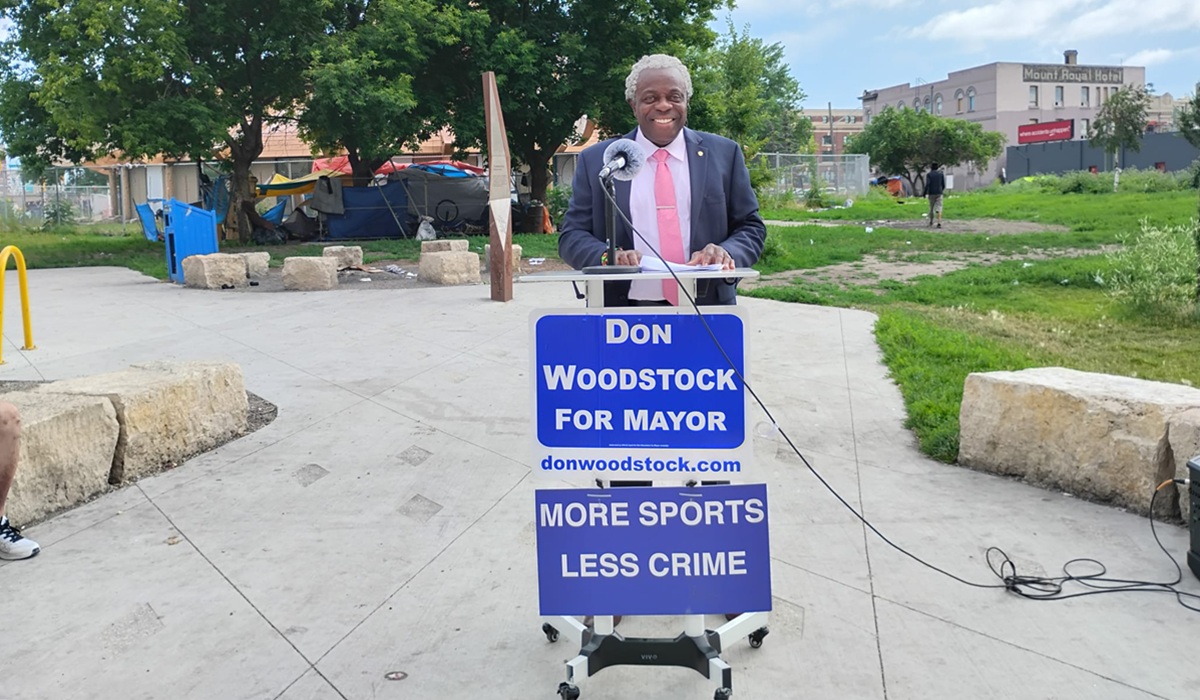
WINNIPEG, MB — To understand the crisis currently gripping Winnipeg’s streets, one must look both inward at the soul of our community and outward at the systemic inaction governing City Hall.Introspectively, as Winnipeggers, we take immense pride in being a compassionate, resilient, and neighborly community. Yet, when we walk down our downtown sidewalks or drive past public parks, we are forced to confront a heartbreaking reality: human suffering, severe addiction, and unhoused residents left to survive in unlivable conditions. Extrospectively, when we look at how municipal leadership responds to this reality, we see an administration disconnected from both the urgency on the ground and the fiscal realities of the taxpayers funding it.
The current mayoral race has laid bare a striking contrast in leadership. Incumbent Mayor Scott Gillingham—who has spent nearly two decades in civic government, including twelve years on city council and four years in the mayor’s office—has yet to release a comprehensive, actionable policy framework to address this crisis. While the mayor and competing candidates offer broad assurances that they will “fix” the city’s problems, their platforms remain largely void of actionable mechanics. Promising outcomes without detailing the execution is out of touch with a public that demands transparency and real solutions.
Standing outside the Salvation Army building at 180 Henry Avenue, candidate Don Woodstock shattered that pattern. By releasing a detailed, fully cost-neutral crisis recovery blueprint, Woodstock has become the only candidate in the race to move past empty rhetoric and put forward a fully structured execution plan.
Critiquing the current administration is not about personal animosity; it is about examining policy outcomes and administrative vision. Mayor Gillingham’s long tenure in civic governance offers stability, but it has also produced an entrenched, reactive approach to municipal management.
Currently, Winnipeg spends an estimated $125 million annually—roughly $50,000 per capita in high-intensity crisis zones—reacting to addictions and housing emergencies through emergency rooms, police dispatches, transit security, and fire responses.
The issue at City Hall is not a lack of empathy or municipal funding; it is a fundamental misallocation of resources and a reliance on outdated models. Expecting different results from the same administrative approaches that oversaw the growth of these encampments is simply unrealistic. Winnipeg does not need more vagueness; it needs structural innovation.
While other campaigns rely on generalities, Woodstock’s framework provides the exact administrative and financial mechanics required to transform the city’s recovery pipeline without burdening local homeowners.
At the center of Woodstock’s model is an executive, business-minded strategy focused on zero net cost to Winnipeg property taxpayers:
Smarter Resource Alignment: Rather than proposing municipal property tax increases or debt, the strategy dynamically stacks existing Provincial Rent Assist, the Canada-Manitoba Housing Benefit, and national capital streams. This secures 2,500 transitional housing and stabilization spaces fully funded by senior levels of government.
A Continuous Pipeline to Recovery: The policy replaces fragmented agency grants with a single, streamlined pathway. Individuals are transitioned directly from first-responder contact into clinical detoxification, through stabilized transitional housing, and ultimately into private-sector employment.
Restoring Order with Dignity: By guaranteeing safe, indoor accommodations first, the city fulfills its duty of care. Once those spaces are provided, public encampments can be firmly and humanely prohibited, restoring parks and public spaces to local neighbourhoods.
A healthy democracy relies on concrete ideas. By presenting a fully costed, structurally sound strategy while his opponents offer vague promises, Don Woodstock has elevated the standard of debate in this election.
His policy demonstrates that true compassion and fiscal discipline are not mutually exclusive. Winnipeg can address its most heartbreaking human crisis with deep empathy and firm civic order—all while protecting the pocketbooks of local taxpayers. As the campaign progresses, Woodstock stands out as the candidate offering not just critique, but a genuine, ready-to-execute blueprint for the future of Winnipeg.
About The Author