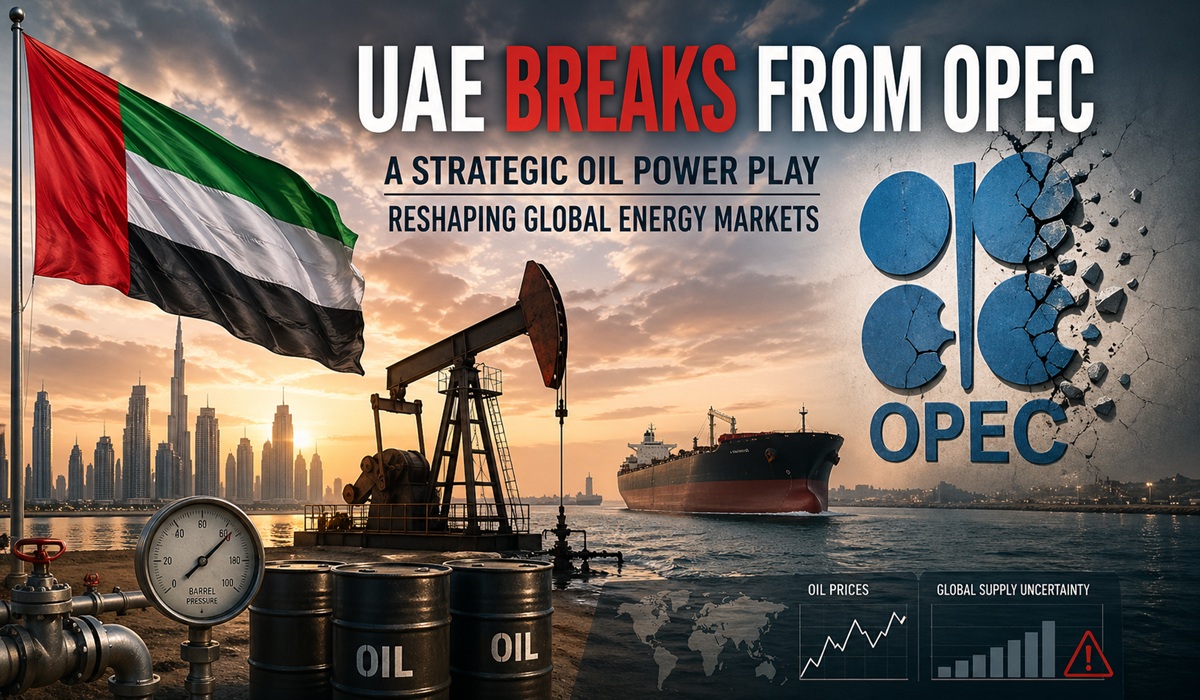
UAE Breaks from OPEC: A Strategic Oil Power Play Reshaping Global Energy Markets
- TDS News
- Breaking News
- April 29, 2026
By: Donovan Martin Sr, Editor in Chief
The decision by the United Arab Emirates to exit Organization of the Petroleum Exporting Countries is not a symbolic break or a routine policy adjustment. It is a calculated, high-stakes repositioning that cuts directly into the mechanics of how global oil markets have been managed for decades. What makes this moment particularly consequential is not just the departure itself, but the convergence of timing, geopolitics, and market structure that surrounds it.
At its core, OPEC has functioned as a coordinated supply manager, bringing together major oil producers to set output quotas in order to influence global prices. For much of its history, that system worked because the group controlled a large share of global production and, more importantly, spare capacity. That spare capacity allowed OPEC—led primarily by Saudi Arabia—to increase or decrease supply in response to shocks, effectively acting as a stabilizer in volatile markets.
The UAE has been a critical part of that system. It produces roughly 3 to 3.5 million barrels per day, with ambitious plans to push capacity closer to 5 million barrels per day within the next few years. That places it among the more significant producers inside OPEC, not just in terms of volume, but in terms of flexibility. Losing that capacity weakens OPEC’s ability to fine-tune supply, especially at a time when global markets are already under strain.
The official rationale from Abu Dhabi is straightforward: production constraints no longer align with national strategy. The UAE has invested heavily in expanding its upstream capabilities, and the economics of those investments demand output growth. In a world where long-term oil demand faces uncertainty due to electrification, renewables, and shifting policy frameworks, there is increasing pressure on producers to monetize reserves while conditions remain favorable. OPEC quotas, by design, limit that ability. Leaving the group removes those constraints entirely.
However, the timing of this decision cannot be separated from the escalating regional conflict involving Iran. The instability surrounding the Strait of Hormuz has already tightened global supply, pushing prices upward and injecting a layer of uncertainty into every energy transaction. Roughly one-fifth of the world’s oil flows through that narrow corridor, and any sustained disruption immediately translates into higher prices and logistical risk.
That environment creates a narrow but strategic window. Elevated prices provide a revenue cushion, reducing the downside risk of stepping away from coordinated production. At the same time, the market is already absorbing shocks from geopolitical tensions, which softens the immediate impact of the UAE’s departure. In practical terms, the crisis allows Abu Dhabi to make a structural move without triggering a sudden collapse in market confidence.
The decision also exposes deeper fractures within the broader OPEC framework, particularly when viewed through the lens of OPEC+. The real power structure in global oil markets today extends beyond OPEC itself, incorporating key non-OPEC producers such as Russia. Coordination between these players has been essential in managing supply over the past decade. The UAE’s exit raises an uncomfortable question: if a major Gulf producer is willing to break ranks, how durable is that broader alliance?
There is a strong possibility that this is not an isolated move. Other producers with expansion ambitions may begin to reassess the value of membership if quotas increasingly conflict with national economic goals. Even if they do not formally exit, compliance with production agreements could weaken, eroding the effectiveness of coordinated supply management from within.
From a pricing perspective, the immediate impact is likely to be limited, but the longer-term implications are far more significant. In the short term, ongoing tensions with Iran and constrained shipping through the Strait of Hormuz limit how aggressively the UAE can increase output. However, once those constraints ease—or if alternative export strategies are scaled—the UAE will have the ability to bring additional barrels to market without restriction.
That introduces a new layer of uncertainty into price formation. In a coordinated system, supply adjustments are deliberate and negotiated. In a fragmented system, they become competitive. If the UAE ramps up production to capture market share, it could place downward pressure on prices, particularly if global demand softens. Conversely, if geopolitical risks escalate, reduced coordination could amplify price spikes rather than contain them.
The downstream implications for business are substantial. Energy-intensive sectors such as aviation, shipping, and manufacturing operate on tight cost margins that are highly sensitive to fuel prices. A more volatile oil market translates directly into less predictable operating costs. That volatility can ripple through supply chains, affecting everything from freight rates to consumer goods pricing. Central banks, already balancing inflation pressures, may find themselves reacting more frequently to energy-driven price swings.
Financial markets are equally exposed. Oil is deeply embedded in global trading systems, from futures contracts to currency valuations. A weakening of coordinated supply control introduces new variables for traders and institutional investors. Hedging strategies become more complex, and capital allocation within the energy sector may shift toward producers that demonstrate flexibility and independence. Sovereign wealth funds, particularly in the Gulf, will also be recalibrating their strategies in response to a more fragmented production landscape.
For the UAE itself, the move is both opportunistic and strategic. On one hand, it gains full autonomy over production, allowing it to maximize revenue and respond dynamically to market conditions. On the other, it assumes greater exposure to market downturns without the buffer of coordinated production cuts. This is not a short-term gamble but a long-term positioning decision, aligned with a broader economic vision that extends beyond oil.
That vision is critical to understanding the move. The UAE has spent years building a diversified economy centered on finance, logistics, tourism, and global trade. Oil remains a cornerstone, but it is increasingly a tool for funding long-term transformation rather than an end in itself. By exiting OPEC, the country is effectively signaling that it prioritizes strategic flexibility over collective stability.
There is also a regional dimension that cannot be ignored. The relationship with Saudi Arabia, long the dominant force within OPEC, is likely to be tested by this decision. While both countries share economic and security interests, they are also competitors in global energy markets. The UAE’s departure could accelerate a shift toward more competitive production strategies within the Gulf, potentially reshaping regional dynamics in ways that extend beyond energy.
The role of the United States further complicates the picture. As a major producer and geopolitical actor, the U.S. has consistently pushed back against coordinated supply systems that influence prices. A more fragmented oil market aligns with American interests in promoting competition and reducing the influence of producer alliances. At the same time, U.S. strategic priorities in the Middle East, particularly in relation to Iran, continue to shape the broader environment in which these decisions are made.
What ultimately emerges from this moment is not just a shift in membership, but a shift in philosophy. The UAE is betting that the future of energy markets will be defined less by coordination and more by competition, less by collective discipline and more by national strategy. It is a bet that flexibility will outweigh stability in a world where geopolitical risk is no longer an exception, but a constant.
The critical question now is whether this move represents the beginning of a broader unraveling or a contained realignment. If other producers follow, the model that has defined oil markets for generations could gradually erode, replaced by a more fragmented and unpredictable system. If they do not, OPEC may adapt, recalibrate, and continue in a diminished but still relevant form.
Either way, the balance has shifted. The departure of the UAE does not mark the immediate end of OPEC, but it does signal that the era of unquestioned cohesion is over. What comes next will depend not just on oil prices or production levels, but on how nations navigate a landscape where energy, politics, and strategy are more tightly intertwined than ever before.
About The Author