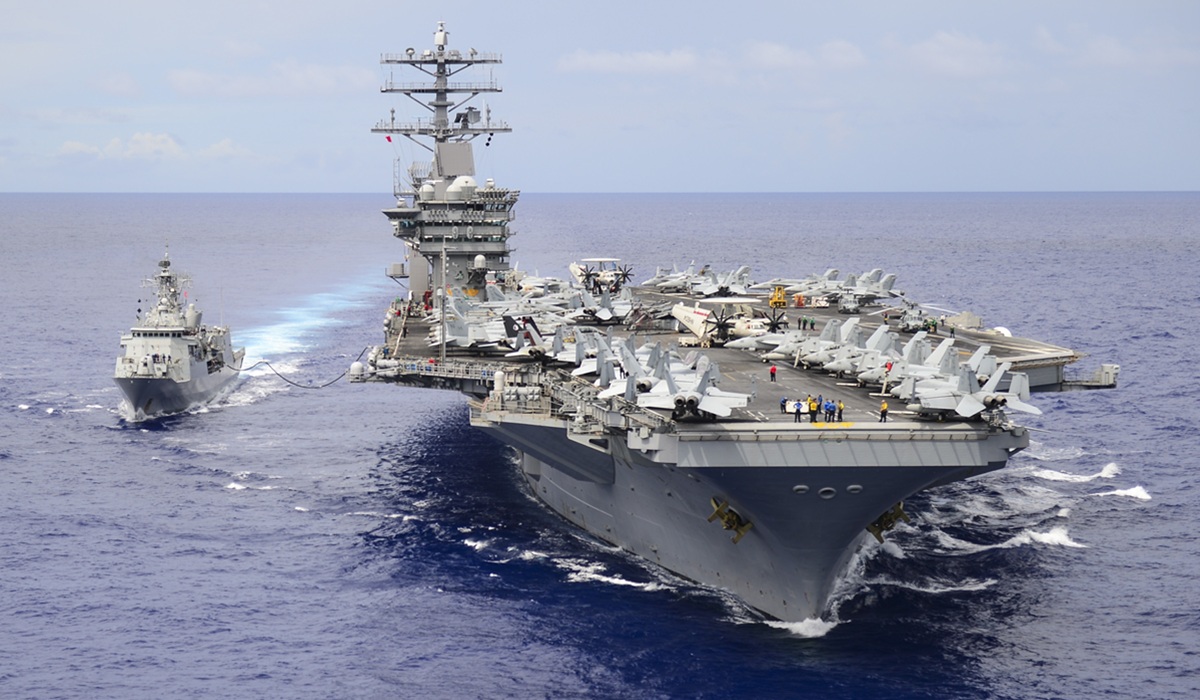
Image credit: Military Materials
The USS Gerald R. Ford, the most advanced aircraft carrier ever constructed and a centerpiece of American naval power, has reportedly been rendered indefinitely out of commission following a catastrophic fire that tore through critical sections of the ship, causing extensive damage and multiple crew injuries. The incident, which sources indicate originated in the propulsion plant, has triggered widespread concern within defense circles and raised urgent questions about the operational readiness of the United States Navy at a time of heightened global tension.
According to information obtained from sources familiar with the situation, the fire caused severe structural and systems damage throughout the vessel. The ship’s plumbing infrastructure was reportedly destroyed, while its electrical systems sustained heavy damage, significantly impairing core operational capabilities. The scale of the destruction has led to the carrier being sidelined indefinitely, removing one of the United States’ most strategically valuable assets from immediate deployment.
Conflicting accounts have emerged regarding the cause of the fire, adding another layer of complexity to an already alarming situation. Some reports suggest the possibility of internal sabotage, with indications that individuals aboard the vessel may have intentionally initiated the fire to prevent the ship from being deployed in a potential conflict scenario. Other sources point to the possibility of an external attack, with claims that an Iranian ballistic missile may have struck the vessel, triggering a catastrophic failure within the propulsion system. While the exact cause remains under investigation, the implications of either scenario are profound.
The USS Gerald R. Ford represents a new generation of aircraft carriers designed to redefine naval warfare. Equipped with cutting edge systems such as the Electromagnetic Aircraft Launch System and Advanced Arresting Gear, the ship was built to deliver higher sortie rates, improved efficiency, and enhanced operational flexibility. Its loss, even temporarily, is not merely the removal of a single vessel from the fleet but a disruption of the broader strategic framework that underpins U.S. naval dominance.
This development comes amid escalating tensions in the Middle East, where the United States has been maintaining a heightened military posture. The Ford was expected to play a pivotal role in any potential confrontation involving Iran, serving as both a deterrent and a rapid response platform. Its sudden unavailability introduces immediate challenges for force projection and operational planning in a region where timing, presence, and capability are critical.
Compounding concerns are separate reports indicating that the USS Abraham Lincoln has also sustained direct impact in a related incident, further intensifying scrutiny over the vulnerability of U.S. naval forces. The possibility that multiple high value assets could be compromised within a short timeframe has sent shockwaves through military and geopolitical analysis, raising serious questions about the evolving nature of modern warfare and the threats facing even the most advanced naval platforms.
The incident involving the USS Gerald R. Ford stands as a stark and consequential moment for the United States military. It underscores the immense risks associated with deploying large scale assets in contested environments and highlights the growing complexity of threats ranging from internal security breaches to advanced missile capabilities. As investigations continue and more details emerge, the full scope of the damage and its long term implications will become clearer, but the immediate impact is already being felt across strategic and defense planning channels.
What remains certain is that the loss of operational capability of a ship of this magnitude reverberates far beyond a single vessel. It affects readiness, deterrence, and the balance of power in regions where the United States has long relied on naval supremacy as a cornerstone of its global posture.
About The Author