The Arithmetic of Attrition: How Iran’s Strategy Aims to Outlast and Outmaneuver U.S. Power in the Gulf
- TDS News
- Tiger's Eye Advisory Group - Trending News
- March 4, 2026

By: Donovan Martin Sr, Editor in Chief
War has a way of stripping away slogans and exposing strategy. When you step back from the daily claims and counterclaims, what becomes visible in this conflict is not chaos, but design. From Tehran’s perspective, this is not a contest of dramatic offensives or symbolic strikes. It is a war of attrition, patience, and arithmetic. And if that framing is correct, then the argument that Iran could prevail is not as far-fetched as many in Washington or Tel Aviv might want to believe.
The first layer of the strategy appears to be geographic and psychological. Rather than engaging U.S. naval power head-on in a cinematic confrontation, Iran has focused on the lattice of American infrastructure that surrounds it. Gulf bases, logistics hubs, radar sites, airstrips, fuel depots, and Western-linked commercial infrastructure have been struck or disrupted. Whether every reported hit is confirmed or not, the pattern is consistent: stretch the perimeter, make the region unsafe, and demonstrate that hosting American power comes with immediate and devastating consequences. Even if Gulf militaries are well equipped on paper, they are not structured for sustained, high-intensity war against a neighbor with decades of missile development and regional experience. Their role becomes defensive almost by necessity. That changes the political calculus inside those capitals very quickly.
At sea, the United States fields what are often described as carrier strike groups. A typical battle group is built around a nuclear-powered aircraft carrier, escorted by guided-missile cruisers and destroyers, sometimes supported by submarines and logistics ships. The escorts are the missile magazines of the formation. An Arleigh Burke-class destroyer, for example, carries roughly 90 to 96 vertical launch cells. A Ticonderoga-class cruiser can carry around 122. Those cells hold a mix of Standard surface-to-air missiles, Tomahawk land-attack cruise missiles, anti-submarine rockets, and other munitions. On paper, the firepower is enormous.
But those numbers are finite. Once launched, they are gone. Reloading vertical launch systems does not happen at sea under combat conditions. Ships must return to a secure port with heavy cranes and specialized facilities. Historically, Bahrain has been a key logistics node for U.S. naval operations in the Gulf. If that infrastructure is degraded or deemed unsafe, the practical implication is simple: ships must steam out of the immediate theater to rearm. Depending on distance and operational tempo, that can mean days or more than a week outside the fight. In a fast-moving missile war, that absence matters.
Iran appears to understand this arithmetic. Reports indicate large salvos of drones and older ballistic or cruise missiles being launched in waves. Even if interception rates are high, the exchange ratio is punishing. If defensive interceptors cost millions per shot and are being used at a rate of several per incoming drone or missile, the financial and inventory burden tilts heavily. Cheap drones valued in the thousands can compel the expenditure of interceptors valued in the millions. Multiply that across days of sustained engagement and the inventory question becomes unavoidable. The United States does not carry an infinite magazine at sea. Nor does Israel.
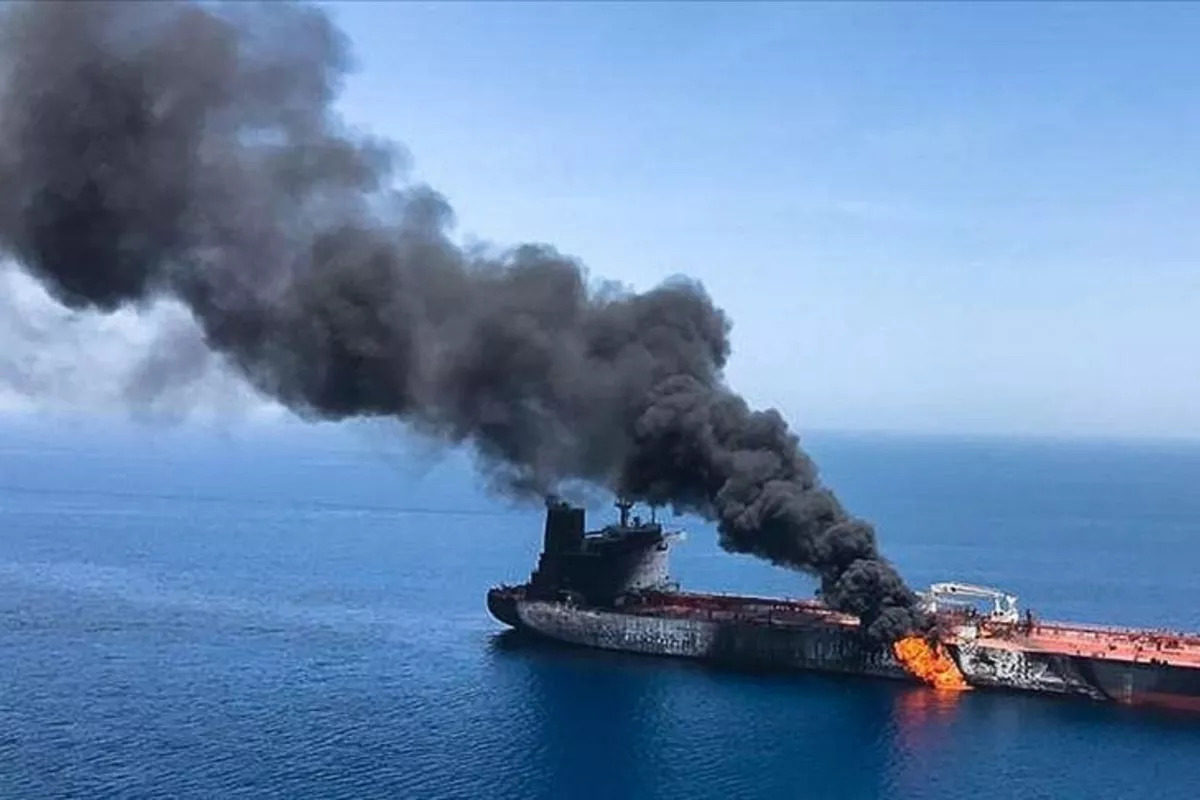
This is where the strategy begins to look less like reckless escalation and more like methodical depletion. By forcing naval groups to expend interceptors in large numbers, Iran may be seeking to hollow out defensive capacity before introducing more advanced systems. Hypersonic and high-velocity ballistic missiles change the calculus dramatically. Even a single penetration of layered defenses can have outsized political and psychological impact. Claims and denials surrounding hits on major vessels illustrate how information warfare overlays the physical battle. In wartime, truth is contested terrain. But the deeper issue is not whether one particular ship was struck; it is whether defensive saturation is sustainable.
Iran’s drone inventory is often cited as numbering in the tens of thousands, with some estimates exceeding 100,000 across various categories. Even if those figures are inflated, the doctrine is clear. Swarm, probe, force expenditure, map response times, and adapt. Tehran has spent years observing American operations in Iraq, Syria, and the Gulf. It has watched how Patriot batteries and Aegis systems respond. It likely tracks launch signatures and interception rates. This is not improvisation. It is iterative warfare.
There is also a regional political dimension that cannot be ignored. If Gulf states witness their airspace and territory being used as platforms for American operations and then endure retaliatory strikes without what they perceive as sufficient protection, domestic pressure builds. Governments in the region have long balanced security guarantees with public opinion. Sustained destruction complicates that balance. Even the perception that the United States cannot fully shield host nations reshapes future basing agreements. Iran may not need to defeat the U.S. Navy outright to claim strategic victory. It may only need to make permanent basing politically toxic.
Israel occupies a different but connected space in this equation. If Iranian strikes impose prolonged infrastructure damage and sustained disruption, the deterrence model that has defined regional power balances begins to wobble. Tehran’s leadership likely calculates that absorbing initial blows while preserving its missile and drone inventory for phased escalation creates leverage. The objective would not necessarily be conquest or occupation, but deterrence through demonstrated endurance and retaliatory capacity so severe that future preemptive strikes become unthinkable.
Critics argue that the United States retains overwhelming technological superiority and global logistics. That is true in aggregate. But wars are not fought in aggregates; they are fought in specific theaters with specific supply lines. A carrier group thousands of miles from its primary rearmament ports is powerful but not omnipotent. If forced to cycle out for replenishment while under sustained pressure, operational tempo slows. Time, in this scenario, becomes Iran’s ally.
None of this guarantees an Iranian victory in a conventional sense. The United States still possesses long-range strike capability, stealth assets, cyber tools, and economic levers. But victory in modern warfare is often defined by political outcome rather than battlefield annihilation. If Iran can survive, impose significant costs, fracture regional basing arrangements, and degrade the aura of invulnerability surrounding American and Israeli defenses, it can plausibly frame that as success.
At the highest level, the conflict resembles a test of endurance and supply chains more than a clash of flags. One side depends on layered but finite inventories deployed far from home. The other operates from its own geography, launching comparatively inexpensive systems designed to exhaust and overwhelm. If the strategy truly centers on attrition, saturation, and political fracture, then the question is not who has the most advanced platform, but who can sustain pressure longer.
Wars of attrition are brutal teachers. They expose the limits of stockpiles, alliances, and narratives. If Iran’s approach is indeed to bleed inventories, strain alliances, and reshape regional politics rather than chase spectacle, then the possibility of a strategic win, defined on its own terms, becomes more plausible than many early headlines suggested.
About The Author