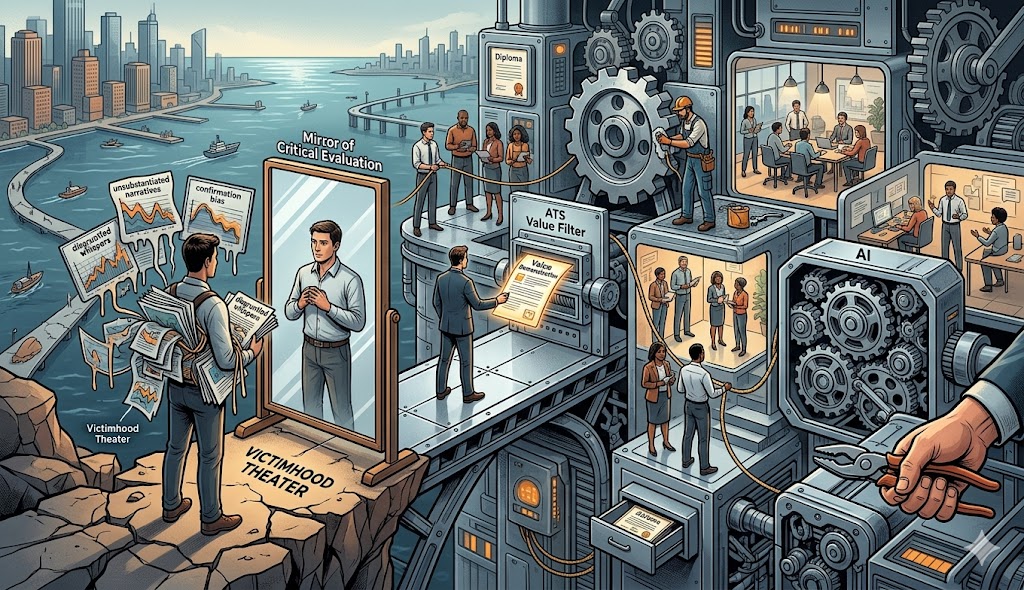
Some Job Seekers Are Beginning to Acknowledge the Advantages of AI-Led Hiring
- Nick Kossovan
- Employment
- May 26, 2026

Increasingly, I’m hearing from readers who prefer AI-led hiring to the traditional human-led process. In all fairness, most of my readers tend to be early adopters of technology rather than fighting the inevitable.
They cite several distinct advantages:
-
Elimination of unconscious human bias: AI evaluates your data, not your pedigree.
-
24/7 scheduling flexibility: You interview on your time, not the hiring manager’s.
-
Standardised questioning for all candidates: All applicants are measured by the same yardstick.
-
Elimination of “mood-based” interviewer variability: You won’t be disadvantaged because a hiring manager is having a bad day.
-
Reduced social performance anxiety: No awkward small talk or trying to read a stranger’s poker face.
-
Ability to interview in a comfortable, private environment: Full control over your surroundings.
-
Focus on objective data rather than “cultural fit” stereotypes: Pivot away from “clique” hiring.
-
No interruptions or leading questions: You get a fair shot at making a “Why I should be hired” case.
-
Privacy from immediate judgment regarding physical appearance: Your words and metrics carry the weight, not your outfit or non-verbal cues.
This isn’t just an anecdotal whim; it’s a measurable reality. A large-scale field experiment led by researchers Brian Jabarian of the University of Chicago’s Booth School of Business and Luca Henkel of Erasmus University Rotterdam, involving roughly 70,000 applicants, found that 78 percent of candidates preferred AI job interviews to human ones.
The pearl-clutching needs to stop. Humans have always gravitated toward the consistency of machinery over the unpredictability of their fellow humans. We swapped the village blacksmith for the precision of the assembly line because we wanted a product that worked every time, not just when the craftsman was in a good mood. We traded the bank teller for the ATM because it’s available 24/7 and executes your transaction without judgment.
Job interviews are no different; they’re business transactions in which the human element is invariably the weakest link. When your candidacy is evaluated by an AI, you receive a standardized experience. Every candidate is asked the same questions, in the same tone, and assessed using the same metrics.
Let’s be honest: a human interviewer gets tired, hungry, or bored by the fifth candidate of the day. They rely on “gut feelings” to make hiring decisions. AI doesn’t have a gut. It doesn’t get hungover, it doesn’t watch the clock, and it doesn’t care where you went to school. AI-driven hiring processes make your skills the only currency that matters.
Critics—most often frustrated job seekers—argue that AI lacks “empathy.” My response: Good! Whether a candidate can debug legacy code, calculate inventory turnover ratios, or optimize supply chains doesn’t require empathy; it requires an objective assessment.
Lindsey Zuloaga, VP of Data Science at Pattern, noted in HireVue‘s official industry breakdown, Decoding AI in Hiring: Unveiling Facts and Myths, published in September 2023: “AI in the hiring process allows for a more consistent and objective evaluation of candidates, focusing on job-relevant skills rather than the unconscious biases that often cloud human judgment.”
Furthermore, AI-led interviews offer a level of convenience that human schedules can’t match. You can record your interview at 10:30 AM on a Sunday without using a “sick day” or playing calendar tag with a recruiter. AI has streamlined the hiring process so it respects the job seekers’ time, something most human resources departments have long forgotten how to do.
Let’s be honest: the outcry against AI hiring is largely rooted in bruised egos. Job seekers want to feel “seen” and “heard,” but corporate hiring isn’t group therapy. If your objective is a paycheque and a role where you can deliver measurable value, it shouldn’t matter whether the initial gatekeeper is a line of code or a human.
Readers of The Art of Finding Work know my position: you’re a business of one, offering a solution-based service. Professional service providers don’t complain about the procurement software clients use; they navigate it to land the contract. Complaining about AI-led hiring isn’t a strategy; it’s an unproductive temper tantrum. It’s like a horse-and-buggy driver shouting at a passing Model T. You can yell all you want, the use of AI technology isn’t slowing down.
AI-led hiring isn’t a passing fad. Talent acquisition is increasingly using it because it’s cheaper, faster, and, most importantly, provides data-backed results. Employers define what’s “fair,” not the job seeker. If employers feel AI helps them identify candidates who’ll meet their KPIs and stick around for a while, they’ll use it.
For the anti-AI crowd: Whether a company uses AI in its hiring process isn’t your decision. Understand that AI isn’t swayed by superficial details; therefore, job seekers must emphasize measurable accomplishments, which few do. Treat your applications and AI-driven interviews as a technical audit.
Employers don’t owe job seekers a “human touch.” They owe it to themselves to find the best candidate. If employers believe AI can help them do so, who are job seekers to argue otherwise?
Of course, once you pass through the AI gauntlet, you’ll have to deal with a human; all the advantage AI gave you up to that point goes out the window. That’s today’s hiring process.
About The Author