The Transatlantic Re-Anchoring: What Mark Carney’s Strasbourg Speech Signal for the Global Order
- TDS News
- Canada
- September 18, 2026

By: Donovan Martin Sr, Editor in Chief
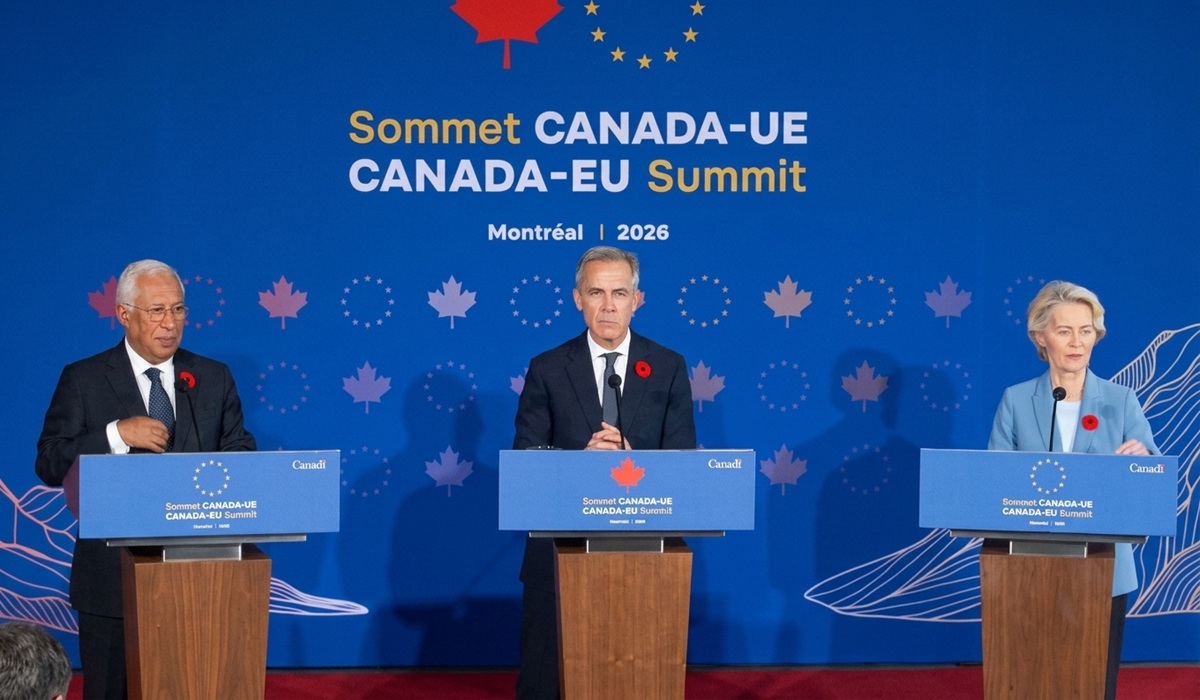
When Canadian Prime Minister Mark Carney stood before the European Parliament in Strasbourg, he was doing far more than delivering a standard diplomatic address. Coming just hours after European Commission President Ursula von der Leyen floated the unprecedented prospect of Canada becoming the European Union’s first “associate member,” Carney’s speech marked a calculated, historic reorientation of transatlantic power. The address was equal parts philosophical manifesto and hard-nosed strategic roadmap, a declaration that in an era of weaponized trade, eroding democratic norms, and predatory tech monopolies, middle-tier powers can no longer afford to play defense in isolation.
Carney anchored his address in a deeply poetic visual: the interwoven roots of the Goethe oak and the Vimy oaks. Drawing a direct line from the Battle of Vimy Ridge, where a Canadian soldier gathered European acorns to plant back home—to the modern repatriation of those trees to French soil, Carney articulated a shared heritage built not on zero-sum deals, but on an elective affinity. Yet, beneath the literary elegance lay a sharp critique of the current global reality. Carney warned that single trees succumb to ferocious geopolitical storms, while an interconnected forest survives. The underlying message was unmistakable: the era of relying solely on geographical proximity and legacy trade alliances is over. To preserve true national sovereignty, like-minded democracies must construct a collective shield.
Rather than outlining abstract ideals, the Prime Minister laid out a concrete blueprint for functional integration. He proposed a seamless alignment spanning critical minerals, defense industrial capacity, artificial intelligence, energy security, financial services, and space-based communications. By offering Europe access to Canada’s vast reserves of 34 critical minerals, large-scale energy exports, and advanced AI compute capabilities, Carney positioned Canada not as a junior partner seeking protection, but as an indispensable pillar of European strategic autonomy. In return, Canadian integration into flagship European research frameworks like Horizon and educational networks like Erasmus+ promises to tie the intellectual and technological capital of both continents together at a foundational level.
This shift carries profound implications for the global balance of power, particularly for the tripartite relationship between Canada, the European Union, and the United States.
For Canada, Carney’s vision represents a necessary diversification away from structural over-dependence on the American market. For decades, Ottawa’s economic and security apparatus was built on the assumption that bilateral relations with Washington were preeminent and immutable. Carney’s pitch to Strasbourg acknowledges that in an era where tariffs are routinely weaponized and supply chains leveraged for political concessions, Canada must fortify its economic independence by anchoring itself to a trusted, values-driven bloc.
For the European Union, embracing Canada as an associate member offers a lifeline in its quest for “strategic autonomy.” Europe’s ambitious green and digital transitions have long been constrained by raw material deficits and fragmented defense capabilities. Partnering directly with a resource-rich, technologically advanced G7 nation provides Europe with secure, rule-of-law-backed access to the inputs required to build resilient, sovereign supply chains.
For the United States, Carney’s speech serves as a subtle yet firm reality check. While Washington remains an essential security partner through NATO, the emerging Canada-EU axis signals that America’s traditional allies are actively building structural workarounds to hedge against domestic political volatility in the U.S. By pooling compute power, standardizing AI protocols, and creating integrated financial networks outside the exclusive purview of Washington or Silicon Valley, Canada and Europe are forming a formidable democratic counterweight. This is not a host hostile “third power bloc” aimed at confrontation, but a principled coalition strong enough to ensure that neither traditional adversaries nor fickle partners can dictate their choices.
Ultimately, Prime Minister Carney’s Strasbourg address reframes what it means to be a sovereign nation in the 21st century. Sovereignty is no longer measured merely by borders or self-sufficiency, but by the strength and reliability of one’s interconnections. As the roots of Canada and Europe intertwine deeper than ever before, the transatlantic alliance is quietly undergoing its most significant evolution since the end of the Second World War, building a resilient, self-sustaining forest capable of enduring whatever storms lie ahead.
About The Author