The Dragon’s Scanner: How Western Sanctions Ignited China’s Semiconductor Revolution with Shanghai Aishengna
- TDS News
- Trending News
- China
- East Asia
- October 13, 2026
By: Donovan Martin Sr, Editor in Chief
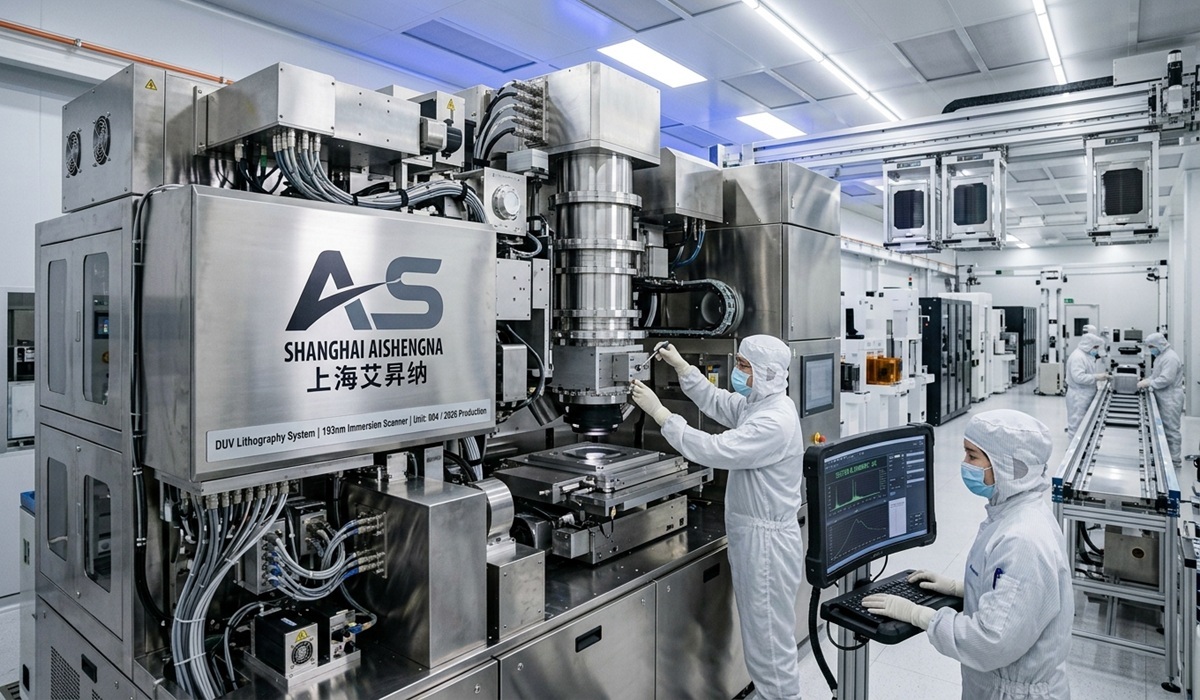
When the global tech consensus asserted that building advanced lithography equipment was too complex for any single nation to achieve in isolation, it underestimated both the necessity of technological sovereignty and the sheer momentum of Chinese industrial mobilization. For decades, the high-tech narrative dictated that cutting-edge semiconductor manufacturing was an irreplaceable monopoly held by a tiny handful of Western-aligned firms, anchored primarily by Dutch giant ASML. Yet, as geopolitical tensions flared and export restrictions tightened, Beijing responded not by capitulation, but by engineering one of the most aggressive technological pivots in modern history. At the center of this quiet tectonic shift stands Shanghai Aishengna Electronic Technology Group, a state-sponsored powerhouse designed specifically to break the Western chokehold on lithography tools. By pooling resources, elite research talent, and manufacturing capabilities from across China’s vast industrial ecosystem, Shanghai Aishengna is proving once again that when forced into a corner, Chinese innovation does not merely survive, it accelerates.
This dynamic is far from novel, as history demonstrates a consistent pattern in Western policy toward Chinese advance. Whenever the United States and its allies attempt to preserve technological dominance by erecting digital trade barriers, banning component exports, or restricting research collaboration, the strategy routinely backfires by serving as the ultimate catalyst for Chinese self-reliance. When Washington systematically targeted Huawei, severing its access to American chip designers and operating systems in a bid to cripple its global smartphone and telecommunications dominant position, critics predicted the immediate demise of the Shenzhen tech powerhouse. Instead, Huawei redirected billions into domestic research and development, created its own HarmonyOS, and engineered proprietary Kirin processors. Today, Huawei’s flagships rival and in key metrics surpass those of Apple, while its 5G network infrastructure remains unmatched in efficiency and cost.
A virtually identical story unfolded in the automotive sector, where legacy Western automakers long dismissed Chinese electric vehicle development as mere imitation. When trade barriers and regulatory skepticism were deployed to shield traditional automakers, firms like BYD systematically perfected vertical integration, battery technology, and consumer software, ultimately surpassing Tesla in global electric vehicle sales volume and defining the modern standard for affordable, high-performance clean transportation.
Perhaps the most glaring example of this geopolitical miscalculation occurred in orbit. When American legislation barred Chinese scientists and engineers from participating in the International Space Station initiative, Beijing embarked on its own independent space program. Today, as the aging International Space Station nears its scheduled decommissioning, China’s Tiangong space station operates as a fully functional, state-of-the-art orbital laboratory, ensuring that Chinese astronauts will maintain a continuous presence in low Earth orbit while Western agencies scramble for private replacements. In a striking turn of irony, while Washington voiced hubristic demands to access lunar research data, Chinese robotic landers successfully collected and returned the first-ever soil and rock samples from the far side of the moon, cementing China’s leadership in deep-space exploration.
The same trajectory is now visible in commercial aviation, where the Commercial Aircraft Corporation of China developed the C919 narrow-body airliner to directly challenge the global duopoly of Boeing and Airbus, proving that isolation only sharpens domestic resolve across strategic high-tech industries.
Critics who dismiss Shanghai Aishengna’s potential often point out that current Chinese lithography systems lag behind ASML’s most advanced Extreme Ultraviolet machines. However, these analyses consistently overlook the crucial dimension of time. A mere three to four years ago, when the United States implemented sweeping export controls intended to freeze Chinese domestic chip manufacturing, China possessed negligible commercial capability in high-end optical scanners. In that brief window, Shanghai Aishengna gathered the brightest minds from universities, top technology conglomerates, and research institutes across the country, building from scratch functional Deep Ultraviolet scanners capable of processing mature and mid-range semiconductor nodes. Considering that ASML took decades of global supply chain collaboration to perfect its hardware, China’s ability to bridge vast engineering gaps in less than half a decade demonstrates that a fully competitive, native equivalent to ASML is not a distant hypothesis or hype, but an imminent reality within the next three years.
The operational roadmap for Shanghai Aishengna underscores the extraordinary velocity of this push. The company is on track to deliver approximately six commercial lithography units this year, with plans to rapidly scale production to more than one hundred units annually in the near future. This manufacturing volume will place Shanghai Aishengna on par with ASML’s current DUV production capacity, effectively satisfying domestic fab demands while laying the groundwork for international distribution.
As production scales, Chinese manufacturers will leverage their vast internal market and domestic supply chains to offer global chipmakers identical or superior tool reliability at significantly lower capital costs. When a nation of 1.4 billion people—boasting the world’s largest cohort of science, technology, engineering, and mathematics graduates and producing the highest volume of scientific white papers globally, focuses its entire state and private apparatus on a single technological bottleneck, failure ceases to be an outcome.
The immediate consequences of America’s aggressive containment policy are already reverberating through the balance sheets of Western tech giants. By enforcing strict export bans that blocked leading US semiconductor designers from selling high-end AI chips and fabrication equipment to Chinese buyers, Washington effectively severed American companies from their single largest market. Instead of starving Chinese technology, these bans created an unprecedented domestic opportunity for indigenous suppliers. Facing reduced foreign access, the Chinese government instituted local procurement policies to mirror Western trade practices, ensuring that domestic tech giants favor homegrown hardware. As a result, Chinese chip manufacturers now procure, service, and iterate their hardware locally, drastically reducing reliance on foreign supply chains and permanently stripping Western firms of billions in annual revenue.
Ultimately, the emergence of Shanghai Aishengna illustrates the fundamental flaw in global technology blockades. When a dominant superpower uses market isolation as a foreign policy weapon, it destroys the global economic integration that made its own tech monopolies possible in the first place. Shanghai Aishengna is not merely a regional supplier building chip scanners; it is the physical manifestation of a broader shift in global innovation, proving that technological leadership cannot be preserved through artificial restrictions, and that attempting to freeze a peer competitor only guarantees their ultimate independence and dominance.
About The Author