By: Donovan Martin Sr, Editor in Chief
There is a quiet, unspoken anxiety whispered only through the trade volume of Wall Street equity desks and the strategic forecasts of Northern Virginia defense corridors. It is an anxiety that dares not speak its name in polite public discourse, yet it governs the structural mechanics of modern American global power. The reality is that peace represents a structural shock to the current fiscal model of the United States—one that would register not as a moral triumph, but as a severe macroeconomic contraction. To understand this disturbing framework is to recognize that the military complex is no longer merely a temporary instrument of national security, but an indispensable engine of industrial policy, technology research, labor absorption, and dollar hegemony.
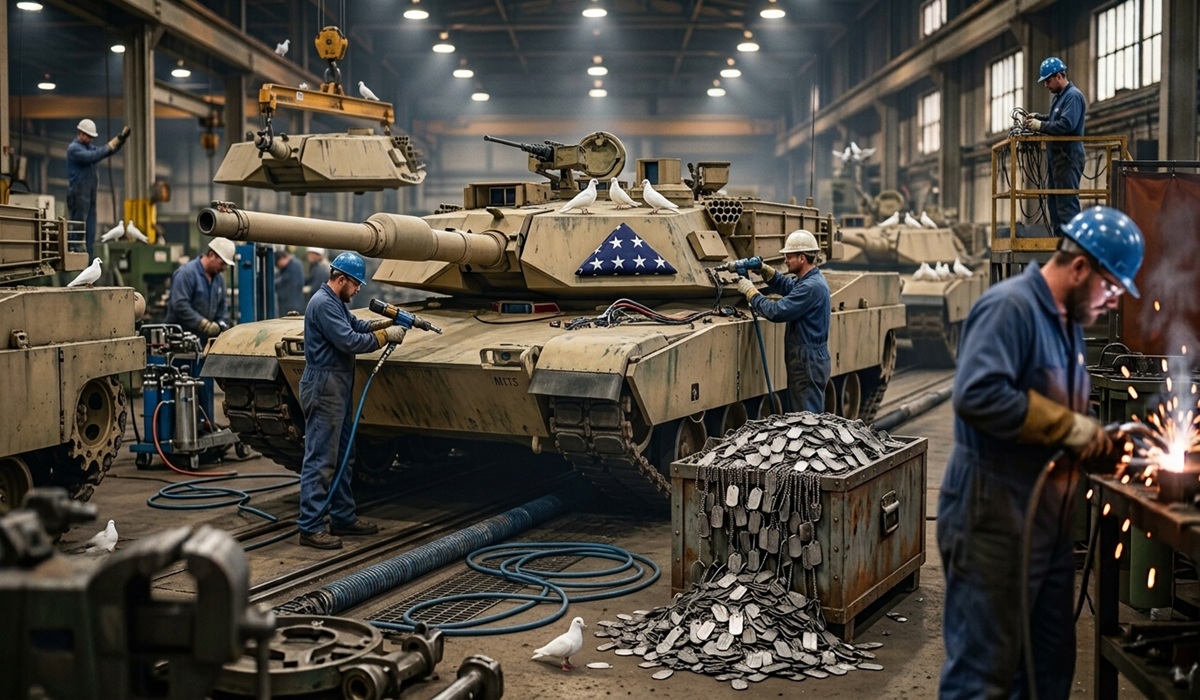
When high-finance algorithms and institutional investors assess global stability, peace represents a threat to multi-decade supply contracts, steady streams of congressional appropriations, and predictable corporate dividend yields. The modern American economic model has so thoroughly integrated weapons development, defense logistics, and geopolitical confrontation into its foundational machinery that a sudden, genuine, and lasting era of worldwide tranquility would trigger a deep demand deficit. It exposes the structural fragility of an economy that uses national defense appropriations as a stealth substitute for federally funded industrial planning.
World War II served as the ultimate proof of concept for this industrial framework, proving that total war could pull a country out of deep depression and transform it into an unmatched global economic titan. Ever since that era, the playbook has remained remarkably consistent: when the domestic economy requires stimulus or structural support, find a conflict, join it, or manufacture one through aggressive geopolitical posturing. This is the ultimate “wag the dog” strategy translated into fiscal architecture, where foreign crisis becomes a proven mechanism to generate domestic prosperity.
When President Dwight D. Eisenhower delivered his famous farewell address in 1961, he warned of the unwarranted influence acquired by the military-industrial complex, a permanent arms industry born out of total mobilization and institutionalized by the Cold War. Before the middle of the twentieth century, the United States maintained a relatively small peacetime standing army, scaling up rapidly during wartime and demobilizing immediately afterward. The aftermath of World War II shattered that historical rhythm, replacing it with a permanent wartime footing where military readiness became a perpetual corporate enterprise.
This enterprise evolved from a traditional manufacturing sector into a sprawling global architecture designed for active power projection. Today, the United States operates over 750 military bases across more than 80 countries, maintaining an unprecedented physical footprint that functions as a permanent garrison network. In the eyes of much of the world, these installations mark the footprint of an occupying force that actively seeks out strategic confrontation rather than peaceful co-existence. By surrounding rivals and controlling crucial maritime chokepoints, this network ensures that potential sparks for military confrontation are always within reach, justifying the continuous deployment of troops and equipment under the guise of global readiness.
The fiscal backbone of this global presence is a staggering national defense allocation approaching a trillion dollars—a figure larger than the individual gross domestic products of most sovereign nations. This immense pool of public capital feeds a self-perpetuating loop between Capitol Hill and defense contractors. Procurement capital flows to major defense firms, generating massive revenues and corporate profits. Those same contractors then reinvest a portion of those earnings back into political campaigns, lobbying networks, and political action committees to ensure that lawmakers continue expanding the defense budget. It is a closed, highly efficient feedback loop where war funding sustains political power, and political power guarantees future war funding.
Within this framework, actively running conflicts serve specific operational and financial functions. The war between Ukraine and Russia provides a clear case study of how proxy conflicts benefit the defense complex. For Washington, the conflict served as an ideal mechanism to clear out older stockpiles of legacy weaponry under the banner of military aid, creating an immediate requirement for the Pentagon to award lucrative new manufacturing contracts to replenish domestic arsenals. Beyond logistics, modern battlefields serve as live-testing grounds for defense contractors. Experimental software, autonomous drones, electronic warfare systems, and precision-guided munitions require real-world combat environments to validate their operational efficacy before full-scale commercialization. Manufacturing or joining active wars provides the defense apparatus with live testing resources that no peacetime simulation can replicate.
Furthermore, the geopolitical maneuvers surrounding Ukraine—specifically the decades-long expansion and encircling strategy of NATO—demonstrate how strategic tensions are cultivated. Despite multiple diplomatic turning points and peace frameworks presented prior to and during the initial stages of the conflict, the overarching posture leaned toward prolonged attrition rather than a rapid, negotiated settlement. Prolonging the confrontation achieved dual objectives: it weakened a major geopolitical adversary while forcing European allies to increase their own military spending, locking them into long-term dependence on American defense technology and supply chains.
A similar strategic logic governs involvement in the Middle East, particularly regarding the ongoing devastation in Gaza and escalating confrontations with Iran. Rather than using decisive political leverage to force a permanent regional peace, policy choices frequently maintain a state of controlled friction. This ongoing turmoil justifies continuous multi-billion-dollar security assistance packages, validates complex missile defense architecture, and secures strategic trade routes. Even in remote regions like Greenland, where melting ice opens strategic sea lanes and mineral reserves, the immediate instinct has been to expand military facilities and stake security claims, transforming potential peaceful border zones into future friction points.
The overarching reality is that the modern American system relies on external friction to sustain its financial and geopolitical structure. Geopolitical conflict is the fuel that powers the dollar’s role as the primary global reserve currency, validates vast capital outlays, and provides political justification for high-risk technology investments. The notion that the United States actively seeks or could quietly endure an era of permanent world peace remains a fundamental fallacy. While domestic tranquility at home may be the stated public ideal, the structural machinery of the state ensures that outside its borders, perpetual conflict remains an indispensable economic requirement.
About The Author