EH! Gander Social and Northsocial: The Rise of Canadian Digital Sovereignty
- Nick Kossovan
- Technology
- Tiger's Eye Advisory Group - Trending News
- May 5, 2026
The digital utopia we were promised turned out to be a bait-and-switch. “Global connectivity” was supposed to deliver, at least that was the implication, a world without borders where ideas could flow freely. It sounded lovely—a virtual potluck where everyone brings their best ideas, and nobody leaves hungry for the truth. Instead, we found ourselves in a chokehold of corporate voyeurism, manipulative algorithms and our personal data being traded like scrap metal in Silicon Valley boardrooms.
Since the advent of the Internet and social media platforms, Canadians have been digital tenants, living in someone else’s house, subject to their rules and their intrusive “smart” doorbells that record every move, used to train algorithms to keep you tethered to their platform and serve you more ads. However, the tide is turning. Canadians are beginning to push away from global Big Tech’s “all-you-can-eat buffet,” where we’ve overindulged and become bloated on American marketing propaganda and political ideologies. Canadians are moving toward something more indigenous: digital sovereignty, a simple yet revolutionary perspective that a nation and its citizens should control their own data, infrastructure, and digital destiny.
It became clear that digital sovereignty was necessary on August 1, 2023, when Meta officially began permanently blocking Canadian news content across Facebook and Instagram. This move, a retaliation against the federal government’s Online News Act (Bill C-18), effectively removed authoritative Canadian journalism from the social feeds of millions of Canadians. Overnight, Canadian media outlets saw their digital presence collapse. Independent and small news organizations were hardest hit, losing upwards of 43% of their public engagement overnight. By prioritizing corporate spite over the public’s right to know, Meta proved that Canadian journalism relying on foreign “Big Tech” for its survival is a colonial trap, making the case for homegrown, sovereign platforms, not just a preference but a democratic imperative.
Digital sovereignty is a strategic form of protection, best explained by two metaphors. First, imagine a nation’s citizens’ data as its water supply. For decades, we’ve allowed foreign corporations to own the pipes, reservoirs, and filtration systems. If those corporations decide to shut off the valves or contaminate the flow with disinformation, the nation parched for truth has no recourse. Second, think of digital sovereignty as a national shoreline. A country that doesn’t control its digital borders is like a coastal nation with no coast guard; anyone can land, extract resources, and leave without ever following the local rule of law.
The “Made in Canada” movement has shifted from manufacturing to digital spaces. Three platforms, all launched in 2025 and notably based in British Columbia, are spearheading efforts to show Canadians what sovereign digital sovereignty looks like.
EH! (ehnow.ca): Based in Parksville, BC, and led by Jessica Glowacki, whose Reddit pedigree gave her a front-row seat to the Internet’s worst impulses. Since its launch, EH! has seen explosive growth. Jessica isn’t interested in hosting a global shouting match; instead, EH! is aggressively replicating Facebook’s community functions, focusing on the hyper-local: neighbourhood groups, local events, and “buy Canadian” tools. Most importantly, it treats data as a sovereign asset by hosting EH! domestically.
Gander Social (gandersocial.ca): Gander, based in Parksville, BC, takes the “sovereignty” label literally. It is decentralized by design—a structural rebuke to foreign entities seeking a single “off switch” to flip. Co-designed with relentless user input, Gander prioritizes privacy and moderation that strictly align with Canadian legal standards. It’s built for the user who demands the utility of social media without the skin-crawling sensation of being watched.
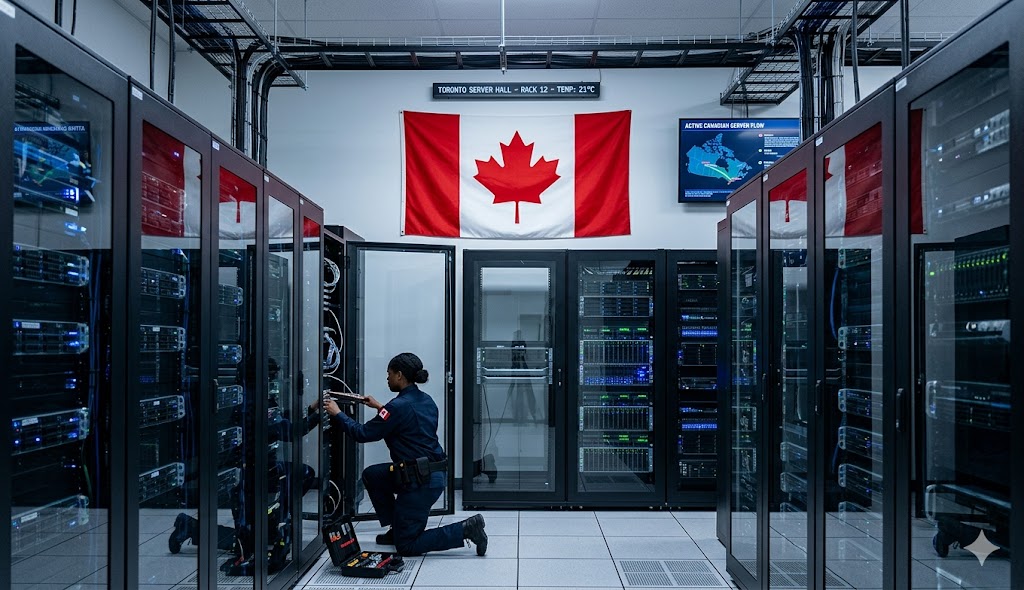
Northsocial (Northsocial.ca): Founded in Chilliwack, BC, by Zynim Media Inc., this platform bypasses manipulative, anger-driven algorithms in favour of a simple chronological feed designed for adults (16+) who are exhausted by the digital equivalent of a barroom brawl. Northsocial stores all data on Canadian servers, ensuring that the Canadian Charter of Rights and Freedoms—not the [whatever state] penal code—governs your digital interactions.
The delay in homegrown platforms wasn’t a talent deficit but a war against the crushing inertia of Big Tech. Canadian digital sovereignty requires abolishing the practice of renting server space from the likes of Amazon Web Services (AWS) and Google Cloud to avoid being digital sharecroppers. There’s also the “social network effect” that must be severed by convincing Canadian social media users to move to a new digital neighbourhood, albeit a Canadian one, even though all their “digital friends” live in the old one.
Slowly but surely, Canadians are moving to a fragmented yet healthier digital landscape. Though mega-platforms aren’t going anywhere, their monopoly over your most valuable asset, your digital presence, is beginning to erode. Ultimately, digital sovereignty comes down to Canadians asserting ownership over where their data resides and renouncing the idea of allowing foreign entities to harvest their identity for their own self-interest.
Canadians are pivoting toward a “small-batch” Internet—niche, sovereign, and unapologetically local. “Canada-made” goes beyond a kitschy sticker on maple syrup; it also includes the data on your screen. The founding of EH! Gander and Northsocial shouldn’t be seen as a trend; they’re a declaration of independence from being digital squatters in our own country.
About The Author