
Asian Markets Tumble as Anthropic’s Record $81.3 Billion Nasdaq Debut Fails to Calm AI Bubble Fears
- Xuemei Pal
- Breaking News
- November 20, 2026
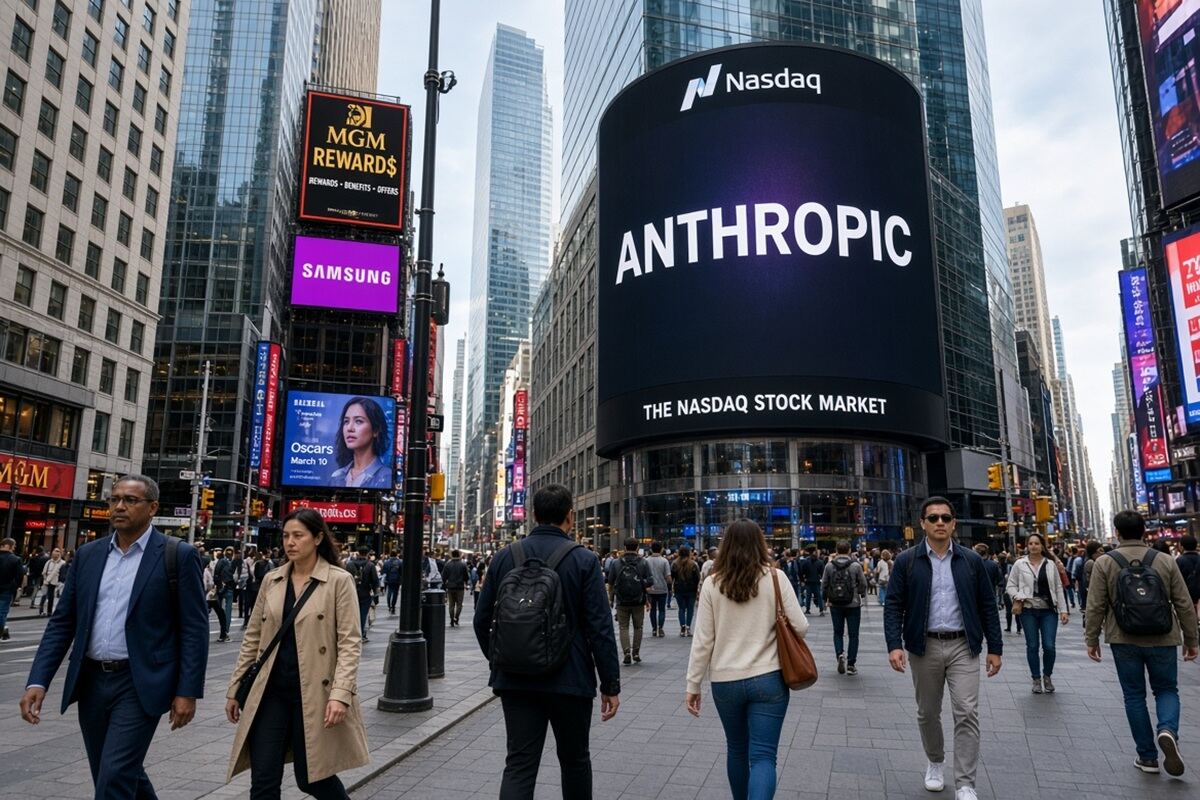
NEW YORK (AP) — Global equity markets tumbled across Asia on Friday, hours after artificial intelligence developer Anthropic completed the largest initial public offering in financial history on the Nasdaq, as investors questioned whether trillions of dollars in projected industry spending can generate sustainable corporate profits.
Major stock indexes in Japan, South Korea, Taiwan, and Hong Kong opened sharply lower on Friday morning, led by steep declines among semiconductor manufacturers, cloud infrastructure providers, and hardware suppliers. The sell-off followed a volatile trading session in New York on Thursday, where the historic debut of the San Francisco-based creator of the Claude artificial intelligence assistant failed to spark a broader rally across technology stocks.
Anthropic priced its initial public offering at $83 per share, raising an unprecedented $81.3 billion in proceeds and surpassing Elon Musk’s SpaceX to claim the record for the biggest market debut of all time. Co-founders Dario Amodei and Daniela Amodei joined company executives at the Nasdaq MarketSite in Times Square on Thursday morning to ring the opening bell before shares began trading midday under the ticker symbol ANT. Outside the exchange, police arrested three demonstrators protesting the rapid commercial deployment of advanced artificial intelligence systems.
Despite strong institutional demand for Anthropic’s shares during the offering process, the milestone listing immediately triggered profit-taking across the broader artificial intelligence ecosystem on Wall Street. Portfolio managers and institutional analysts pointed to mounting anxiety over the sheer scale of capital expenditure required to train and operate frontier AI models, alongside persistent macroeconomic headwinds including elevated inflation and rising borrowing costs.
According to recent industry projections from technology research firm Gartner, global spending related to artificial intelligence is forecast to reach $2.7 trillion in 2026 and climb to $3.6 trillion in 2027. While those figures underscore the transformative ambition of major technology corporations, market strategists warn that end-user software revenues are not yet expanding fast enough to justify the massive debt loads and data center investments accumulated across the sector.
Those structural concerns were vividly illustrated in Thursday’s trading of major AI infrastructure firms. Shares of specialized cloud computing provider CoreWeave fell sharply following Anthropic’s debut, even after the company reported third-quarter revenue of $3.7 billion, representing a 168 percent year-over-year surge that handily beat Wall Street consensus estimates. Investors looked past the top-line growth and raised full-year guidance to focus instead on CoreWeave’s balance sheet, which carried more than $40 billion in debt at the end of the third quarter to finance rapid data center expansion.
With inflation proving stubborn across major Western economies and central banks signaling that interest rates are likely to remain elevated, servicing multibillion-dollar debt obligations has become a primary vulnerability for capital-intensive technology companies. Even CoreWeave’s multi-year agreement signed earlier this year to supply computing capacity to Anthropic was insufficient to shield the stock from Thursday’s wave of risk aversion.
The ripple effects were felt immediately across Asian financial hubs on Friday, where equity markets are heavily weighted toward the physical supply chain powering the artificial intelligence boom. Chipmakers in Taiwan and South Korea, which fabricate the high-bandwidth memory and advanced processors essential for data centers, bore the brunt of early selling pressure as traders reassessed order growth for 2027. Tokyo’s benchmark index also retreated as institutional investors rotated capital out of high-multiple technology equities and into defensive sectors such as utilities and consumer staples.
Adding to the cautious mood on global trading floors were geopolitical tensions impacting energy and shipping costs. Maritime industry warnings issued this week highlighted that the ongoing United States naval blockade of Iranian ports is driving up war-risk insurance premiums for vessels transiting the Persian Gulf, threatening to keep global freight and energy costs elevated. Higher energy prices directly affect the operating economics of power-hungry artificial intelligence data centers, further squeezing margins for cloud operators.
At the same time, technology investors are weighing regulatory and geopolitical uncertainties surrounding semiconductor exports. Disclosures indicating that Washington signed off on sales of nearly 900,000 advanced AI chips to Chinese buyers over the past six months have sparked debate in Congress and on Wall Street over whether future export restrictions could abruptly disrupt revenue streams for American chip designers.
For Anthropic, entering the public markets at a historic valuation brings intense quarterly scrutiny over its path to sustained profitability and its corporate governance structure. Founded with an explicit focus on artificial intelligence safety and interpretability research, the company now faces the dual challenge of competing aggressively against rival frontier labs while satisfying public shareholders demanding disciplined capital allocation.
Market veterans noted that record-breaking initial public offerings have historically marked inflection points in major technology cycles, often prompting investors to shift from rewarding pure growth narratives to demanding tangible free cash flow. While few analysts doubt the long-term economic impact of artificial intelligence across healthcare, finance, and enterprise software, Friday’s downturn across Asia suggests that global markets are entering a more skeptical phase in which even the largest stock debut in history cannot silence doubts about an overheating market.
About The Author