US Strikes Qeshm Island as Maritime Attacks and Riyadh Missile Barrages Escalate Persian Gulf Crisis
- Hami Aziz
- Middle East
- Trending News
- November 27, 2026
DUBAI, United Arab Emirates (AP) — The conflict gripping the Persian Gulf and the Arabian Peninsula entered a volatile new phase this month as American airstrikes on Iranian coastal defenses collided with deadly attacks on commercial shipping off Oman and repeated ballistic missile and drone barrages targeting Saudi Arabia’s capital and energy infrastructure.
From the narrow shipping lanes of the Strait of Hormuz to the glass skyscrapers of Riyadh’s financial district, a widening arc of military confrontation is testing air defense networks, disrupting global energy transit, and putting civilian seafarers in the crossfire. Military officials, diplomatic mediators, and maritime security analysts warn that the cycle of retaliatory strikes threatens to erase fragile diplomatic openings while pushing the Middle East deeper into a protracted war of attrition.
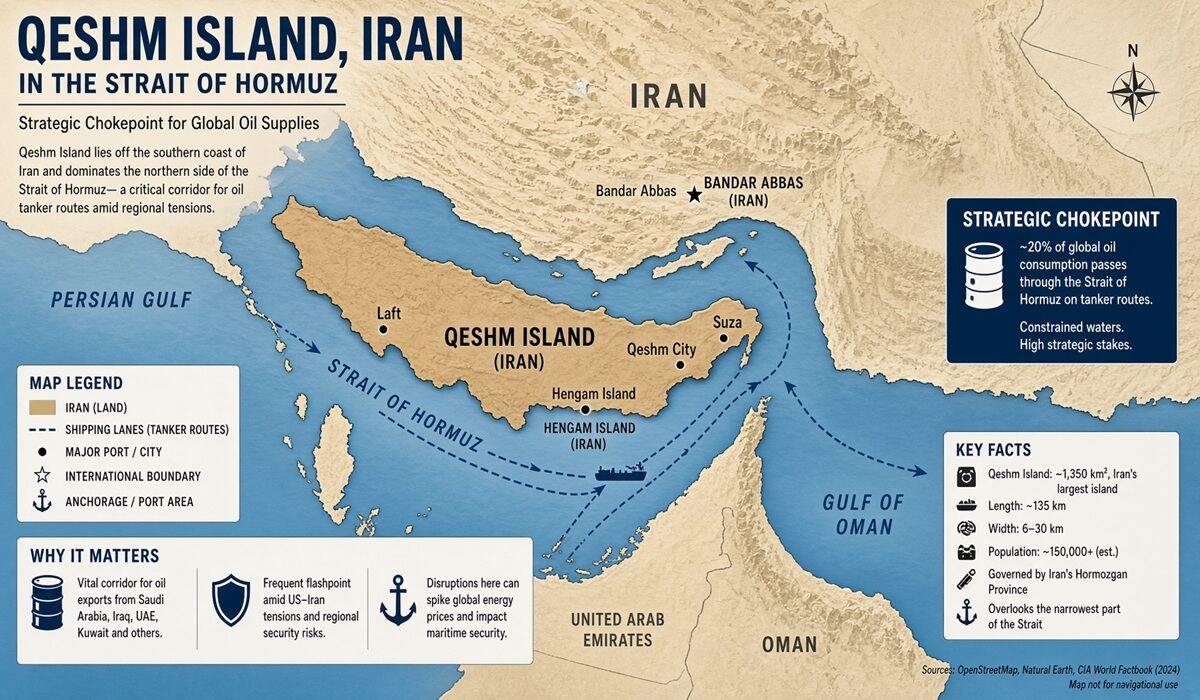
The latest military exchanges center on Qeshm Island, a strategic Iranian landmass sitting directly at the mouth of the Strait of Hormuz near the mainland port of Bandar Abbas. United States military officials confirmed that American forces conducted precision strikes against Islamic Revolutionary Guard Corps missile installations on the island, describing the operations as defensive measures taken after Iranian forces fired surface to air missiles at American aircraft operating in the region. President Donald Trump characterized the operations as minor strikes executed to neutralize anti aircraft equipment, even as he maintained that Washington had already secured strategic dominance in the conflict and had no immediate need to finalize a diplomatic agreement with Tehran.
Iranian authorities offered a starkly different account of the engagements on Qeshm Island. State news agencies including Tasnim and IRNA reported missile impacts near the Suza area of the island while insisting the strikes caused no casualties. Within hours of the bombardment, Islamic Revolutionary Guard Corps commanders claimed their air defenses had downed an American drone over Qeshm and announced they were lifting self imposed range restrictions on Iranian ballistic missiles. Iranian army spokesman Brig. Gen. Mohammad Akraminia declared that the Strait of Hormuz would remain closed until Tehran’s seven stated conditions were satisfied, warning that American military assets across the globe were legitimate targets.
The standoff at the strait is the culmination of months of intensifying hostility that began in late February when the United States and Israel launched sweeping aerial and cyber operations against Iranian nuclear and military sites, killing Supreme Leader Ali Khamenei and senior commanders. Iran retaliated by launching hundreds of missiles and drones across the region and imposing intermittent blockades on the Strait of Hormuz, a vital maritime chokepoint that handled 138 commercial vessels per day before the Islamic Revolutionary Guard Corps formally reimposed a full closure on Oct. 26. Although American naval forces announced in mid November that they had cleared Iranian sea mines from the waterway’s primary international transit lanes, Tehran has continued to demand that merchant ships seek Iranian permission to use a northern corridor hugging its coastline while targeting vessels that venture through southern routes.
For civilian mariners navigating the waters between the Persian Gulf and the Gulf of Oman, the geopolitical struggle has turned lethal. According to the International Maritime Organization and independent security monitors, at least 130 commercial vessels have been caught in security incidents since the conflict erupted, resulting in the deaths of 25 seafarers. November alone saw 30 maritime incidents across the Arabian Gulf, the Strait of Hormuz, and the Gulf of Oman, with 10 occurring in a single seven day span.
Indian seafarers, who make up a substantial portion of the global merchant marine workforce, have borne a heavy share of the casualties off the Omani coast. On Nov. 2, an unidentified aerial object struck the Indian flagged cargo vessel MSV Al Jusufi as it transited near Oman while bound for Gujarat’s Porbandar port from the United Arab Emirates. Indian Union Shipping Minister Sarbananda Sonowal confirmed that crew member Gandhar Nahim Ajij succumbed to his injuries, while the Omani Coast Guard rescued the remaining 13 Indian nationals aboard. Two weeks later, on Nov. 16, a projectile struck the Panama flagged liquefied petroleum gas tanker MT Tara Gas near Oman’s Musandam Peninsula, igniting a fire aboard the vessel. Omani rescue teams evacuated 21 Indian crew members to the port of Khasab and hospitalized two others with injuries, while search teams scoured the waters for a 24th Indian sailor who went missing in the blast.
Iranian military officials subsequently reported that several oil tankers and a liquefied natural gas carrier caught fire after striking naval mines east of the Strait of Hormuz and off its southern approaches. New Delhi’s Ministry of External Affairs condemned the repeated strikes on merchant shipping, emphasizing that attacks on civilian vessels violate international law and threaten vital global supply chains.
At the same time, the conflict has spilled aggressively into Saudi Arabia as Yemen’s Iran backed Houthi movement escalates cross border attacks against the kingdom’s economic heartland. Houthi forces have consolidated their grip over the Bab el Mandeb Strait at the southern entrance to the Red Sea while launching sustained waves of ballistic missiles and armed drones deep into Saudi territory. On Nov. 8, debris from an intercepted Houthi attack struck a high rise tower housing the offices of state oil giant Saudi Aramco inside Riyadh’s King Abdullah Financial District. Days later, Houthi military spokesman Yahya Saree claimed responsibility for a three phase cruise and ballistic missile assault targeting Riyadh’s international airport and financial district, damaging the headquarters tower of the kingdom’s Public Investment Fund and wounding 11 people.
Saudi air defenses have been stretched by what military analysts describe as a persistent nightly campaign of launches designed to exhaust interceptor stockpiles. On Nov. 26, the Saudi led military coalition announced it had intercepted and destroyed two ballistic missiles aimed at Riyadh alongside two drones over the oil rich Eastern Province, even as another Houthi projectile fell on the southern Red Sea port of Jazan and a drone was downed near Jeddah. Houthi leaders said the strikes were direct retaliation for Saudi coalition airstrikes on the Yemeni port of Hodeidah, the primary lifeline for food and commercial imports into northern Yemen, as well as repeated coalition bombardments of missile depots and drone workshops in Sanaa. Saudi officials have privately warned Western allies that their renewed military campaign in Yemen could extend for at least another six months as Riyadh seeks to help forces loyal to Yemen’s internationally recognized government reclaim territory before entering any ceasefire talks.
The spillover has reached neighboring Gulf states as well. Iranian forces launched one way attack drones toward an American radar installation in Bahrain in retaliation for a United States strike on an Iranian communications tower, though Central Command reported all incoming drones were intercepted. In Kuwait, falling shrapnel from intercepted Iranian drones targeting military installations wounded four people, including two Italian technicians, a Kuwaiti citizen, and a Pakistani national, prompting sharp diplomatic condemnation from European officials.
Despite the relentless tempo of military strikes, regional mediators continue to search for an off ramp. Qatari diplomats have circulated a 48 hour de escalation framework aimed at halting naval hostilities and reopening commercial transit through the Strait of Hormuz, though neither Washington nor Tehran has formally accepted the terms. Meanwhile, global energy markets remain on edge as consumer prices inside Iran surge nearly 89 percent year over year under the weight of American sanctions and naval blockades, leaving millions of civilians across the region and beyond paying the price for a war with no clear diplomatic horizon.
About The Author