When Superpowers Sit at One Table: What the Historic Shenzhen Summit Means for Global Cooperation
- TDS News
- Trending News
- November 21, 2026
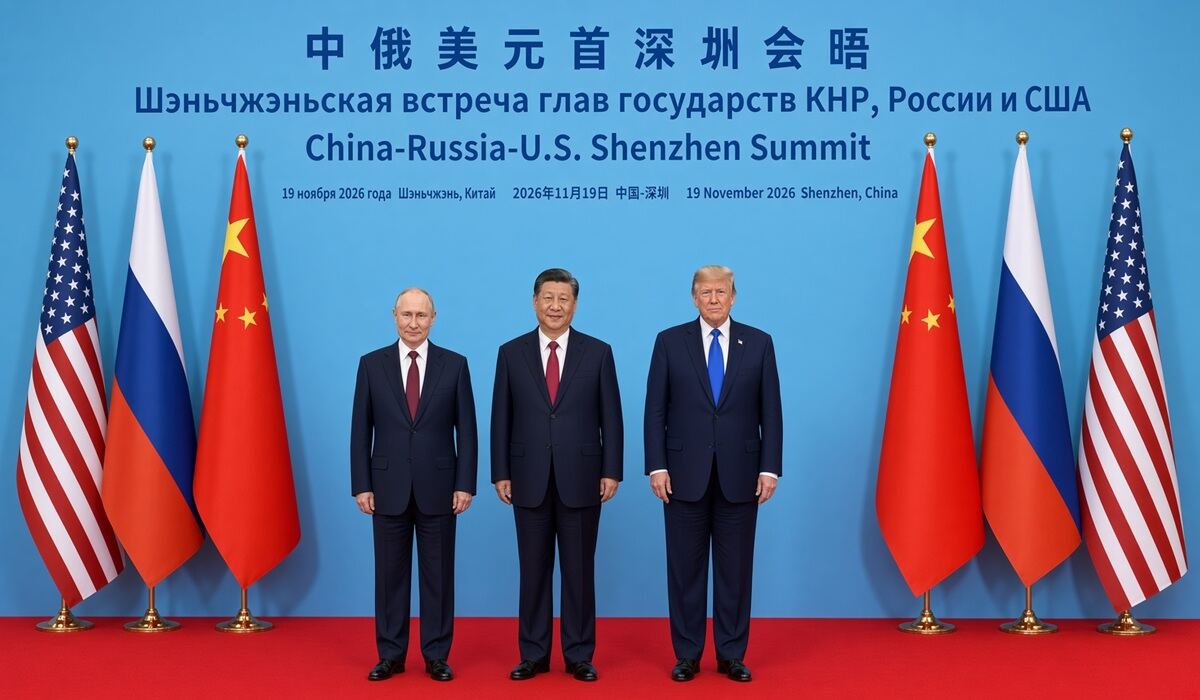
On November 19, 2026, in the southern Chinese metropolis of Shenzhen, the leaders of China, the United States, and Russia sat down together for their first-ever face-to-face trilateral summit. In an era defined by trade friction, regional conflicts, and rapid technological disruption, the image of Chinese President Xi Jinping, U.S. President Donald J. Trump, and Russian President Vladimir Putin sharing a diplomatic table immediately captured the world’s attention. The meeting is historic before a single communiqué is parsed. Yet history is never made by optics alone, it is forged by what leaders choose to build once the cameras leave the room.
For years, international diplomacy has been characterized by competing blocs, hardened rhetoric, and parallel summits that rarely intersect. Against that backdrop, Shenzhen, a city that transformed within four decades from a modest coastal hub into an engine of global innovation and commerce, offered a striking stage for direct engagement. When the world’s three most consequential military and economic powers convene in person, the ripple effects touch every continent, every supply chain, and every household navigating an uncertain global economy.
At the heart of the Shenzhen gathering is a straightforward question that defines twenty-first-century statecraft: how can major powers with deeply divergent political systems and competing strategic interests find a workable path to coexist without sliding into catastrophic confrontation? During the afternoon session, President Xi framed that challenge directly, emphasizing that mutual respect remains the foundational prerequisite for stable relations among major nations. Respect, in diplomatic terms, does not require agreement on every policy or ideology. Rather, it requires recognizing that the alternative to dialogue is miscalculation, and in a nuclear-armed, economically interconnected world, miscalculation is a luxury humanity cannot afford.
Observers around the globe have been quick to compare the Shenzhen summit to twentieth-century turning points, invoking everything from Yalta to Reykjavik. Those comparisons miss a critical reality. Shenzhen is not about carving the world into spheres of influence behind closed doors. Today’s international landscape is far too complex, multipolar, and interdependent for any three capitals to dictate terms to the rest of the planet. Middle powers, emerging economies, and regional coalitions across Asia, Europe, Africa, and the Americas all hold stakes in how Washington, Beijing, and Moscow manage their differences.
Consider the immediate pressures weighing on global citizens this week alone. In Antalya, Türkiye, climate negotiators at COP31 are working into overtime, wrestling with deep divisions over energy transitions, emissions targets, and climate finance for developing nations. In Eastern Europe, ongoing hostilities continue to exact a devastating human toll, underscoring the urgent need for credible diplomatic off-ramps that protect civilians and uphold international stability. Meanwhile, across global financial markets and technology sectors, rapid advances in artificial intelligence and shifting semiconductor export policies are reshaping industries faster than regulatory frameworks can keep pace. None of these challenges can be resolved in isolation, and none can be solved if the world’s largest powers refuse to speak directly to one another.
What makes direct leadership engagement indispensable is its ability to cut through bureaucratic inertia. Diplomatic cables and ministerial working groups serve vital functions, yet they often become trapped in procedural caution. When heads of state meet face to face, ambiguity narrows. Priorities are stated plainly, red lines are clarified without intermediaries, and areas of potential cooperation, whether in crisis communication, trade stabilization, or emerging technology governance, can be tested in real time.
Critics of high-level summits often argue that grand meetings raise expectations only to deliver modest incremental steps. That skepticism deserves a fair hearing. A single afternoon in Shenzhen will not erase decades of geopolitical rivalry, resolve longstanding territorial disputes, or harmonize fundamentally different economic models. Expecting instant transformation from one summit sets an unrealistic standard that obscures genuine diplomatic progress.
In fact, the true value of the Shenzhen trilateral lies in re-establishing a habit of structured dialogue. History demonstrates that the most dangerous periods in international relations occur not when nations disagree, but when channels of communication go dark. Keeping the lines open between Washington, Beijing, and Moscow lowers the temperature across dozens of secondary flashpoints, giving smaller nations breathing room to pursue trade, development, and domestic renewal without being forced into zero-sum choices.
For countries like Canada and its partners across North America and Europe, a more predictable trilateral dynamic among the major powers carries tangible benefits. Export-driven economies rely on stable shipping lanes, transparent trade rules, and functioning international institutions. When major powers commit to managing competition responsibly, businesses can invest with greater confidence, innovators can collaborate across borders, and governments can focus resources on domestic priorities, from infrastructure and healthcare to clean energy and housing, rather than bracing for perpetual geopolitical shockwaves.
Beyond economics and security, the Shenzhen summit also speaks to a broader human aspiration. Across every continent, ordinary people share remarkably similar hopes: safe communities, economic opportunity, clean air and water, and a peaceful future for their children. When political discourse reduces international affairs to endless hostility, it loses sight of the humanity that binds nations together. Thoughtful diplomacy does not ignore real policy disagreements or accountability; instead, it insists that leaders elevate the long-term well-being of humanity above short-term political posturing.
The coming weeks will reveal whether the conversations begun in Shenzhen translate into concrete diplomatic mechanisms, working groups on risk reduction, renewed climate coordination, or steadier economic guardrails. Every major breakthrough in international relations starts with a decision to show up, listen carefully, and test whether common ground exists beneath competing narratives.
Shenzhen has opened a door that had been bolted shut for far too long. Whether the world walks through it toward a more stable and cooperative era depends on the discipline, patience, and statesmanship that follow, and on the willingness of citizens and leaders alike to demand diplomacy equal to the challenges of our time.
About The Author