
Anatomy of a Breakdown: Inside the Friday the 13th Tech Paralysis
- Kingston Bailey
- Trending News
- November 16, 2026
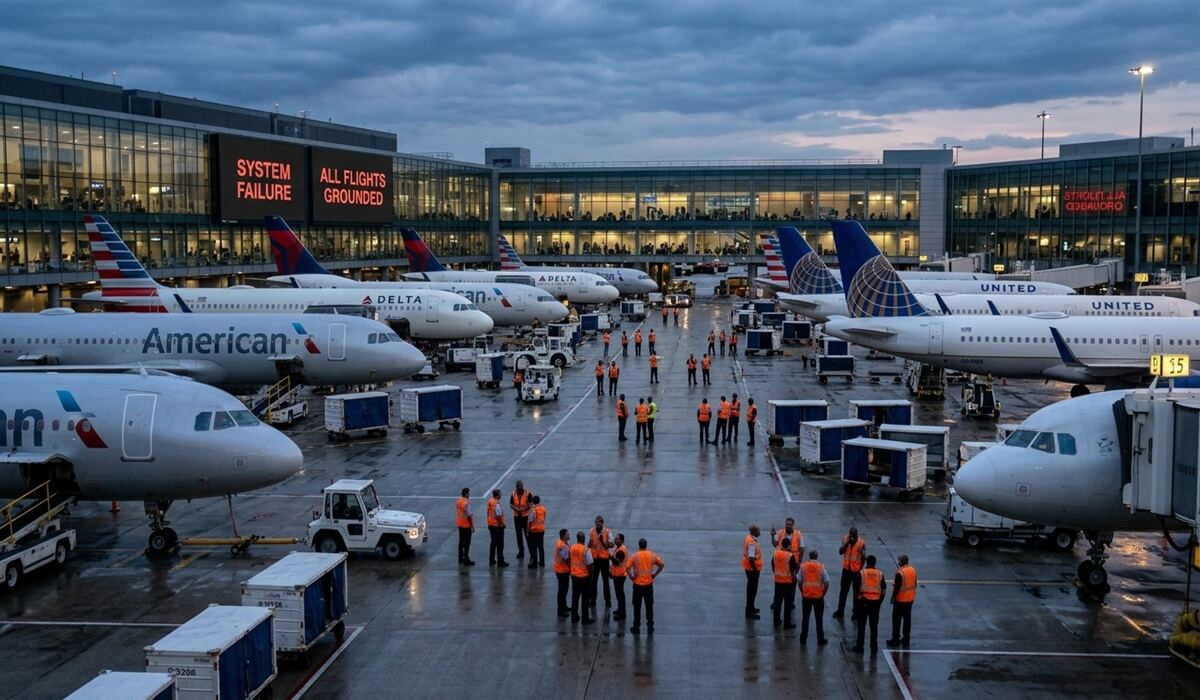
For four hours and twenty-one minutes on Friday, Nov. 13, 2026, the busiest airspace in the world went quiet.
When the Federal Aviation Administration issued a nationwide ground stop at 3:54 p.m. Eastern time, it marked only the third time in American history that every departing commercial flight across the country had been ordered to stay on the tarmac. The first was on Sept. 11, 2001, and the second followed a database failure in January 2023. Yet as more than 3,500 airborne planes scrambled to land under emergency protocols and terminals from New York to Chicago descended into gridlock, the aviation freeze was only the most visible piece of a sprawling digital collapse that gripped the country over a 36-hour stretch.
From hospital wards and courthouses to congressional offices, rail networks, and global corporate email servers, critical systems buckled in rapid succession. And while federal officials and technology executives rushed to the podiums to blame routine software patches, aging copper wires, and overloaded routers, the sheer scale and synchronization of the failures left cybersecurity specialists, lawmakers, and millions of stranded travelers questioning whether the official explanations told the whole story.
The digital tremors began more than 24 hours before the first planes were halted. Shortly after noon on Thursday, Nov. 12, Microsoft 365 services began failing across North America, Europe, and the Asia-Pacific region. Exchange Online, Outlook, Microsoft Teams, and the company’s Copilot AI assistant went dark or slowed to a crawl for tens of millions of commercial and government users. By Friday morning, as Friday the 13th dawned, the outage had stretched past the 20-hour mark, making it one of the longest and most disruptive cloud failures in Microsoft’s history.
The real-world fallout was immediate and severe. In the United States, the House of Representatives issued emergency alerts to staffers cut off from official communications. Sheriff’s offices, state agencies, and municipal courts lost access to internal email and scheduling networks, forcing judges to warn of delayed rulings. Hospitals and health networks across North America and the United Kingdom were forced to reschedule medical procedures and revert to paper charts as clinical messaging systems stalled. In Canada, major medical centers in Toronto, university campuses, and Via Rail passenger services reported widespread operational disruptions, while overseas, Japan’s Digital Agency could not receive external messages and Immigration New Zealand suspended visa processing.
Microsoft insisted the collapse was purely technical. Engineers pointed to a cascade failure triggered during a network capacity upgrade following a recent configuration change, explaining that a process handling secure server connections had become overwhelmed after several servers dropped offline unexpectedly. The company stated explicitly that it had found no indication of malicious activity or artificial intelligence interference.
Then, on Friday afternoon, just as Microsoft reported that email queues were finally beginning to stabilize, the nation’s aviation infrastructure suffered an unprecedented shock.
Trouble first surfaced in the Midwest when Chicago O’Hare and Midway international airports halted departures over what officials initially termed a localized equipment outage. Within minutes, however, radio frequencies and radar data feeds across all 20 FAA Air Route Traffic Control Centers began exhibiting severe instability. Air traffic controllers reported that routers were flooding networks with inconsistent tracking data, threatening the system’s ability to safely separate aircraft in flight.
At 3:54 p.m. Eastern time, the FAA took the extraordinary step of freezing all domestic departures nationwide, leaving open-ended uncertainty as to when planes would fly again. At the request of Washington, Eurocontrol suspended transatlantic departures bound for the United States from 42 European member states. Inside American terminals, departure boards turned into walls of red. More than 10,000 flights were delayed on Friday alone, and thousands more were canceled outright through Saturday and Sunday as airlines struggled to reposition stranded crews and aircraft. College football teams scrambled onto charter buses to make Saturday kickoffs, and Amtrak booking servers buckled under a sudden surge of desperate travelers trying to buy train tickets.
When Transportation Secretary Sean Duffy and Homeland Security Secretary Markwayne Mullin stepped before reporters at the White House on Friday night to announce that the airspace had reopened at 8:15 p.m., their explanation did little to quiet public skepticism.
Duffy blamed the breakdown on antiquated 1980s telecommunications infrastructure, telling reporters that legacy switches and routers running on old copper lines had simply become overloaded with data. Yet during the same briefing, Duffy and Mullin offered shifting and contradictory details. Duffy initially said the routers went down before correcting himself to say they had remained online while pumping out corrupted, inconsistent data. He later pointed to a newly installed router tied to contractor L3Harris and a multi-year transition from copper wiring to fiber optics, claiming the device had begun firing off a thousand connection attempts every few seconds and flooding backup facilities across the network.
At the same time, Mullin declared that there was no cyberattack because security agencies had seen no digital footprints and no hacker groups had stepped forward to claim credit. Moments later, however, Mullin hedged, acknowledging that federal investigators were still examining the network and that nothing could be completely ruled out. Adding to the political scrutiny was the timing: Duffy and the White House had formally lobbied Congress for $30 billion to overhaul air traffic control hardware just one day before the system failed.
For independent cybersecurity analysts and veteran network engineers, the administration’s narrative raised immediate red flags. While officials framed the back-to-back crises as an unlucky coincidence of routine software updates and aging hardware, the mechanics of Friday’s failures mirrored the classic signatures of a coordinated cyber disruption.
The first hallmark is the nature of the traffic flood itself. A newly installed router suddenly generating a thousand connection requests every few seconds and cascading across isolated backup systems behaves remarkably like an internal distributed denial-of-service storm or a compromised firmware injection. Properly segmented air traffic control networks are specifically engineered so that a single malfunctioning switch cannot propagate instability across regional control centers nationwide. When backup redundancies fail simultaneously with primary lines, security specialists look for lateral movement or malicious logic designed to exploit trust relationships between old copper interfaces and new fiber hardware.
The second hallmark is data integrity corruption rather than a simple power or hardware blackout. As FAA Administrator Bryan Bedford admitted after the briefing, no facilities actually went dark. Instead, routers began feeding controllers false or inconsistent aircraft position data. In modern offensive cyber operations against critical infrastructure, adversaries increasingly favor subtle data manipulation over crude system destruction because corrupted telemetry forces human operators to shut down the network themselves out of fear of a catastrophic collision.
The third hallmark is timing and target selection. Striking global enterprise communication platforms on a Thursday afternoon, blinding government agencies, courts, and emergency responders, and then triggering a cascade failure in national airspace controls during the peak Friday afternoon travel rush maximizes economic disruption and institutional confusion. Furthermore, security researchers note that sophisticated nation-state actors rarely issue public boasts on social media after probing critical infrastructure, making Mullin’s reliance on a lack of hacker chatter a weak standard for ruling out an intrusion.
Even if federal investigators ultimately maintain that no outside adversary breached the firewalls, Friday the 13th exposed a sobering reality about American national security. Whether brought to its knees by foreign code or by its own brittle, interconnected architecture, the country’s most vital digital arteries proved vulnerable to a sudden, sweeping paralysis. For millions of Americans left sleeping on airport floors, waiting on delayed hospital care, or watching government offices grind to a halt, the official assurances that it was merely a routine update offered little comfort on a day the nation will not soon forget.
About The Author