Sealing the Fate of Farmers Before They Knew It: How Bill C-15 and High-Speed Rail Left Agriculture Blindsided
- TDS News
- Canada
- November 12, 2026
By: Donovan Martin Sr., Editor-in-Chief
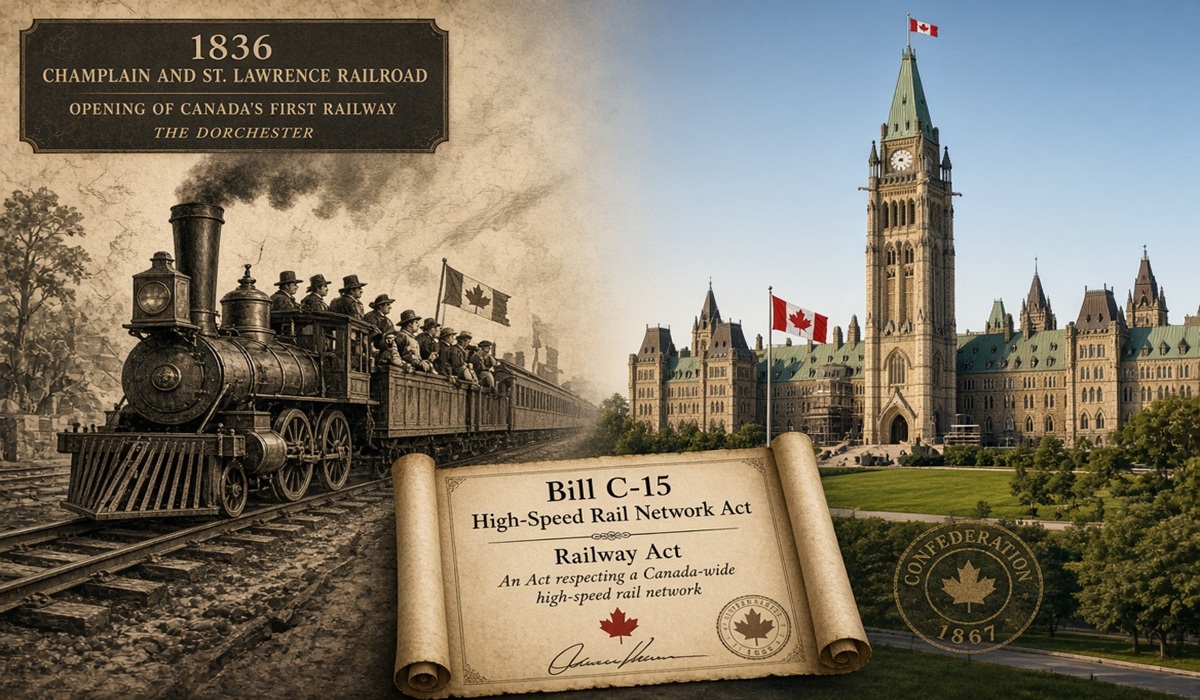
When Parliament passes an omnibus budget bill, the headline numbers on tax credits and program spending always capture the immediate media cycle, while the machinery buried deep in the final divisions quietly rewrites the rules of property, jurisdiction, and state power for decades to come. Bill C-15, formally titled the Budget 2025 Implementation Act, No. 1, was introduced in the House of Commons on Nov. 18, 2025, by Minister of Finance and National Revenue François-Philippe Champagne during the first session of the 45th Parliament. Sponsored through the House by Liberal MP Ryan Turnbull and guided through the Senate by Senator Sandra Pupatello, the legislation moved rapidly through parliamentary scrutiny before receiving royal assent on March 26, 2026. On its surface, the federal government framed Bill C-15 as an economic engine designed to implement the Nov. 4, 2025, federal budget, highlighting measures such as the expanded lifetime capital gains exemption, accelerated investment incentives, the repeal of the digital services tax, and long-term funding for a national school food program. Champagne stated upon royal assent that the legislation would help build one united economy, drive growth, and protect Canadian sovereignty for generations.
Yet anyone who watches how Ottawa actually governs understands that federal legislation rarely exists solely for the fiscal year in which it is tabled. Governments think in multi-decade horizons, laying legal groundwork years before the first shovel hits the soil so that when political or logistical friction inevitably arrives, the statutory authority is already locked in place. Tucked inside Part 5, Division 1 of Bill C-15 is the High-Speed Rail Network Act, a sweeping statutory framework engineered specifically to clear the path for the Alto high-speed rail corridor stretching roughly 1,000 kilometres between Toronto and Quebec City. Long before rural landowners, municipal councils, or agricultural federations across Ontario and Quebec grasped the exact route or the personal cost to their properties, Ottawa embedded extraordinary powers into law that fundamentally alter the balance between the federal Crown and private property owners.
The legal architecture inside the High-Speed Rail Network Act goes far beyond traditional expropriation rules under existing federal statutes. First, Parliament invoked Section 92(10)(c) of the Constitution Act, 1867, formally declaring all railways constructed for the high-speed rail network to be works for the general advantage of Canada. That constitutional trigger strips away provincial jurisdiction over any intra-provincial segments of the line, insulating the project from provincial regulatory bottlenecks and consolidating authority firmly in federal hands. Second, the act deems any railway line built by VIA HFR – VIA TGF Inc., operating as Alto, to have already received Section 98 approval under the Canada Transportation Act, bypassing an entire layer of traditional regulatory review and preventing potential conflicts between agency assessments and cabinet decisions on where the tracks will run.
Even more consequential are the land control and expropriation mechanisms granted to Alto and the Minister of Public Works and Government Services. Under normal federal expropriation law, the Crown must engage in a mandatory purchase attempt and allow affected property owners to demand a public hearing of necessity before their land is taken. Bill C-15 eliminates both safeguards for the high-speed rail corridor. Alto is no longer required to make an initial purchase offer before commencing expropriation proceedings, and property owners have lost their right to an oral public hearing. Instead, landowners are restricted to submitting written objections reviewed through an internal administrative process. Furthermore, the act empowers the federal government to register a notice of prohibition on work directly onto private land titles. For up to four years, a landowner hit with such a notice is legally frozen from developing, building on, or altering their own property, and any unauthorized improvements made after registration are excluded from appraisal calculations when the government eventually determines compensation. Alongside that freeze sits a statutory right of first refusal lasting up to eight years. Once Alto registers a right of first refusal on a property within the prospective corridor, any sale to a third party is legally invalid unless the owner first offers the land to the Crown corporation. Most notably, Bill C-15 authorizes the federal government to register these work prohibitions, acquire properties, and execute full expropriations prior to receiving final approval under the Impact Assessment Act. While physical construction cannot commence until environmental assessments clear, the state can legally strip ownership and lock down vast swaths of real estate long before the environmental viability of the route is settled.
This legislative preemptive strike exposes a broader structural truth about how major infrastructure initiatives are managed and sold to the Canadian public by federal authorities. When governments at the federal level push for massive, transformative projects, information flows strictly on a need-to-know basis until the statutory machinery is irreversible. By the time communities in eastern Ontario and rural Quebec realized the scope of the corridor in late 2026, prompting protest marches from East Hawkesbury to Ottawa and municipal resolutions in Prescott-Russell refusing access to county lands, the legal framework enabling compulsory acquisition had already been law for months. Central to this institutional choreography across public administration in general is the commissioning of external consulting studies, feasibility assessments, and white papers. When governments desire to pursue a controversial project, a standard playbook often involves hiring prestigious engineering and management consultancies to conduct public-facing commission studies. In theory, these exercises are presented as objective due diligence to determine whether a policy direction is sound. In practice, public administration experience shows that when governments commission major policy or infrastructure studies, the underlying terms of reference frequently establish a clear administrative expectation where broader strategic parameters are shaped well in advance. While specific corporate entities like Alto navigate their own independent statutory timelines and upcoming 2027 business case disclosures, the broader systemic pattern reflects how government-commissioned studies operate across the public sector to evaluate major public works.
The tension now confronting Canada is not whether we need transformative transit, because we undeniably do. As a G7 nation and a modern industrialized economy, Canada stands out as the only major developed country without a true high-speed rail network linking its densely populated economic heartland. Connecting Toronto, Ottawa, Montreal, and Quebec City with frequent, rapid passenger service is essential for reducing highway congestion, cutting aviation emissions, and integrating regional labour markets. At the same time, food security and domestic agricultural capacity are equally vital pillars of national sovereignty. The Quebec City to Windsor corridor contains some of the richest, most productive Class 1 farmland in the country, and agricultural organizations including the Ontario Federation of Agriculture, the National Farmers Union, and Quebec’s Union des producteurs agricoles have warned that carving a brand-new, straight, flat alignment through prime agricultural regions risks permanently fragmenting family farms and destroying irreplaceable soil.
Moving forward requires an approach that refuses to pit modern mobility against agricultural survival. Rather than treating rural landowners as obstacles to be steamrolled by truncated expropriation timelines and four-year development freezes, federal planners and Alto must prioritize co-locating the new high-speed tracks alongside existing transportation and utility corridors wherever engineering permits, minimizing the severance of productive acreage. Where greenfield alignments are unavoidable, compensation frameworks must go beyond narrow market appraisals to account for generational farm disruption, soil restoration, and dedicated agricultural overpasses that keep divided fields connected. True nation-building demands both speed and stewardship. If Ottawa uses the sweeping powers of Bill C-15 as a blunt instrument rather than a carefully bounded backstop, it risks poisoning public trust in megaprojects for another generation. By pairing bold infrastructure ambition with genuine transparency, route optimization that respects prime farmland, and fair partnership with the communities feeding the nation, Canada can finally build the world-class rail network it deserves without sacrificing the land that sustains it.
About The Author