Hymns of Slaughter: The Violent Indoctrination Hidden in Our National Anthems
- TDS News
- Trending News
- October 4, 2026
By: Donovan Martin Sr, Editor-in-Chief
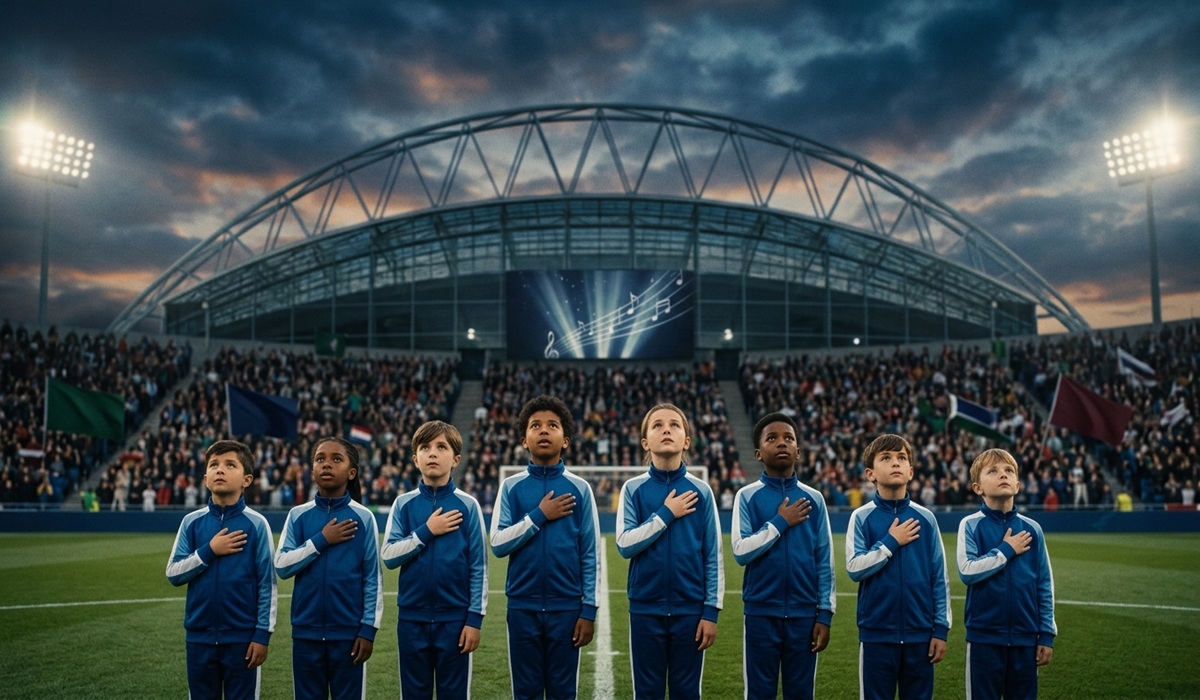
The air in a packed stadium is electrically charged, smelling of roasted peanuts, damp turf, and the collective breath of fifty thousand human beings waiting for kickoff. Players stand on the sidelines, hands over their hearts, young children in uniform clutching their hands as mascots. The stadium announcer steps to the microphone, asking the crowd to rise for the national anthem. What follows is a ritual so deeply ingrained in world culture that almost no one stops to analyze the words coming out of their mouths, or the minds of the children standing beside them.
In those solemn seconds, millions of young, impressionable minds absorb a melody designed to stir the soul. But if you listen closely to the text being beamed across global television broadcasts, the vocabulary is often startlingly gruesome.
Consider the Azerbaijan national anthem, a composition forged in the crucible of early twentieth-century warfare. Millions sing along to pledges of offering up their lives, proclaiming that they are ready to shed their very own blood for the soil, crowning a legacy where the homeland itself is explicitly framed as a bloody battlefield. It is a stirring, dramatic piece of music, but its central thesis is unmistakable: national identity is inextricably tied to violent sacrifice and death on the line of combat.
This is far from an isolated anomaly. The French national anthem, La Marseillaise, revered worldwide as a masterpiece of patriotic fervor, invites citizens into a horrific vision of warfare. “Do you hear, in the countryside, the roar of those ferocious soldiers? They’re coming right into your arms to cut the throats of your sons, your companions!” The chorus then demands that citizens march so that “an impure blood should water our fields.” When sung by a teenager at an international football match, the literal meaning is grotesque: a vivid, graphic call to arms demanding foreign blood fertilize agricultural soil.
Across the globe, other nations weave similar tales of martial death into their sacred state music. The Italian national anthem features lines where citizens gladly declare themselves ready to die because “Italy has called,” binding the country’s birth to a march toward the grave. The Mexican national anthem warns that a foreign enemy will find a soldier in every son, calling for the earth to tremble at the roar of cannon fire and painted scenes of blood soaking the national banners.
These songs were born out of existential terror, revolution, and brutal military campaigns where survival literally depended on convincing young men to march into gunfire. They served a functional purpose in their era. But when stripped of historical context and placed into the modern arena, a sports match, a school morning assembly, a diplomatic ceremony- their continued presence demands a serious question. Why are we conditioning generations of children to associate love of country with killing, bleeding, and dying?
To understand how jarring this reality is, one only needs to look at nations that endured the absolute worst atrocities of human history, slavery, brutal colonization, genocide, and systemic plunder, yet chose a radically different path for their national songs.
Take the national anthem of South Africa, Nkosi Sikelel’ iAfrika. A nation torn apart by the unimaginable brutality of Apartheid, built on centuries of colonial oppression and racial violence, did not construct its identity around revenge or bloodshed. Instead, the country created a hybrid anthem that begins as a prayer for blessing, peace, and unity. It asks for divine guidance over the land, lifting up the voices of its people, calling for conflict to end and for freedom to reign. It acknowledges the deep pain of the past without demanding fresh blood to wash it away.
Similarly, consider the anthems of nations across the Caribbean and Africa that emerged from the horrors of the transatlantic slave trade and foreign domination. Jamaica’s anthem, Jamaica, Land We Love, opens with a plea: “Eternal Father bless our land, guide us with Thy Mighty Hand.” It asks for wisdom, truth, and respect for all, urging its citizens to work together to build a noble nation. It speaks of rising, of uplifting the human spirit, and of stewarding the land for future generations. There are no calls to slaughter oppressors or soak the soil in the blood of enemies, despite Jamaica having every historical reason to harbor deep, ancestral rage.
This stark contrast exposes a profound paradox. Nations that suffered the most unspeakable cruelties often chose anthems centered on hope, reconciliation, and rising above tragedy. Meanwhile, many powers that shaped global history remain tethered to eighteen-hundreds battle cries that glorify gore and combat.
The psychological impact of this dynamic cannot be brushed aside as mere tradition. When a child stands in a stadium and repeatedly sings about severed throats, pouring out blood, and perishing enemies, it performs a subtle, powerful work of indoctrination. It teaches the young mind that patriotism is inherently defensive, adversarial, and lethal. It suggests that the highest form of love one can offer a homeland is not innovation, kindness, scientific discovery, or social care, but the willingness to kill and be killed in its name.
This leads us to the ultimate question that traditionalists dread: Should national anthems be changed?
History tells us that national anthems are not divine decrees set in stone; they are political and cultural artifacts. They have been changed, rewritten, and replaced repeatedly throughout modern history. Russia has altered its anthem multiple times across different regimes. South Africa created a new one to mark the end of an era of hate. Canada modified the lyrics of O Canada to ensure gender neutrality, demonstrating that state symbols can evolve alongside societal values. Germany stripped away its controversial opening verses after World War II, keeping only the third stanza focused on unity, justice, and freedom.
If an anthem can be changed to reflect shifting political borders or modern standards of equality, it can certainly be evolved to reflect a nation’s mature aspirations rather than its ancient traumas.
When we stand at a sporting event, a global celebration of human achievement, athleticism, and peaceful competition, the presence of anthems that dwell on slaughter feels profoundly out of place. Moments of international dignity should reflect what a society aims to become, not the horrific violence it once survived.
A nation’s identity is a living, breathing concept. Inheriting a song written during a bloody revolution two hundred years ago does not obligate us to teach it to six-year-olds as an unquestionable truth for the rest of time. If the purpose of a national song is to unite a people and inspire the young, then that song should speak to the best of what humanity can achieve. It should speak of building, healing, rising, and holding out a hand to the rest of the world. Continuing to chant battle cries in times of peace is not honoring history; it is letting the ghosts of past wars dictate the moral imagination of our children. It is time we ask ourselves what we truly want ingrained in their hearts, and whether we are brave enough to change the tune.
About The Author