Montreal Can Fast Track an Anti Insult Bylaw, So Why Are Black Montrealers Still Waiting for Police Accountability?
- Emma Ansah
- Canada
- September 28, 2026
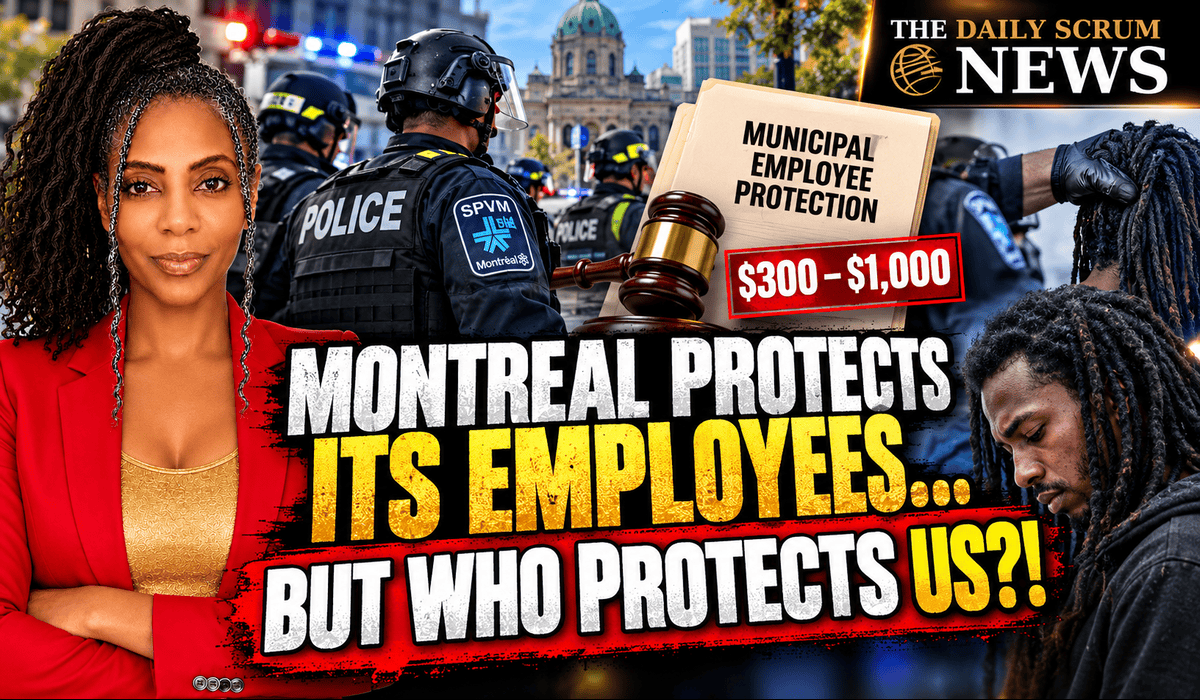
Montreal has found a way to move quickly when municipal employees, including police officers, say they are being verbally abused. On September 22, 2026, Montreal city council voted 35 to 25 to adopt a controversial new bylaw prohibiting insults, harassment, threats, intimidation, abuse and certain offensive or aggressive behaviour directed at municipal employees while they are performing their duties. Depending on the offence, people can face hundreds of dollars in fines, with repeat offences potentially reaching $2,000. Yet as Montreal expands protections for the people who work for the city, another question deserves just as much attention: Why does government appear capable of moving so quickly when police and municipal workers need protection, while Black Montrealers have spent decades demanding meaningful protection from racial profiling, discrimination and alleged police misconduct?
The timing makes that question even harder to ignore. Montreal announced in August that approximately 3,500 SPVM officers would eventually receive body worn cameras and roughly 600 patrol vehicles would be equipped with vehicle cameras and automated licence plate readers. The city committed $40 million toward the initiative, which Mayor Soraya Martinez Ferrada presented as a measure that could improve safety and accountability for both citizens and police. However, reports indicate Montrealers could wait as long as a year before the first body cameras appear on officers, while the full deployment could take three to four years. Montreal has debated police body cameras for years, including an earlier SPVM pilot project, yet the city moved from renewed discussion of an anti insult measure to adoption of the bylaw on a dramatically shorter timeline.
That contrast raises a legitimate question rather than establishing a conclusion: Is this new bylaw partly distracting public attention from the much bigger accountability conversation surrounding those 3,500 body cameras and 600 vehicle cameras, and why can the city move rapidly on regulating the behaviour of citizens toward police while equipment designed to document encounters between police and the public will take years to fully implement? There is currently no evidence establishing that Montreal adopted the bylaw as a deliberate distraction, so presenting that motive as fact would go beyond the evidence. The timing, however, is absolutely fair territory for public scrutiny, particularly because the city announced the camera initiative and proposed anti insult protections together in August.
The body camera announcement itself did not emerge in a vacuum. It followed disturbing allegations involving a 16 member patrol unit attached to SPVM Station 39 in Montréal Nord. Police dismantled the unit in June after allegations involving racism, misconduct and potentially criminal behaviour. According to the SPVM, information concerning members of the unit was sufficiently concerning to trigger an investigation, and the force suspended officers and reassigned members of the team away from public facing duties. By August, a fourth officer had been suspended in connection with the investigation.
Among the most disturbing allegations to emerge was the claim that members of the unit cut hair from racialized people they encountered and kept it as trophies. These remain allegations and should be reported as such, but they are not merely social media rumours. The allegations have been reported by major Canadian news organizations, and on September 28 the SPVM confirmed that evidence gathered during the initial investigation had been forwarded to Quebec’s Director of Criminal and Penal Prosecutions, which will determine the appropriate next steps. Other related investigations remain underway.
For Black Montrealers, the imagery surrounding those allegations is especially disturbing. Hair in Black communities, including locs, carries cultural, historical and personal significance. An allegation that officers entrusted with state authority may have cut hair from racialized citizens and retained it as a trophy therefore deserves more than outrage. It raises questions about dignity, racial dehumanization, police culture, oversight and what protections citizens have when the alleged misconduct comes from the very institution empowered to enforce the law.
This is precisely why the speed of Montreal’s new bylaw deserves examination. City officials have pointed to increasing hostility toward municipal workers, reporting a 263 percent increase in incidents categorized as incivility, aggression, threats and violence between 2019 and 2025. A widely circulated video involving a motorist verbally abusing a female Montreal police officer also became part of the public discussion leading to the new measure. Protecting workers from genuine threats, intimidation and harassment is a legitimate public policy objective, and municipal employees should not be expected to tolerate violence simply because their jobs involve dealing with the public.
But that still leaves an uncomfortable question: Why was the political response to verbal abuse directed toward municipal employees so swift when Black residents have spent generations raising concerns about racial profiling and discriminatory policing? If offensive language toward a police officer demands rapid legislative action, what level of urgency should allegations that police officers cut the hair of racialized citizens and allegedly kept it as trophies command? If dignity is the principle behind the new law, should the dignity of the citizen standing across from the officer not carry equal weight?
There is also a significant civil liberties issue embedded in the bylaw. Unlike a threat, which can be investigated based on words, context and evidence, an insult can be highly subjective. The adopted measure does not clearly define everything that constitutes an insult, and that ambiguity became a major point of contention during the city council debate. Opposition councillor Carla Beauvais argued that the distinction between legitimate anger and prohibited offence was insufficiently clear and criticized the absence of public consultation before the vote.
The Canadian Civil Liberties Association, Ligue des droits et libertés, Hoodstock and Clinique juridique de Saint Michel raised an even more consequential concern before the measure was adopted. They warned that empowering SPVM officers to ticket people for comments deemed offensive but not threatening could deepen the existing power imbalance between citizens and police. Their statement specifically identified Black, Indigenous and Arab communities as populations already subjected to disproportionate police surveillance and racial profiling and warned that subjective enforcement could produce arbitrary or discriminatory outcomes.
That concern becomes particularly significant during a police encounter. A citizen stopped by an officer may be angry, frightened or convinced that they are being treated unfairly. Under the new framework, where exactly does forceful criticism end and an actionable insult begin? More importantly, when the allegedly offended person is also the officer empowered to issue the ticket, who protects citizens from selective enforcement? These are not arguments in favour of threatening or harassing police officers. They are questions about how government power should operate when freedom of expression and police authority collide.
There is another question Montreal should answer clearly: Why could this bylaw move from political proposal to adoption within weeks while the city says the first body cameras could take approximately a year to appear and complete deployment could take three or four years? Technical procurement, privacy rules, data storage, training and operational policies undoubtedly make deploying thousands of cameras more complicated than passing a municipal bylaw. That practical difference matters. But after years of debate over body cameras, Montrealers are entitled to ask why mechanisms that increase accountability appear to require years of preparation while mechanisms that increase the state’s authority over citizens can move considerably faster.
Body cameras themselves are not a magic solution to racial profiling or police misconduct, and cameras are only as effective as the policies governing when they must be activated, how footage is stored, who can access it and what consequences follow when officers fail to comply. SPVM Chief Fady Dagher has said officers will not simply be able to choose when they record encounters, an important commitment that will need to be reflected in enforceable policy. The real test will come when those cameras are operating during the interactions that have historically generated complaints from Black and other racialized Montrealers.
Montreal therefore finds itself confronting two very different questions about dignity at the same time. One asks how the city should protect police officers and municipal employees from abuse by members of the public. The other asks how the city will protect members of the public from abuse, discrimination or misconduct by people exercising state authority. Those goals do not have to compete, but neither should one be pursued with urgency while the other remains trapped in years of studies, promises and delayed implementation.
Perhaps the most important question is the simplest one: If Montreal can act quickly when its employees say they need protection, why should Black Montrealers accept anything less than the same urgency when they say they need protection too?
The 3,500 body cameras and approximately 600 vehicle cameras have already been announced. The money has been earmarked. Allegations concerning Station 39 have already become serious enough for evidence to be sent to Quebec prosecutors. The debate should therefore not end with whether Montrealers are allowed to insult police officers. It should include a much larger question about power, accountability and equal protection: Who gets protected quickly in Montreal, who is asked to keep waiting, and why?
About The Author