The Great Shut-In: How We’re Curating Ourselves Out of the Real World
- Nick Kossovan
- Culture
- Tiger's Eye Advisory Group - Trending News
- July 22, 2026
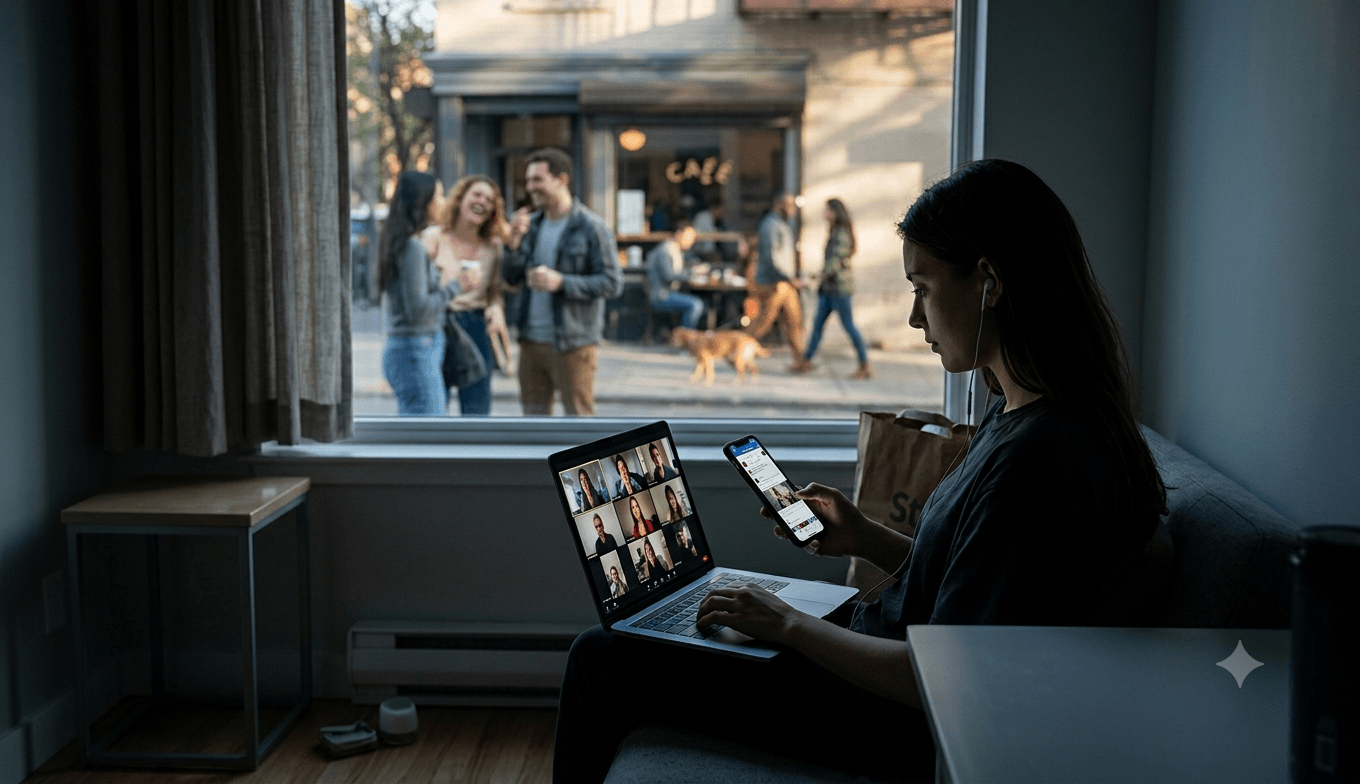
My observation of many under 35: no friends, no intimate relationships, no steady job, no religion, no community, no children, but lots and lots of social media.
We no longer start our days quietly. Upon waking, a firehose of digital noise awaits on our nightstand: news from every direction, strangers’ angst, marketers selling the illusion that their product or service will help us live our best life, and endless entertainment. We swipe a finger across the glass to silence our alarm, then open our inbox, where messages from people we’ve never met await a passive nod. Breakfast is cobbled together from groceries ordered via Instacart. By nine, we’re in your home office, an isolation chamber of sorts, speaking into a camera and nodding at sixteen postage-stamp-sized faces performing a digital pantomime of engagement. At noon, we don’t walk to a local diner; we order via Uber Eats. In the evening, we don’t meet friends at a local pub; we stream a movie alone.
Driven by convenience, social avoidance, and plain laziness, we’ve built a world where you can survive for months without confronting the unedited reality of another human being. It’s an efficiency masterpiece, and it’s quietly killing us.
The frictionless life is marketed as the ultimate luxury, a liberation from the messy hassles of going out and dealing with (gasp) people. However, it eliminates the spontaneous, low-stakes encounters with reality that come from shopping, buying groceries, going to the movies, and leaving the house to earn a living. The nod to the letter carrier, the wry exchange with the barista, the shared small talk in a slow-moving line. These small interactions form the fabric of daily life. They anchor us to a shared narrative called life. Nowadays, we live in solitary loops, thinking that because we are constantly connected (texting, DMing, group chats, posting, commenting), we’re connected.
Communication isn’t connection. We’re drowning in the former while starving for the latter, trading real-time presence for text threads, DMs, and voice notes. In his 2024 book The Anxious Generation: How the Great Rewiring of Childhood Is Causing an Epidemic of Mental Illness, social psychologist Jonathan Haidt observed that digital portals “calls them away from the people nearby and into an alternative universe that was exciting, addictive and unstable.” This fracture isn’t merely cultural; it’s deeply personal. We’ve traded the vulnerable, messy practice of presence for the safe, curated distance that glass and pixels afford us.
Trading physical presence for digital pixels isn’t an existential crisis; it’s a tangible reality. Studies in Social Psychiatry and Psychiatric Epidemiology show that nearly 40% of adults experience persistent, intense loneliness. We’ve created a society where people are physically closer than ever yet remain emotionally isolated on their own islands.
Work-from-home (WFH) arrangements accelerated this withdrawal. Suggesting that remote work is anything less than a white-collar right invites scorn and defensive rage, born of entitlement. Nevertheless, no matter how loudly WFH evangelists shout from their soapboxes, they can’t deny the consequences for individuals and society at large. Mothballing the corporate workplace eliminates more than the commute; it destroys the innate community of the office, the shared eyeroll across a table, the impromptu coffee run, and the post-meeting debriefs about everything except spreadsheets. By converting our homes into offices, gyms, and cinemas, we’ve built comfortable refuges. In doing so, we’ve traded the unpredictable theatre outside our front door, which demands social and judgment skills to navigate, for the safe predictability of four walls.
In addition to turning our homes into hiding places from the world, we’ve redefined “introvert,” once a useful descriptor for those who recharge in quiet contemplation, to justify our self-imposed exile. The term has been weaponized as a blanket excuse for social laziness, serving as a shield against the effort of engaging with the world. People increasingly prefer to passively observe the lives, careers, friendships, and romances they wish they had, substituting observation of other people’s lives for living their own.
We write off our social anxiety not as a muscle weakened by disuse, but as a permanent part of our identity. “I can’t go to Jenni’s wedding; I’m an introvert!” “I can’t go to my office holiday party; I’m an introvert!” Yet there’s a vast difference between needing quiet to recharge and using solitude as a shield. Social skills aren’t static traits; they’re active practices. Avoiding conversations with strangers, navigating awkward pauses, or risking rejection withers your capacity to engage with others. We’ve grown fragile behind smartphone and laptop screens, editing text messages, polishing emails, and curating our thoughts before hitting “send.” Faced with real-time, unscripted human exchange, we panic, blame “introversion,” and retreat to our digital bunkers.
True community doesn’t descend like a morning mist, nor does it belong to us simply because we share a telephone area code, a mayor, or a sports team. A city doesn’t hand you connection. You can live in a high-rise surrounded by thousands and remain invisible and lonely if you choose not to engage. Meeting people who share your interests, forming meaningful friendships, and finding a romantic partner require sweat equity, the deliberate, uncomfortable effort of placing yourself where spontaneous interaction happens, rather than taking the path of least digital resistance. Choose the cashier over self-checkout. Join a local bowling league, volunteer at a community garden, or have breakfast three mornings a week at the same diner so you become a familiar regular. Take the initiative. Start small talk, offer to help, ask for help, or simply say, “Let’s go grab a coffee.” Connection isn’t a commodity to download; it’s cultivated with intention that dispels the fear of rejection. You connect with the world by participating in it, not by scrolling through other people’s curated posts.
The discomfort we feel when stepping out of our home bunkers isn’t a sign that we’re broken or don’t belong in the world. It’s simply the friction of life returning to our joints, the strain of muscles being stretched after years of inactivity. This minor discomfort isn’t a threat; it’s the price of admission to a life of depth and meaning. Living solely through screens offers nothing more than second-hand warmth. If you want to live your “best life,” surrounded by people who cheer for you, listen to your hopes and dreams, support your goals, and lift you up when you stumble, you must open your front door, step outside, and re-enter the beautifully messy, unpredictable, and often rewarding real world. Human connections are waiting for you, but they won’t knock on your door. You must go out and meet them.
About The Author