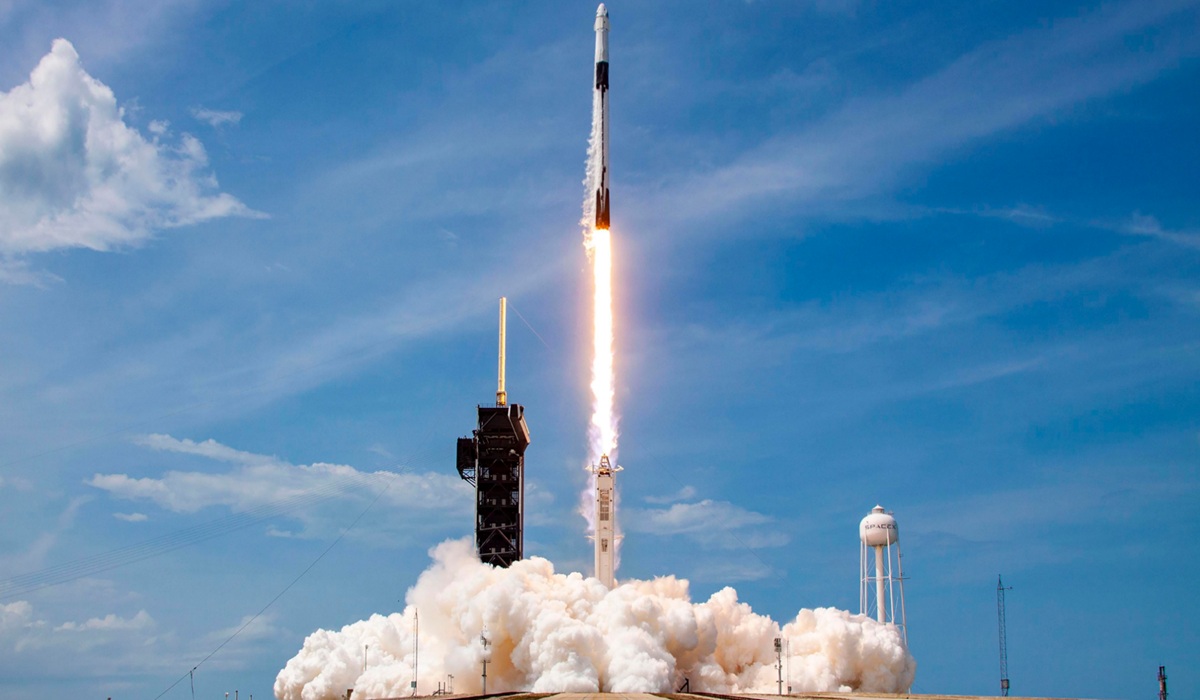
Image credit: Space X
When a discarded piece of a SpaceX Falcon 9 rocket slammed into the moon at roughly 5,400 miles per hour, it quickly generated a flurry of online confusion and dramatic claims. Social media posts painted the event as a reckless, government-funded demolition project, arguing that billions of taxpayer dollars were being spent to smash hardware into the lunar surface instead of funding social programs on Earth. But looking past the sensational headlines reveals a very different reality, one rooted not in intentional destruction or wasted budgets, but in the complex, long-term physics of deep-space orbital mechanics.
The object in question was not a primary booster or a payload, but rather the empty upper-stage booster from a mission launched over a year and a half prior. When rockets launch payloads toward deep-space destinations like the moon, the second-stage component must burn through nearly all its fuel to escape Earth’s immediate gravitational grip. Once it drops off its cargo, it is left drifting as space debris, possessing no remaining fuel reserves to execute a controlled return to Earth or a targeted de-orbit burn.
Without propulsion, this massive piece of metal entered a long, looping orbit between the Earth and the sun. Over months of exposure, tiny external forces, including solar radiation pressure and the shifting gravitational pulls of the Earth, moon, and sun gradually altered its path.Independent astronomers tracking the object eventually realized that these subtle, cumulative nudges had put the derelict booster on an inevitable collision course with the moon’s western hemisphere near the Einstein Crater.
When the impact occurred, it happened on a sunlit portion of the lunar surface, making a direct visual sighting of the initial flash nearly impossible for ground-based observers.However, professional facilities like the European Southern Observatory’s Very Large Telescope managed to capture the massive dust and debris plume kicked up by the explosion.By analyzing the light spectrum passing through that ejected cloud, scientists detected distinct chemical signatures, including sodium from the lunar regolith and trace lithium originating from the spacecraft hardware itself.While entirely accidental, the crash offered researchers a rare, real-world data set to study impact dynamics and crater formation in a low-gravity environment.
The narrative that this event was a deliberate, taxpayer-funded stunt collapses under basic institutional scrutiny. Commercial space companies and national space agencies do not target celestial bodies with spent hardware as a matter of operational design. Furthermore, government contracts awarded to private aerospace providers are strictly tied to specific deliverablesm such as launching defense payloads, resupplying the International Space Station, and developing crewed lunar landers—rather than disposing of debris onto the moon.
While the incident certainly highlights the growing challenge of managing space traffic and orbital debris as lunar exploration accelerates, it was fundamentally an unplanned consequence of deep-space physics. Stripping away the political rhetoric leaves behind an ordinary occurrence in the history of spaceflight: an abandoned piece of human engineering completing a multi-year journey through the cosmos and returning, by pure gravity, to the dust.
About The Author