Why Did MBS Turn to Trump for Help?
- Naveed Aman Khan
- Pinpoint
- Middle East
- Trending News
- September 22, 2026
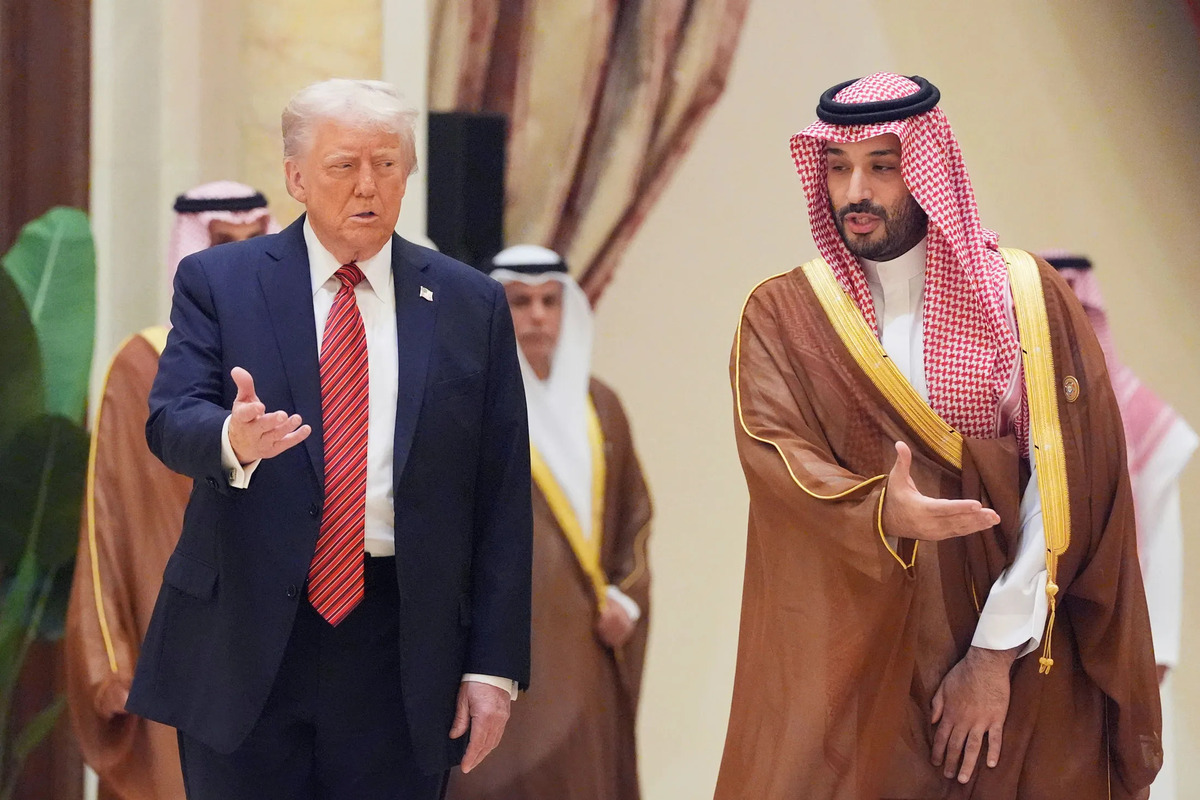
The escalating conflict between Saudi Arabia and the Houthis has become a difficult test not only for the security of the Middle East, but also for the regional balance of power and the wider international order. What began as a Yemeni conflict is no longer confined to Yemen. It is now directly connected to Saudi Arabia’s national security, Iran’s regional influence, international shipping through the Red Sea, global energy markets, and the future of the emerging defense relationship among Saudi Arabia, Pakistan and Turkiye.
Against this backdrop, Saudi Crown Prince Mohammed bin Salman turned to U.S. President Donald Trump for assistance in confronting the Houthis. Yet Washington has been reluctant to commit American forces directly to another major military campaign in Yemen. Recent reporting indicates that Saudi Arabia has sought stronger American involvement while the Trump administration has preferred intelligence and other forms of support rather than committing to a new U.S. war.
This raises an important question: if Saudi Arabia has recently established a joint defense framework with Pakistan and Türkiye, why did Mohammed bin Salman still look toward Washington for immediate military support? The answer lies in the difference between a defense agreement and immediate battlefield capability.
Saudi Arabia, Pakistan and Türkiye signed the Makkah Joint Defense Agreement on August 7, 2026. The agreement states that an armed attack against one of the three countries will be regarded as an attack against all three and calls for broader defense cooperation. This is a significant political and strategic commitment. However, the existence of such an agreement does not automatically mean that every military crisis will immediately trigger the deployment of Pakistani or Turkish forces into an active theater of war.
The distinction is particularly important in the case of Yemen. A country facing an immediate missile, drone or air attack requires capabilities that can be deployed rapidly. The United States possesses extensive military infrastructure in the Middle East, advanced intelligence and satellite surveillance systems, sophisticated airpower, missile-defense capabilities, drones, logistics networks and long-range precision-strike assets. These capabilities give Washington a unique role in any crisis threatening Saudi territory.
Pakistan and Turkiye are both major military powers, but their involvement in a conflict involving the Houthis would carry very different strategic and political consequences. Pakistan shares a border with Iran and has longstanding political, economic and security ties with Saudi Arabia. Türkiye has its own regional interests and calculations. Neither country can approach the Yemen conflict simply as a conventional military operation.
This explains why Saudi Arabia may seek American assistance even while developing alternative strategic partnerships. At the same time, Washington’s reluctance to enter the conflict directly is significant. The US is already dealing with multiple security challenges across the ME. Opening another major front against the Houthis could create a chain reaction involving Iran, Yemen, Saudi Arabia, the United States and other regional powers. The strategic waterways surrounding the Red Sea and Bab el-Mandeb are particularly sensitive. Any major escalation could disrupt international shipping and put additional pressure on global oil prices.
The American calculation is also shaped by domestic politics. The US has already paid a heavy political, financial and human price for prolonged Middle Eastern wars. It is therefore difficult for any administration to enter another conflict without a clearly defined objective and an identifiable path toward an end. The distinction between helping Saudi Arabia defend itself and launching a new American war against the Houthis is therefore crucial.
The roots of the Yemen conflict go back more than a decade. The Houthis expanded their control over Sana’a in September 2014, taking advantage of Yemen’s political instability and internal divisions. In early 2015, the situation deteriorated further, and Saudi Arabia assembled a coalition that launched military operations in March 2015 after President Abdrabbuh Mansour Hadi appealed for outside intervention. What had initially been a domestic Yemeni power struggle consequently became a major regional conflict.
For Saudi Arabia, the Houthis represent a serious security challenge along its southern border. Riyadh has long viewed the movement as closely aligned with Iran and has regarded Houthi missile and drone capabilities as a direct threat to Saudi territory, energy infrastructure and strategic interests.
Iran’s relationship with the Houthis has made the conflict even more complicated. Tehran has provided various forms of support to the movement, while Iranian officials have rejected portrayals of the Houthis as a force completely controlled by Iran. The Houthis have their own Yemeni political, tribal and ideological interests and cannot be understood solely through the lens of Iranian policy.
Nevertheless, at the strategic level, the conflict has increasingly become part of the broader Saudi-Iranian competition for regional influence. Iran does not necessarily need to deploy its own forces into Yemen to exert pressure on Saudi Arabia. If the Houthis can threaten Saudi military installations, energy infrastructure or critical maritime routes, Tehran can gain strategic leverage without becoming directly involved in a conventional war.
The Houthis’ ability to threaten the Red Sea and Bab el-Mandeb gives the conflict an importance far beyond the borders of Yemen. Bab el-Mandeb is one of the world’s most important maritime chokepoints, linking the Red Sea with the Gulf of Aden and connecting major international shipping routes between Europe, Asia and the ME. Any sustained disruption can affect freight costs, insurance premiums, energy markets and global supply chains.
Recent Houthi advances have therefore raised concerns well beyond Saudi Arabia. Reports indicate that the group has increased its territorial and military pressure while threatening Saudi interests and strategic maritime routes. This brings the newly established Saudi-Pakistani-Turkish defense framework into its first major test.
The central question is whether the agreement will remain primarily a political and strategic commitment or develop into an operational defense mechanism capable of responding to an actual conflict. The agreement clearly strengthens the three countries’ collective security framework, but the practical military arrangements, political decision-making and circumstances under which forces would be deployed remain critically important. For Pakistan, the situation is particularly sensitive.
Islamabad has deep fraternal, economic, political and defense ties with Saudi Arabia. At the same time, Iran is Pakistan’s immediate western neighbor. Pakistan must therefore consider not only its commitments to Saudi Arabia but also border security, regional stability, trade interests and its diplomatic relationship with Tehran.
This is why direct Pakistani participation in a war inside Yemen would be an extremely complicated decision. Pakistan faced a similar dilemma in 2015. When Saudi Arabia asked for participation in the Yemen conflict, Pakistan’s Parliament unanimously adopted a resolution calling for neutrality in the conflict while reaffirming support for Saudi Arabia. That precedent remains relevant to Islamabad’s current strategic calculations.
A direct Pakistani military campaign against the Houthis could have serious consequences. Iran could interpret Pakistani participation as an action against its strategic interests, potentially damaging bilateral relations. Pakistani personnel, military facilities and Pakistani interests in Saudi Arabia could also face increased risks. Domestically, a new foreign military intervention could generate political controversy and divide public opinion. There is, however, a middle path between military disengagement and participation in an offensive war.
Pakistan can support Saudi Arabia’s defensive requirements without becoming directly involved in offensive operations inside Yemen. Islamabad could contribute through air-defense cooperation, intelligence sharing, military training, border-security expertise, maritime security and diplomatic engagement. Such an approach would allow Pakistan to honor the spirit of its defense relationship with Saudi Arabia while avoiding direct confrontation with Iran. The distinction must remain clear: helping protect Saudi territory is not necessarily the same thing as joining a Saudi-led offensive inside Yemen.
Turkiye can similarly play an important role through defense cooperation, military technology, diplomatic engagement and regional coordination. Saudi Arabia, meanwhile, has substantial financial resources with which to strengthen its own air-defense and military capabilities.
The US, for its part, appears determined to preserve a degree of strategic distance from another open-ended Yemen war. Recent reporting shows Washington resisting direct military involvement despite pressure for stronger action, while other Western partners have considered more limited forms of assistance. The broader lesson is that modern security cannot be guaranteed by military hardware or defense agreements alone. Saudi Arabia possesses enormous financial resources. Pakistan has extensive military experience. Turkiye has developed a rapidly expanding defense industry. The US possesses some of the world’s most advanced military technologies. Yet none of these advantages can, by themselves, resolve Yemen’s underlying political crisis.
The ultimate solution to Yemen’s conflict will have to involve politics and diplomacy.
For Pakistan, the most sustainable course is therefore to maintain its defense commitment to Saudi Arabia while avoiding direct participation in an offensive war inside Yemen. Islamabad’s greatest strategic asset may not be military intervention but diplomatic access. Pakistan can maintain communication with Saudi Arabia, Iran and Turkiye simultaneously and potentially use those relationships to encourage de-escalation.
The Yemen conflict is no longer simply a war between one Yemeni faction and another. It has become a test of the emerging balance of power in the ME, the credibility of regional defense partnerships, the future role of the US, Iran’s regional strategy and the ability of countries such as Pakistan and Turkiye to contribute to regional security without becoming trapped in another prolonged war.
The most important question is therefore not simply who has more missiles, drones, aircraft or military alliances. The real question is whether the countries of the region will once again rely primarily on proxy warfare and military escalation—or whether they will give diplomacy a genuine opportunity.
For Pakistan, maintaining solidarity with Saudi Arabia while avoiding direct involvement in offensive operations in Yemen offers a way to balance its defense commitments with its relations with neighboring Iran and its broader national interests. If Islamabad enters the conflict militarily, it risks becoming part of a war with no clearly defined end and no easy exit. The future of the ME will not be decided solely on the battlefield. Ultimately, the more consequential struggle may be over who can help build a new regional security architecture through diplomacy rather than force. The countries that succeed in reducing tensions, maintaining dialogue and preventing another cycle of regional escalation will have a far greater opportunity to shape the Middle East that emerges from this crisis.
About The Author