
The Abyss of Imperial Reckoning: Pickaxe Mountain, the Petrodollar, and the Illusion of Preventive Armageddon
- Hami Aziz
- Trending News
- Middle East
- November 5, 2026
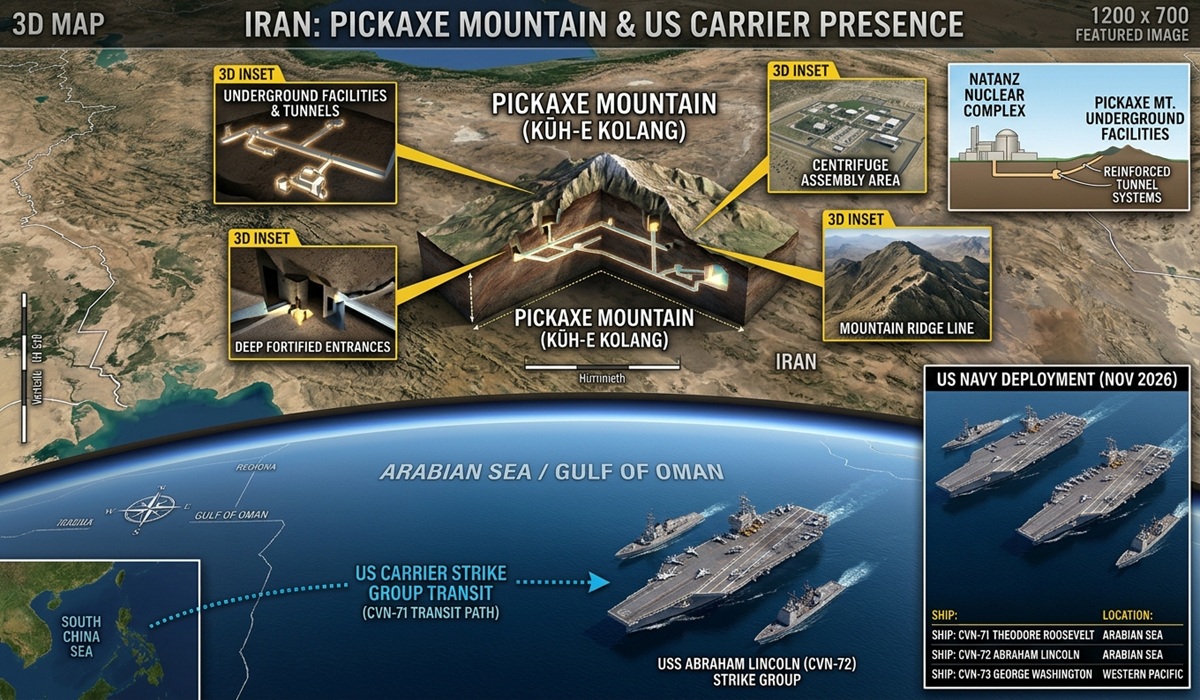
The sheer scale of Pickaxe Mountain near Natanz is a physical testament to the enduring terror of the nuclear age. Encased beneath layers of granite and engineered earth, the subterranean stronghold represents what military strategists describe as an untreatable hardened target. For Donald Trump, returning to the White House with an aggressive foreign policy mandate, this granite fortress has become an obsessive focal point. The rhetoric emanating from Washington frequently flirts with the ultimate taboo: the use of tactical nuclear weapons to obliterate a complex that conventional bunker busters might never penetrate. Within the corridors of power, two prevailing schools of thought attempt to parse this apocalyptic posturing. The first views him as a mercurial leader whose unpredictable instincts could drive him to cross the nuclear threshold simply to demonstrate absolute capability, operating under the personal conviction that a decisive display of unmatched force guarantees American security. The second interpretation sees a calculated geopolitical theatricality, a willingness to hide extreme kinetic ambitions under the guise of fulfilling Israel’s strategic demands.
Yet the military logic used to justify such an extreme act collapses under rudimentary strategic analysis. The argument that Iran poses an existential, immediate threat to the American homeland through long-range aerial or missile strikes is a geopolitical fantasy. Iranian ballistic missiles lack the intercontinental range to cross both the Atlantic and Pacific oceans, and its air force possesses no stealth or long-range strategic bombers capable of breaching complex, multi-layered Western air defense systems. Any offensive strike vehicle launched from Iranian soil toward the Western Hemisphere would be detected instantly by early warning satellite constellations and intercepted long before reaching North American airspace. The threat, therefore, is not an impending destruction of Washington or New York, but a fundamentally different kind of challenge to the architecture of global dominance.
The window for executing such an extraordinary action without immediate congressional intervention is remarkably brief. Between the certification of presidential election results and the formal swearing-in of a newly elected Congress on January 3rd, an incumbent or incoming commander-in-chief operates within a brief institutional vacuum. During this narrow legislative intermission, executive authority over the nuclear triad remains technically unencumbered by fresh oversight, committee subpoenas, or funding restrictions. It is precisely during this window that a president intent on altering the global strategic landscape could act unilaterally, bypassing the slow machinery of democratic debate to deliver a irreversible fait accompli.
The true catastrophe of triggering a nuclear strike on Pickaxe Mountain, however, would not end at the physical destruction of the Iranian plateau. The immediate result would be the sudden, catastrophic breakdown of the American economic system. The moment a nuclear weapon is detonated offensively in the twenty-first century, the foundational pillar of modern international finance, the absolute predictability and safety of U.S. debt instruments, would vanish. Global institutional investors, sovereign wealth funds, and foreign central banks would immediately conclude that the central power of the international order had become unpredictable.
This realization would trigger an unprecedented run on the United States Treasury market. As yields surged to astronomical heights and bond prices collapsed, the core collateral supporting global banking liquidity would be rendered suspect. Equities across major stock exchanges would plunge into freefall as market participants rushed to liquidate assets, seeking sanctuary in physical commodities or non-aligned currencies. The United States would discover that its true weapon of mass destruction had not been detonated over an Iranian mountain, but within its own capital markets. A nation that relies on foreign capital to finance its debt cannot detonate nuclear warheads without incinerating the trust that makes its paper money valuable.
The geopolitical fallout would extend far beyond financial markets, instantly dismantling the fragile nuclear non-proliferation regime. If the United States were to normalize the offensive use of nuclear weapons against a non-nuclear-armed state, it would grant immediate structural license to other nuclear powers. Russia, locked in an exhausting war of attrition in Ukraine, would lose whatever lingering diplomatic constraint keeps its own tactical nuclear arsenal in reserve. Moscow could frame its own nuclear escalation as a proportional response to American precedents. Around the globe, every regional state existing under a security threat would conclude that sovereign survival requires nuclear weapons, triggering an unchecked global armaments race that no treaty could ever contain.
To understand why the United States remains so obsessively focused on subduing Iran, one must look past the official security doctrines and examine the underlying mechanics of global monetary power, specifically the petrodollar architecture. Established in the mid-1970s through a series of formal and informal agreements between Washington and Saudi Arabia, the petrodollar system required the kingdom—and subsequently the rest of the Organization of the Petroleum Exporting Countries, to price and settle all international oil transactions exclusively in U.S. dollars. In exchange, the United States provided absolute security guarantees to the ruling monarchies of the Persian Gulf, deploying its military apparatus to safeguard oil fields, shipping lanes, and dynastic stability.
This systemic arrangement generated artificial, worldwide demand for the U.S. dollar. Every nation on earth required greenbacks simply to purchase the energy necessary to run its industrial economy. These dollars then flowed back into the American financial ecosystem through the purchase of U.S. Treasury securities, effectively allowing Washington to run massive budget deficits, fund sprawling overseas military infrastructure, and consume far beyond its domestic production capacity without facing the inflationary consequences that typically plague heavily indebted nations. The petrodollar was the quiet engine behind American exceptionalism.
That historic bargain, however, has fractured beyond repair. Saudi Arabia’s recent refusal to automatically renew its exclusive dollar-denominated trade arrangements marks a monumental shift in international finance. The Gulf monarchies have increasingly signaled a willingness to accept alternative currencies, including the Chinese yuan, the euro, and local digital settlement mechanisms for their energy exports.
The decline of the security foundation underlying the petrodollar accelerated when critical Saudi oil infrastructure, including the massive processing facilities at Abqaiq and Khurais, suffered devastating strike attacks attributed to Iranian-backed regional networks. The expected, overwhelming U.S. military retaliation never materialised. Gulf leaders were left with the uncomfortable realization that the American security umbrella, the very foundation of the petrodollar compromise, was no longer absolute. If Washington could not guarantee protection against regional strikes, the strategic logic of maintaining exclusive monetary loyalty to the dollar lost its foundation.
This brings into focus the true, existential anxiety driving American policy toward Tehran. Iran represents a structural threat not because of an imaginary fleet of intercontinental missiles, but because of its unique geography, resources, and potential to catalyze an autonomous, non-dollar-denominated economic bloc across the Middle East. If Iran successfully integrates its economy with neighboring Arab states and coordinates energy trade in alternative currencies, the systemic necessity for the petrodollar collapses.
Unlike many of its desert neighbors, Iran possesses a resilient, self-contained geographical foundation. It is the only major Middle Eastern nation with vast, direct maritime access to both the Caspian Sea in the north and the Persian Gulf and Gulf of Oman in the south, bypassing the dangerous strategic bottlenecks that constrain its neighbors. Crucially, Iran does not rely on vulnerable, energy-intensive desalination plants for its basic survival. Supported by major mountain ranges that capture atmospheric moisture, its terrain features extensive river basins and fertile agricultural valleys. Iran remains one of the largest regional producers of agricultural staples, capable of feeding its own domestic population while exporting food across the arid landscapes of the Arabian Peninsula.
When the United States isolated Iran through comprehensive economic sanctions, financial blockades, and trade embargos, it sought to strangle the nation into submission. Instead, this isolation forced Iran to develop an independent domestic industrial infrastructure, construct complex shadow banking networks, and build non-Western trade relationships. By turning inward and linking its economy to Eurasian trade networks like the Shanghai Cooperation Organization and the BRICS bloc, Iran has demonstrated that a major nation can survive outside the framework of U.S. financial hegemony.
If Iran completes this strategic transition and facilitates a unified economic zone across the Middle East where energy, food, and raw materials are traded in regional currencies or gold-backed digital assets, the petrodollar will meet its definitive end. The artificial global demand for U.S. currency will evaporate, forcing trillions of unneeded dollars back into the domestic American economy. The result would be severe domestic inflation, skyrocketing interest rates, and an inability for the U.S. government to service its sovereign debt without massive currency devaluation.
The obsession with Pickaxe Mountain is ultimately the terminal symptom of an empire coming to terms with its monetary limits. The impulse to deploy nuclear weapons against a subterranean fortress is not a demonstration of ultimate strength, but an act of strategic desperation. It is an attempt to use kinetic violence to preserve a global monetary order that can no longer be sustained through diplomacy or financial dominance. The true danger of striking Pickaxe Mountain is not just that it might fail to destroy the subterranean bunkers beneath the granite; it is that the act itself would trigger the collapse of the very empire the strike was meant to protect.
About The Author