Project Azorian: The Sunken Soviet Submarine, Howard Hughes, and the Cold War Operation Hidden Beneath the Ocean
- TDS News
- Tiger's Eye Advisory Group - Trending News
- June 6, 2026
By: Donovan Martin Sr, Editor in Chief
In 1968, a Soviet submarine vanished beneath the Pacific Ocean, and with it went one of the Cold War’s most valuable intelligence prizes. The vessel was K-129, a Soviet diesel-electric ballistic missile submarine carrying nuclear capability, classified equipment, code materials, and the secrets of a rival superpower. It sank in deep water northwest of Hawaii, far beyond normal salvage reach, in a place so remote and unforgiving that even the Soviet Union could not find its own lost warship.
That failure opened the door to one of the most extraordinary covert operations in modern history. The United States did not simply search for the submarine. It built an entire deception around recovering it. It created a fake commercial ocean-mining story, attached the name of one of the most famous billionaires in the world, constructed a ship unlike anything seen before, and attempted to steal a Soviet submarine from the bottom of the Pacific without Moscow knowing what was really happening. Welcome to Project Azorian, the Cold War operation that looked like science, sounded like business, and moved like espionage.
The K-129 went down in March 1968, during one of the most dangerous years of the Cold War. The official cause of the sinking remains unresolved. Several theories have circulated for decades, including an internal explosion, battery failure, missile malfunction, accidental flooding, or even a collision. None has been proven with complete certainty in the public record. What is known is that the submarine suffered a catastrophic event and settled thousands of metres below the surface, taking its crew with it.
The Soviet Navy launched a major search effort, but it came up empty. That alone was remarkable. A superpower had lost a submarine carrying strategic weapons and could not locate it. The ocean had swallowed the evidence, and Moscow was left searching blind. The United States, however, had advantages the Soviets did not fully understand. American underwater listening systems had detected acoustic clues connected to the disaster, and those clues helped narrow the search area.
The U.S. Navy later used the specially equipped submarine USS Halibut to search the deep ocean floor. That mission was not a casual expedition. It was a classified intelligence hunt. Using deep-sea camera systems, the Americans found the wreckage and photographed it extensively. Those images changed everything. Washington now knew where the submarine was. More importantly, it knew what might still be inside.
The prize was enormous. A Soviet submarine could contain missile technology, nuclear weapons information, cryptographic equipment, codebooks, sonar systems, communications gear, and design details that American intelligence could study for years. In the Cold War, information was power. A recovered submarine was not scrap metal. It was a library of enemy secrets sitting at the bottom of the sea.
The problem was almost impossible. The wreck was roughly three miles down. No one had ever secretly recovered a large piece of a submarine from that depth. The engineering challenge alone was staggering. The political risk was even greater. If the Soviets discovered the operation, it could trigger a major international crisis. The U.S. needed a plan that could hide in plain sight. That is where Howard Hughes entered the story.
Hughes was one of the few names large enough, strange enough, and wealthy enough to make the cover story believable. He was already associated with aviation, engineering, defense contracts, secrecy, eccentric projects, and massive spending. If the public heard that Howard Hughes was building a giant ship to mine the ocean floor for minerals, it sounded unusual, but not impossible. Hughes was the kind of man people expected to do something outrageous.
The cover story was deep-sea mining. The official fiction was that the Hughes Glomar Explorer had been built to collect manganese nodules from the ocean floor. These nodules were real. They contain valuable metals such as manganese, nickel, copper, and cobalt, and in the 1960s and 1970s there was genuine interest in the possibility of harvesting them commercially. That made the lie strong because it was built around a real scientific and industrial idea.
But the ship was not truly built for mining. It was built for a covert recovery mission. Howard Hughes did not personally dream up the plan, and he did not pay for it like some private adventure. His name and corporate world were used as the mask. The money, purpose, and strategic value came from the U.S. intelligence and defense apparatus. Hughes was the perfect front because his reputation made the unbelievable look believable.
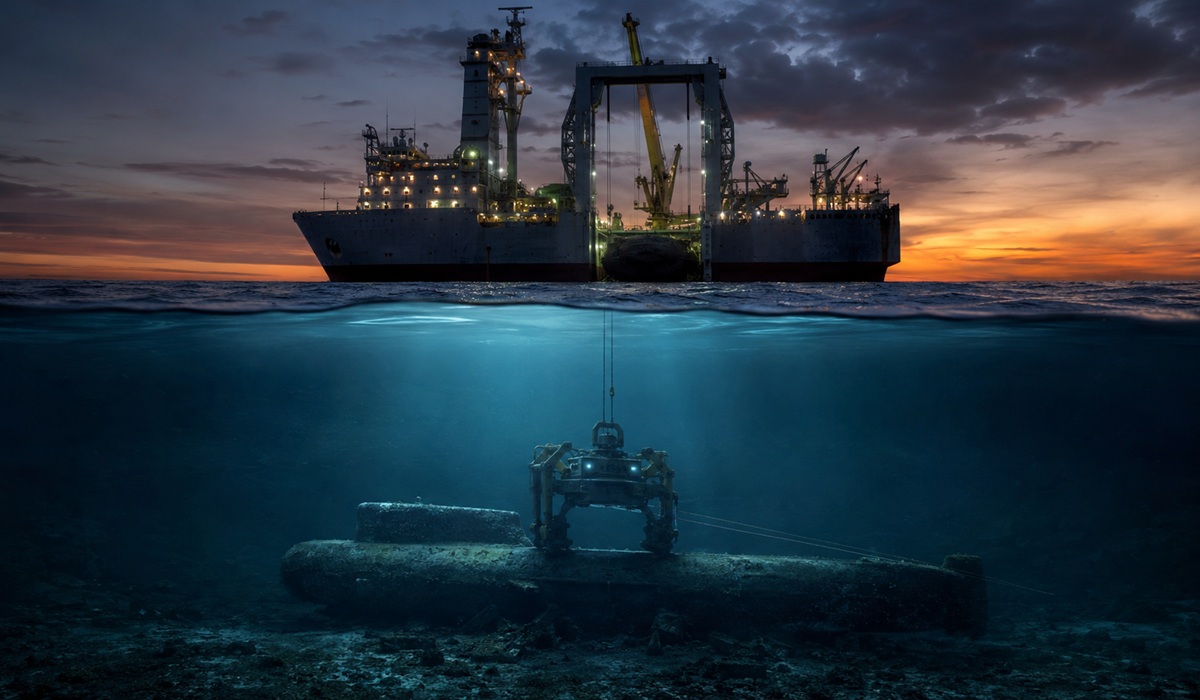
The Hughes Glomar Explorer was one of the most ambitious deception platforms ever created. It had to look like a commercial vessel while hiding a massive recovery system inside. It needed to hover over a fixed point in the open ocean, lower a huge capture device thousands of metres down, grab part of a wrecked submarine, lift it slowly through the water column, and bring it into a hidden internal bay called a moon pool. The ship itself was a weapon of secrecy.
The operation depended on a giant mechanical claw known as the capture vehicle. This device was designed to descend to the ocean floor, grip the target section of the submarine, and lift it upward piece by piece through a pipe-string system. The idea sounds simple until the scale is understood. The ship had to remain stable on the surface while reaching down nearly three miles into darkness, pressure, current, and uncertainty. One mistake could destroy the entire mission.
In 1974, the operation began. The Glomar Explorer moved into position under its commercial cover. To the outside world, it was an experimental mining ship. In reality, it was attempting one of the boldest intelligence thefts of the 20th century. The Soviets even monitored the area at points, but the mining story helped explain why the strange vessel was there and why it was doing unusual things.
For a time, the plan worked. The capture vehicle reached the submarine section and began the lift. Slowly, the remains of K-129 started rising from the ocean floor. For the CIA and the engineers aboard, this must have felt like touching the impossible. The United States was not merely spying from the sky or intercepting radio traffic. It was physically raising a piece of the Soviet military from the bottom of the Pacific.
Then the operation partially failed. During the lift, part of the captured submarine section broke away and fell back to the ocean floor. The most valuable portions may have been lost in that moment. The dream of recovering the larger target section did not fully succeed. Still, the mission did recover part of the submarine, including the remains of six Soviet sailors, who were later given a formal burial at sea with military honors.
That burial matters. It cuts through the machinery and secrecy and reminds us that this was not only a spy story. Men died inside that submarine. Their government could not find them. Their enemy did. And in one of the strangest moral contradictions of the Cold War, the same country that tried to steal their submarine also gave them a respectful military burial.
As for precious metals, the answer is more complicated than legend. The famous “valuable metals” in the story were mainly tied to the cover story, not the submarine itself. Manganese nodules contain commercially interesting metals, and they made the mining explanation plausible. The public-facing story was about harvesting minerals from the seabed. The real target was military intelligence, not treasure.
There have long been rumours about what the United States actually recovered from K-129. Some accounts suggest documents, equipment, torpedoes, or other materials may have been recovered. Other claims remain uncertain because key details are still classified or disputed. What can be said safely is this: the United States did not spend hundreds of millions of dollars because it wanted ocean rocks. It wanted Soviet secrets.
Project Azorian also produced one of the most famous phrases in government secrecy. When journalists and researchers later pushed for information, the CIA responded in a way that became known as the “Glomar response”: the agency could neither confirm nor deny the existence of the records. That phrase became a permanent part of the language of secrecy. It was born from an operation designed to hide a submarine recovery behind a billionaire, a fake mining mission, and a ship that was really a floating intelligence machine.
The exposure of the operation damaged plans for any follow-up recovery. Once the press began revealing the story in 1975, the secrecy was compromised. A second attempt became far more difficult politically and operationally. Project Azorian entered history as a partial success, a partial failure, and a complete masterpiece of covert imagination.
What makes the operation so powerful is not only what happened, but what it reveals. Governments do not always build what they say they are building. Expeditions are not always expeditions. Research vessels are not always research vessels. Mining projects are not always about minerals. Sometimes the public story is a curtain, and behind that curtain is a military objective, an intelligence requirement, and a budget that no private businessman would ever carry alone.
Howard Hughes, in this story, was less the builder than the mask. His image made the operation plausible. His business empire gave the cover story a body. His reputation for secrecy made the silence believable. But the real architect was the national security state. The real customer was American intelligence. The real reason was Cold War advantage.
Project Azorian belongs in the same world as other clandestine operations where deception was not an accessory but the central design. It sits beside spy-plane programs, underwater cable-tapping missions, secret surveillance platforms, covert propaganda campaigns, and hidden military research projects that used civilian language to disguise strategic intent. The Cold War was full of mirrors, and Azorian was one of the finest smoke-and-mirror operations ever executed.
The lesson is not that every expedition hides a conspiracy. The lesson is sharper than that. When the stakes are high enough, when the target is valuable enough, and when the public explanation is useful enough, governments can build entire realities around a cover story. They can create companies, vessels, budgets, press narratives, and technical explanations that all point in one direction while the real mission moves quietly in another.
Project Azorian was not simply about a sunken Soviet submarine. It was about the architecture of deception. It was about how power moves when it does not want to be seen. It was about the difference between what the public is told and what the machinery of state is actually doing.
In the end, the Pacific kept most of K-129. The United States recovered only part of what it wanted. The Soviets eventually learned that their lost submarine had become the target of an American intelligence operation. Howard Hughes became permanently attached to a mission he helped conceal more than command. And the Hughes Glomar Explorer became one of the most famous ships in espionage history.
Project Azorian remains a warning from the deep. Beneath the surface of the ocean was a submarine. Beneath the surface of the mining story was the CIA. Beneath the name Howard Hughes was the U.S. national security budget. Beneath the language of exploration was a covert operation. And beneath the official world we are shown, there is often another world moving in silence.
About The Author