BRICS at a Crossroads: India’s Diplomatic Test and the Challenge of Cohesion
- Naveed Aman Khan
- Pinpoint
- September 10, 2026
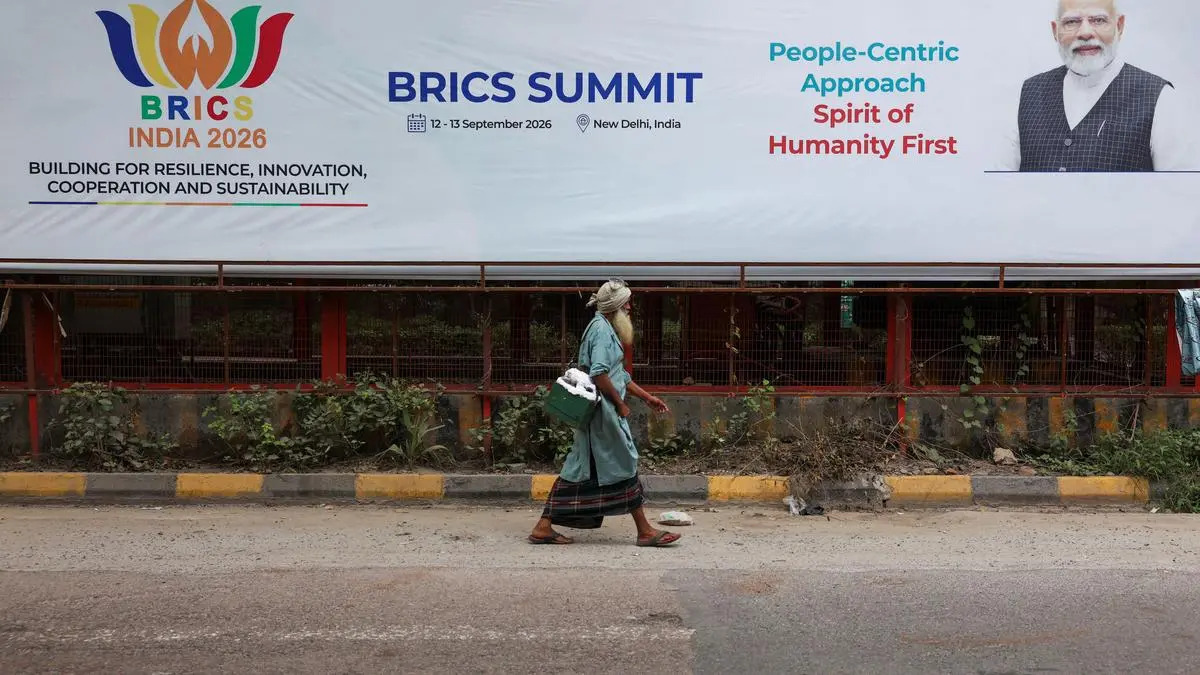
The 18th BRICS Summit in New Delhi is being presented by India as an important demonstration of its growing diplomatic weight and its role in shaping the emerging global order. Yet, only a day before the two-day summit is scheduled to begin, uncertainty over the attendance of several heads of government has created an unexpected diplomatic challenge for New Delhi. Of the 11 BRICS member states, only three national leaders have so far formally confirmed their participation, while the attendance of several other major leaders remains uncertain. For India, which has invested considerable political and diplomatic capital in hosting the summit, the situation raises questions that go well beyond protocol. It concerns the credibility, attraction and cohesion of the grouping itself.
The decision by Brazilian President Luiz Inácio Lula da Silva and the President of the UAE to decline participation is particularly significant. Brazil is one of the founding members of BRICS and has historically been an important voice within the grouping. The absence of its president therefore carries greater political symbolism than the absence of a leader from a less established participant. The UAE, represents the expanding geographical and economic reach of BRICS. Its decision not to attend at the highest level could reinforce perceptions that the enlarged grouping has yet to develop the political cohesion necessary to match its growing membership.
Russian President Vladimir Putin and Iranian President Masoud Pezeshkian, after initial uncertainty, have indicated their willingness to participate. Their presence would provide the New Delhi summit with considerable political weight. Russia remains one of the central founding powers of the BRICS concept, while Iran’s participation reflects the grouping’s expanding role in a changing geopolitical landscape. Moscow’s involvement would also underline the continuing importance of BRICS as a platform through which non-Western powers can coordinate their views on international economic and political issues.
The greater uncertainty concerns Chinese President Xi Jinping, Egyptian President Abdel Fattah el-Sisi, Ethiopian Prime Minister Abiy Ahmed and Indonesian President Prabowo Subianto. These are not peripheral participants. China is the largest economic power within BRICS and arguably the most influential member in terms of trade, investment and institutional capacity. Any uncertainty surrounding President Xi’s participation therefore has an immediate impact on perceptions of the summit. If the Chinese leader does not attend, India’s attempt to project the gathering as a major event of the emerging global order could lose some of its intended political force.
The same applies, although in different ways, to Egypt, Ethiopia and Indonesia. Their inclusion reflects the transformation of BRICS from a relatively small group of emerging economies into a much broader coalition representing different regions, political systems and economic interests. Their leaders’ participation is important because the credibility of an expanded BRICS depends not merely on adding countries to a list but on ensuring that those countries remain politically engaged at the highest level.
India has every reason to attach exceptional importance to the summit. New Delhi has sought to use its BRICS presidency to strengthen its credentials as a major global power and as an influential voice of the Global South. India increasingly portrays itself as a bridge between established Western institutions and the emerging powers of Asia, Africa, Latin America and the ME. Hosting a successful BRICS summit would therefore provide Prime Minister Narendra Modi’s government with an opportunity to demonstrate that India can convene major powers and influence discussions on the future of global governance.
Diplomacy is measured not by the grandeur of ceremonies but by political participation and substantive outcomes. A summit attended by most leaders would allow India to claim that New Delhi has become an indispensable venue for global diplomacy. Conversely, conspicuous absences could create a very different narrative. International observers could interpret weak attendance as an indication that India’s diplomatic attraction has limits, particularly when competing strategic interests among BRICS members are taken into account.
BRICS was never designed as a conventional military or political alliance. Its members have different strategic priorities, economic structures and relationships with the United States, Europe and one another. China and India, for example, remain strategic competitors in several areas despite their participation in the same multilateral framework. Russia has different relationship with the West from that of countries such as India, the UAE or Indonesia. Iran brings another geopolitical perspective, while Brazil’s priorities are strongly connected to Latin American economic and development concerns.
These differences are both the strength and weakness of BRICS. They demonstrate that the organization represents a diverse part of the international system rather than a single ideological bloc. At the same time, diversity makes consensus more difficult. The enlargement of BRICS has increased its geographical reach and economic significance, but it has also made the task of developing common political positions more complicated.
An organization becomes influential when its members consistently participate, coordinate policies and demonstrate a willingness to defend common interests. If leaders frequently remain absent or if summit declarations are not followed by practical cooperation, the expansion of membership could become more symbolic than substantive.
BRICS possesses substantial structural advantages. Its members collectively represent a significant share of the world’s population, economic activity, energy resources, trade and natural resources. The grouping also reflects a broader dissatisfaction among many developing countries with aspects of the existing international financial and political system. Questions concerning reform of global financial institutions, greater representation for developing economies, local-currency trade, development financing and a more balanced international order provide BRICS with a potentially powerful agenda.
If the summit produces meaningful progress on trade, investment, development finance, technology, energy security and institutional reform, BRICS can demonstrate that its expanding membership has genuine strategic value.
For India, the immediate diplomatic optics remain important. New Delhi has sought to portray itself as an increasingly central power in the international system. The summit represents a test of diplomatic convening power. The absence of Brazil’s president is already noteworthy, while uncertainty over several other major leaders adds to the pressure. India will need to ensure that differences among members do not dominate the narrative and that the summit produces substantive results capable of overshadowing questions about attendance.
There is also a broader lesson for Indian diplomacy. Global influence cannot be established through summit hosting alone. It requires sustained trust, balanced relationships and the ability to accommodate the interests of countries that do not necessarily share the host nation’s strategic worldview. BRICS members are unlikely to accept an agenda that appears designed primarily to advance the interests of any single country. India must therefore demonstrate that its presidency is about strengthening the institution rather than using it principally as a platform for national prestige.
The New Delhi BRICS Summit is consequently much more than another item on the international diplomatic calendar. It is a test for India and, at the same time, a test for BRICS. For New Delhi, the challenge is to prove that its growing international profile is supported by genuine diplomatic influence and the ability to attract the world’s major emerging powers. If several prominent leaders remain absent, India’s carefully cultivated image as a leading voice of the Global South could suffer a significant setback.
Expansion has given the organization greater demographic, economic and geographical weight, but size alone does not create influence. The grouping now needs stronger institutional mechanisms, greater political coordination and a clearer set of common priorities. Its members must decide whether BRICS is simply a forum for periodic consultations or whether they want to build a durable pillar of a more multipolar international system. The success of the New Delhi summit will not be determined by attendance figures alone. It will be determined by whether the leaders who do gather can demonstrate unity despite their differences and convert the collective weight of BRICS into practical initiatives.
About The Author