Bill S-206 Isn’t UBI Progress; It’s Ottawa’s Next Taxpayer-Funded Boondoggle
- Nick Kossovan
- Canada
- August 25, 2026
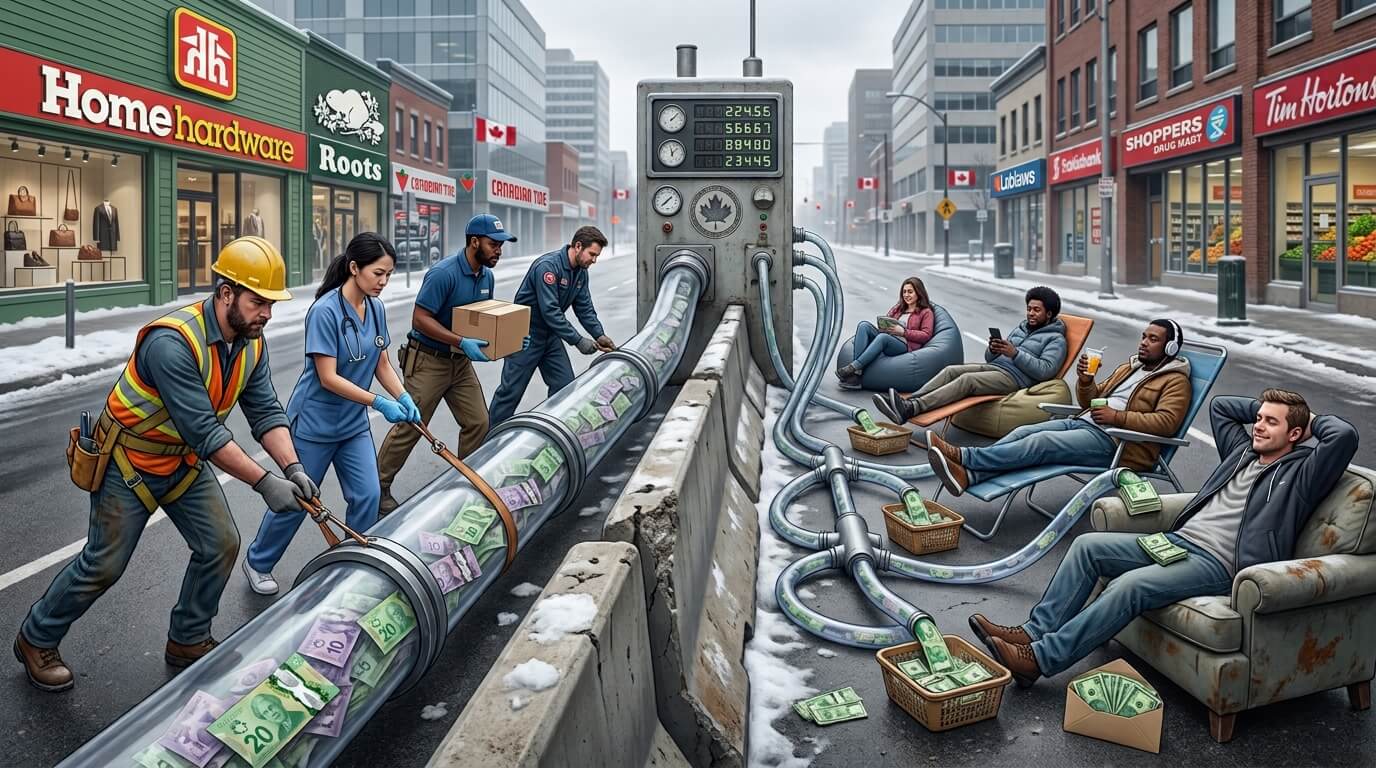
A close friend, and frequent sounding board for my writing, recently texted me a CBC News story covering the 25th annual Basic Income Earth Network (BIEN) Congress, which took place in Toronto from August 19 to 22. Academics, professional activists, and career bureaucrats descended on Toronto Metropolitan University to swoon over Bill S-206. Sponsored by Senator Kim Pate, the bill would set up a national universal basic income framework guaranteeing a livable income for everyone over 17, with zero requirement to actually work.
Proponents frame the bill as a shield against AI and wealth inequality. Opponents, such as Senator Michael MacDonald, rightly argue that state handouts diminish personal ambition just as young people should be building their futures. Mark Carney was conspicuously absent, refusing to lend his elite central-planning cachet to what’s essentially high-profile virtue-signalling.
After reading the coverage, I have to ask: how does one become a “basic income expert”? Is there an accredited degree involved, or is it simply the refined art of sitting in air-conditioned conference rooms, debating how to redistribute money earned by folks who get up at 6:00 a.m. to go to work?
Stripping away the academic jargon, Bill S-206 positions basic income as a deeply divisive wedge among taxpayers. Canadian UBI evangelists conveniently ignore our southern neighbour, where a culture of risk, innovation, and hard work creates a magnet for global enterprise and investment. If Ottawa embraces cradle-to-grave nannyism, it still has to figure out how to hand out money without crushing the incentive to earn it. Spoiler alert: it can’t.
Human nature isn’t driven by noble intentions. Ambition isn’t a factory setting; it’s a muscle built through struggle. The fear of poverty and the shame of failure aren’t flaws in human design—they are pressure mechanisms that drove civilizations to create, invent, and prosper. Yet even with these ferocious motivators snapping at our heels, millions still chase the comfort of dependency over the work it takes to achieve financial independence.
Imagine the spiral when you remove the stakes that require someone to fend for themselves and replace rock bottom with a taxpayer-subsidized buffer against personal accountability. For many adults—and by adults, I mean anyone over 21—being taken care of by parents, employers, or the government has become their primary goal. When you tell a 19-year-old that Ottawa will pad their bank account whether they master a trade or scroll on their phone until noon, you aren’t empowering them. You’re neutering their drive. You’re trapping them in a comfortable prison—a gilded cage—of lifelong government dependency.
At the heart of my argument is deep concern for an expanding, disenfranchised youth population. When purpose evaporates and hope diminishes, “no future” becomes a convenient cover for apathy (read: Why bother trying?).
While an income safety net may eventually be necessary to keep young Canadians from falling through the cracks, it must never become a permanent, state-funded lifestyle. Any viable income support must be strictly capped at the barest necessities—a temporary floor for survival, not a comfortable salary to live off. Above all, access must be tied to non-negotiable conditions, requiring UBI recipients to pursue trade training (which is where the jobs are), higher education, or active employment so their drive remains intact.
Before Ottawa rushes into a bureaucratic boondoggle of unearned handouts, it needs to exhaust obvious, low-hanging income solutions first. The consequences of this growing aimlessness are already visible across the West, where young people increasingly embrace political extremism on platforms like TikTok and X. Interpol, Europol, and the FBI have documented teenagers migrating toward extremist digital networks that trade in nihilism, accelerationism, and anti-establishment ideology. These channels rarely rely on sophisticated theory; they simply offer hopeless youth a ready-made tribe and a surrogate sense of purpose. Lacking real-world ambition, a disenfranchised generation will naturally seek out radical doctrines to fill the void.
After 25 annual gatherings, what has the BIEN actually delivered? Endless academic navel-gazing and zero practical results.
If Ottawa is serious about helping struggling families, it shouldn’t be expanding the welfare state, it should be overhauling the tax code. Take an arbitrary, generous benchmark: exempting the first $45,000 of individual income from federal taxation. Economists can debate the precise math, but raising the federal tax-free threshold provides instant relief, directly rewards work, and could be implemented almost overnight without creating another government bureaucracy.
Instead of offering hard math, UBI evangelists lean on sentimentality: “Some people simply can’t earn a living wage.”
The reality? Canadians are being bled dry. According to the latest Organisation for Economic Co-operation and Development Tax Revenue Statistics, personal income taxes account for 36.7% of Canada’s total tax revenue, far surpassing the OECD average of 23.7%. Unlike economic peers like Germany, France, Japan, the UK, or Australia, Ottawa squeezes everyday working families—not to invest in domestic priorities, but to underwrite foreign virtue-signalling, overstaffed bureaucracies, five-star official travel, and botched multi-million-dollar tech projects like ArriveCAN.
Then comes the thorny, unavoidable question of eligibility. Should someone who’s worked, paid taxes, and contributed to Canada for 30 or 40 years receive the exact same monthly check as a recent arrival, a newly minted citizen, or someone who’s never worked a day in their life? Should non-citizens and brand-new residents draw from the same well built by decades of Canadian labour? The moment you turn the federal treasury into an open tap, the line for taxpayer-funded handouts stretches far beyond Canada’s borders, and the potential for exploitation becomes uncontainable.
When a government confiscates nearly 40% of your earnings under threat of audit, then promises to return a fraction as a “guaranteed allowance,” that isn’t compassion—it’s a protection racket. It’s an old political sleight of hand: create hardship, distribute state-issued crutches, and demand your vote in gratitude. Once citizens rely on government cheques to pay rent and buy groceries, they are no longer sovereign citizens; they become clients of the state. It illustrates the warning in Marilyn French’s 1980 novel The Bleeding Heart: “There is no power greater than the power of passive dependency.”
Bill S-206 isn’t social progress; it’s a taxpayer-funded golden leash that kills individual initiative, a fiscally reckless boondoggle, and a ticking time bomb for a taxpayer revolt. By guaranteeing a livable wage without condition, contribution, or accountability, Ottawa reduces Canadians from self-reliant citizens to government dependents: keep the herd quiet, keep them fed, and keep them compliant. As the old political axiom warns, the hand that feeds you always holds the collar.
About The Author