Bad Coaching, Sub-Par Guard Play, Puts Raptors On The Edge Of Elimination
- TDS News
- Sports
- April 30, 2026
By: Donovan Martin Sr, Editor in Chief
The Toronto Raptors didn’t just lose a playoff game in Cleveland; they let a winnable game slip through their hands in a way that is becoming far too familiar in this series against the Cleveland Cavaliers. This was not a night where the Raptors were outclassed from start to finish or overwhelmed by talent. Instead, it was a game defined by missed opportunities, questionable rotations, and a refusal to lean into the players who are clearly capable of shifting momentum when it matters most.
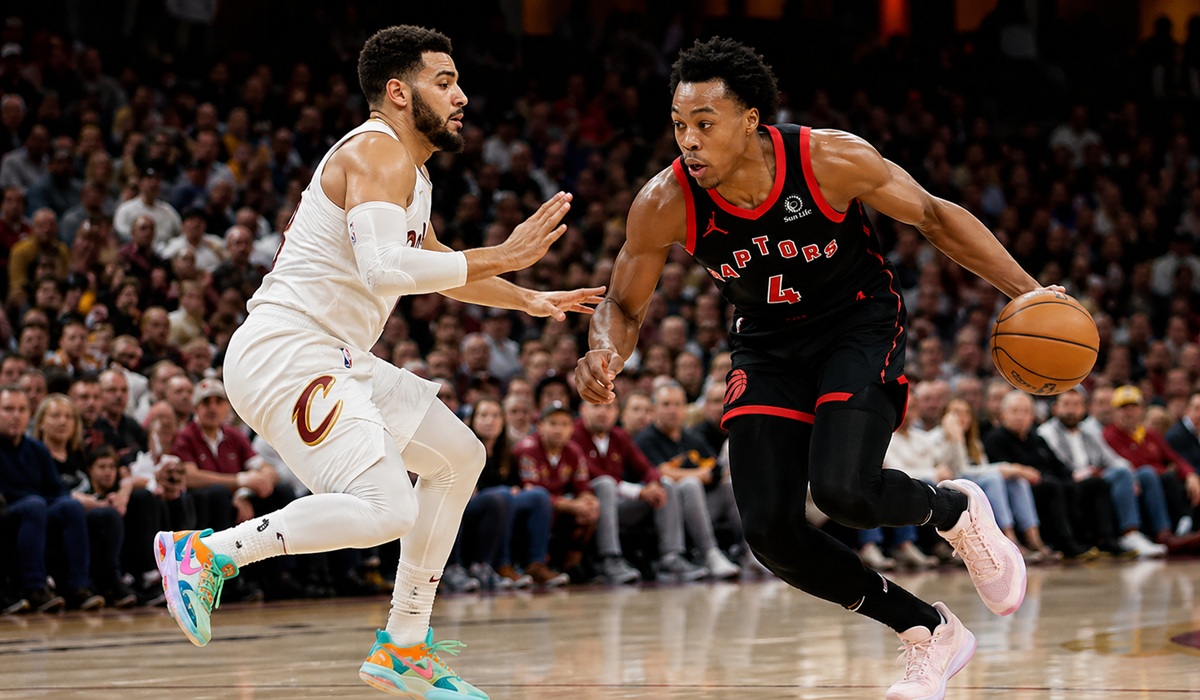
There were stretches where Toronto looked like the better team and led throughout most of the first half. Scottie Barnes played with the urgency and control expected from a franchise cornerstone, attacking the rim, defending multiple positions, and doing everything possible to impose his will on the game. RJ Barrett complemented that effort with timely scoring, finding ways to keep the offense afloat when possessions began to stall and Cleveland’s defense tightened. For moments at a time, the Raptors dictated pace, forced turnovers, and looked poised to take control of the game in a hostile environment.
That control disappeared the moment adversity hit, and the response from the bench made matters worse rather than better. When Brandon Ingram went down with an injury, the Raptors lost more than just a scoring option; they lost balance, spacing, and any semblance of offensive rhythm beyond Barnes creating on his own. Cleveland immediately adjusted by collapsing defensively, sending extra bodies toward Barnes and daring the rest of the roster to respond. No one consistently did, and the coaching staff failed to make the necessary adjustments to counter that shift.
The absence of Immanuel Quickley at the point guard position has clearly impacted the structure of the offense, particularly in late-game execution where decision-making and tempo control are critical. However, injuries are part of playoff basketball, and they cannot be used as a shield to deflect what has become an undeniable issue with how this team is being managed during the most important stretch of the season. The decisions being made with rotations and substitutions are not reflective of a team that understands the urgency of playoff basketball, and that disconnect is costing Toronto real opportunities to win.
There is no rational explanation for how Colin Murray-Boyles is being utilized in this series, because the reality on the floor makes it obvious that he should be playing a far more significant role. His energy, physicality, and ability to impact both ends of the court have stood out whenever he is given meaningful minutes, yet those minutes continue to come inconsistently and often far too late to influence the outcome of the game. In a playoff setting where rotations are expected to tighten and coaches are expected to rely heavily on their most effective players, keeping someone of his impact on the bench for extended stretches reflects a failure to adapt to the moment.
The frustration deepens when considering that this is not a roster devoid of talent or experience. The narrative that Toronto is somehow overachieving or simply competing beyond expectations does not hold up under scrutiny, because this team has legitimate NBA pedigree, proven contributors, and a fanbase that expects a higher standard. The Raptors are not a rebuilding afterthought playing with house money; they are a team with identifiable strengths that are not being fully leveraged, and that responsibility falls directly on the coaching staff.
Jakob Poeltl represents another area where more is required, as his presence in the paint has not been nearly as forceful as it needs to be in a series where interior play can shift momentum. There have been too many possessions where he appears content to occupy space rather than aggressively demand the ball, attack the rim, and create second-chance opportunities through physical play. Against a disciplined Cleveland defense, passive play in the frontcourt becomes a liability, and without consistent pressure inside, the Raptors become far easier to defend on the perimeter.
The issues in the backcourt have been even more damaging, because inconsistency at the guard position has disrupted the flow of the offense throughout the game. Ja’Kobe Walter has struggled to find his scoring touch and any sustained rhythm, alternating between brief flashes of promise and stretches where decision-making and shot selection undermine the team’s offensive structure. Jamal Shead continues to provide defensive effort, but the lack of consistent offensive production needed to remain at the NBA level, allows Cleveland to sag off, crowd driving lanes, and focus defensive attention elsewhere without consequence. Gradey Dick, who has been largely invisible not just in this series but throughout significant portions of the season, has failed to provide the perimeter shooting that was expected to space the floor and open opportunities for others, leaving the offense overly dependent on Barnes and Barrett to generate points.
These roster issues inevitably lead to questions about construction, and while Masai Ujiri has earned a reputation as one of the most respected executives in the league, the results in the backcourt over recent seasons demand scrutiny. The organization deserves credit for identifying and drafting Murray-Boyles, who has already shown the potential to be a major contributor, but that success is offset by the inconsistency and inefficiency that continues to define the guard rotation. In the playoffs, those weaknesses are amplified, and what might be manageable during the regular season becomes a defining limitation.
Despite those flaws, the larger issue remains that Toronto is not maximizing the talent it currently has, and that failure is most visible in how the game is being coached. Across the league, playoff basketball is defined by urgency, adaptability, and a willingness to ride the players who are performing at the highest level, regardless of experience or status. The Raptors have not demonstrated that level of urgency, and the reluctance to fully commit to their most effective lineups has created a pattern where momentum is repeatedly lost at critical moments.
This is a team supported by one of the most passionate fanbases in the sport, a global following that includes high-profile figures such as Drake, and an organizational history that includes championship success, yet the product on the floor in this series does not reflect that standard. The expectations are higher than moral victories or narratives built around effort, and the margin for error in the playoffs does not allow for prolonged indecision or miscalculation.
If the Raptors are eliminated from this series, the outcome cannot be framed as a team that simply exceeded expectations or fought valiantly against a stronger opponent. The reality is far less forgiving, as the combination of ineffective rotations, inconsistent guard play, and an unwillingness to fully utilize key contributors will stand as the defining factors. In a series where the difference between winning and losing has been measured in execution and decision-making, Toronto has repeatedly come up short in both areas, and that is not a reflection of effort but of leadership and direction when it matters most.
About The Author