China Unicom and Huawei Turn a Beijing Marathon Into a Glimpse of the Future
- Ingrid Jones
- Sports
- April 20, 2026
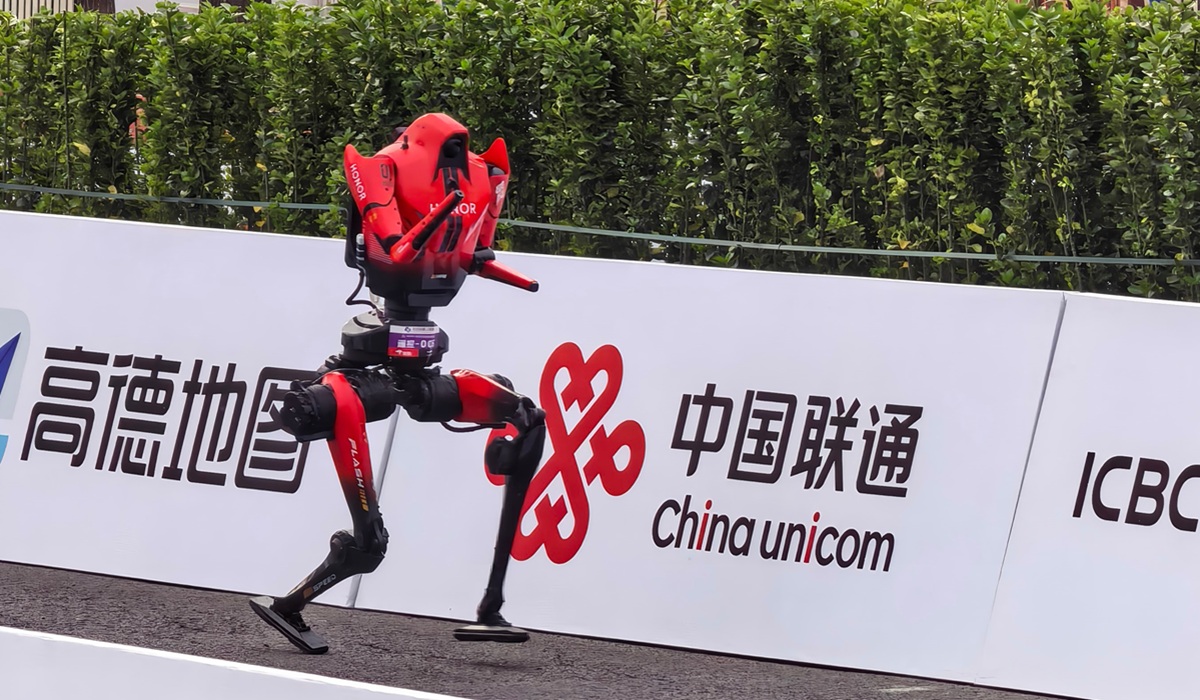
Beijing’s E-Town in the Daxing District did not just host another long-distance race. It became a proving ground for what the next generation of connectivity, artificial intelligence, and human-machine interaction actually looks like when it leaves the lab and enters the real world. At the center of it all were China Unicom and Huawei, who used the Beijing E-Town Half-Marathon and the world’s first Humanoid Robot Half-Marathon to showcase the power of 5G-Advanced, also known as 5G-A, through a technology they call GigaUplink.
This was not just about faster internet speeds or better signal coverage. It was about redefining what large-scale events can become when connectivity is no longer a limitation. In a setting where tens of thousands of spectators, athletes, media crews, and now humanoid robots all rely on real-time data transmission, the challenge has always been managing massive uplink demand. Traditionally, networks struggle when everyone tries to upload video, stream content, or share moments at the same time. In Beijing, that bottleneck was effectively removed.
China Unicom and Huawei deployed a 5G-A network using multi-band aggregation across 3.5 GHz and 2.1 GHz frequencies, achieving uplink performance that consistently delivered over 20 Mbps for more than 99 percent of users, with peak speeds reaching 677 Mbps. That level of reliability meant uninterrupted 4K and even 8K broadcasting, seamless livestreaming, and real-time editing capabilities for media teams covering the event. Spectators were no longer passive observers. They became active participants, sharing high-definition content instantly without lag or disruption, even in the most crowded moments of the race.
What made this deployment stand out was not just raw speed but the intelligence behind it. The network dynamically adjusted itself through what the companies describe as “intelligent base stations,” creating flexible, elastic channels that could prioritize different types of traffic. Livestreaming feeds, video calls, short-form content, and voice communication were all handled differently depending on demand, ensuring that no single service overwhelmed the network. The result was a consistently smooth experience, even when usage peaked.
Yet the most striking element of the event was not the connectivity itself, but what that connectivity made possible. For the first time, human runners shared the course with humanoid robots in a competitive race format. These machines were not simple demonstrations. They were fully integrated participants, divided into autonomous and remotely controlled categories, each relying heavily on constant data transmission to function.
Every robot required roughly 10 Mbps of uplink capacity to manage a combination of video streaming, environmental sensing, navigation, and movement control. That demand would typically strain any network, especially across a long and dynamic race course. Instead, dedicated network slices were allocated specifically for these machines, ensuring ultra-reliable connections with sub-decimeter positioning accuracy and end-to-end latency kept below 30 milliseconds.
That level of precision allowed robots to do more than just move forward. They could detect obstacles, adjust their path in real time, handle turns, and maintain balance while accelerating toward the finish line. In other words, they were not just connected devices; they were functioning as embodied AI systems operating in a live, unpredictable environment. Without a network capable of delivering high-speed, low-latency uplink consistently, that level of performance would not have been possible.
For China Unicom, the event reinforced its position as a key enabler of intelligent infrastructure. Company leadership emphasized that the integration of 5G-A and AI is not a niche experiment but a foundational shift in how industries will operate moving forward. The focus now extends beyond connectivity into computing power, service ecosystems, and security, all of which are necessary to support the growing demands of AI-driven applications.
Huawei, meanwhile, framed the event as a preview of a broader transformation. The company highlighted how the integration of mobile networks with embodied intelligence is reshaping not only sports and entertainment but also manufacturing, urban planning, and everyday life. What was demonstrated on a marathon course in Beijing is, in many ways, a scaled-down version of what future smart cities could look like, where machines, people, and digital systems interact seamlessly in real time.
There is a tendency to view advancements like 5G-A as incremental upgrades, something marginally better than what came before. What unfolded in Beijing challenges that assumption. When connectivity reaches a level where latency is nearly imperceptible and capacity is effectively abundant, it stops being a constraint and starts becoming an enabler of entirely new experiences.
The Beijing E-Town Half-Marathon was not just a race. It was a statement. It showed that the convergence of high-performance networks and advanced AI is no longer theoretical. It is operational, scalable, and already beginning to reshape the boundaries of what is possible in public spaces.
As the finish line came into view for both human and robotic runners, the real story was not who crossed it first. It was the realization that the infrastructure supporting that moment is quietly redefining the future, one connection at a time.
About The Author