14 neonates burnt to ashes in PIMS: Where Was the System When Needed It Most?
- Naveed Aman Khan
- Pinpoint
- August 27, 2026
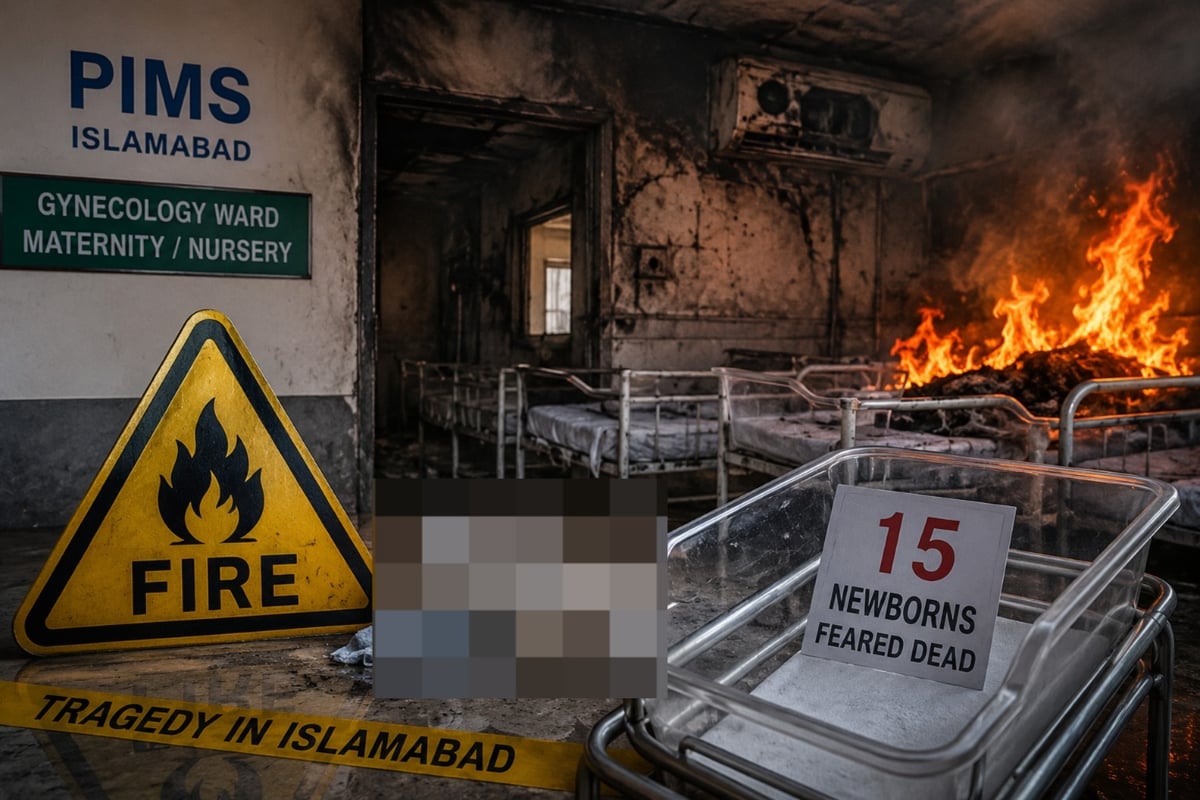
Hospitals are not merely places for medical treatment but serve as a final sanctuary for life. The fire that tore through the Mother and Child Health ward of the Pakistan Institute of Medical Sciences (PIMS) in Islamabad on Wednesday is not merely another tragic hospital accident. It is a devastating indictment of the systems that are supposed to protect the most vulnerable human beings: newborn children who could neither walk, speak, escape, nor call for help. Fourteen infants lost their lives in a catastrophe that has already raised deeply disturbing questions about hospital management, emergency preparedness, staffing, fire safety and institutional accountability. The fire began in the nursery early in the morning, with officials pointing to an air-conditioning unit or electrical failure as the initial cause. Fifteen infants were admitted in the ward, with only one surviving.
The most painful question is therefore not simply how did the fire start? The more important question is: why were so many helpless babies unable to receive immediate assistance once the fire began?
A neonatal ward is not an ordinary hospital room. Babies in such units may be inside incubators, receiving oxygen, attached to monitoring equipment and completely dependent on nurses and doctors. Emergency planning in such an environment must assume that patients cannot save themselves. Every second matters. If there was inadequate staffing, delayed response, locked or obstructed access, malfunctioning fire equipment, inadequate evacuation routes or insufficiently trained personnel, then the tragedy cannot be dismissed as an unavoidable accident.
There are already conflicting accounts about what happened inside the ward. Families and eyewitnesses have questioned the availability and response of hospital staff, while reports from the scene have described severe difficulties in reaching the infants. Some relatives have also alleged that access to the ward was locked or obstructed. These allegations must be independently verified rather than either accepted as fact or dismissed as emotional reactions. This leads directly to the question of duty rosters. Where were the doctors, nurses, technicians and other designated staff at the precise moment the emergency began? If personnel were officially assigned to the ward, investigators must establish their exact locations through attendance records, access-control logs, CCTV footage, telephone records where legally justified, and statements from witnesses. If staff members were not present, investigators must determine why. Was there unauthorized absence? Was the roster improperly prepared? Were employees working elsewhere? Was there a shortage of personnel? Had anyone been instructed to leave the ward unattended? Or was there a breakdown in supervision?
These are not minor administrative questions. They go to the heart of criminal and institutional responsibility.
At the same time, it would be irresponsible to prejudge individual doctors, nurses or hospital employees before evidence is collected. A disaster scene generates rumors almost immediately. A doctor helped rescue a surviving infant, while other accounts emphasize an apparent absence of staff. The investigation must distinguish clearly between verified facts, eyewitness testimony and speculation. The second major issue is fire safety. A hospital caring for oxygen-dependent newborns should have extraordinarily strict fire-prevention and evacuation procedures. Investigators need to determine whether sprinklers were operational, whether fire alarms functioned, whether extinguishers were available, whether emergency exits were accessible, whether fire doors operated correctly, whether oxygen systems complied with safety standards, and whether staff had conducted evacuation drills. Firefighters and witnesses have raised concerns about deficiencies in emergency infrastructure, while grieving relatives have questioned whether basic safety measures were adequate.
The role of the air-conditioning system must also be examined scientifically. Was there an electrical short circuit? Did an air-conditioner compressor explode? Was maintenance overdue? Had the equipment previously developed faults? Were previous complaints recorded? Had hospital engineers inspected it? Were electrical loads within approved limits? Was oxygen concentration in the room a factor in the rapid spread of the flames? Officials have indicated that high oxygen levels accelerated the fire. But there is another dimension that cannot simply be ignored: the possibility of deliberate interference or sabotage.
forensic evidence of involvement of any terrorism be given importance. Nevertheless, in a country facing serious militant threats, investigators should examine every plausible hypothesis—including human negligence, technical failure, criminal negligence, deliberate sabotage and terrorism—until evidence establishes the truth. That investigation, however, must be evidence-based.
If investigators find credible grounds to examine particular employees or outsiders, then their professional conduct, access to restricted areas, financial activity where legally relevant, communications, movements and associations should be examined through lawful investigative procedures. Call-detail records and digital communications can be relevant in a criminal investigation, but only where legally authorized and tied to reasonable investigative grounds. The same standards must apply to everyone—senior officials, doctors, nurses, technicians, security personnel, contractors and outsiders.
The investigation should also examine whether anyone had motive, opportunity or access to the nursery. CCTV footage must be preserved before it disappears or is overwritten. Electronic access logs, duty registers, maintenance records, security logs and emergency-call records should be secured immediately. The physical site should be treated as a forensic crime scene until investigators establish that no criminal element was involved.
The government has already ordered an investigation and Prime Minister Shehbaz Sharif has sought accountability, including action involving the health secretary. But Pakistan has seen too many inquiries that produce headlines for a few days and then disappear into official files. This case cannot follow that familiar pattern. An effective inquiry should include independent fire-safety experts, forensic investigators, electrical engineers, hospital-management specialists, police investigators and representatives capable of examining neonatal-care protocols. Its mandate should cover not only the immediate cause of the fire but the entire chain of responsibility preceding it.
Who inspected the ward? Who certified its safety? Who approved its electrical systems? Who was responsible for fire drills? Who prepared the duty roster? Who supervised the staff? Who maintained the air-conditioning equipment? Who was responsible for emergency evacuation? Were previous complaints ignored? Were safety deficiencies reported to senior management? If so, why were they not corrected? And perhaps the most important question: could these children have been saved if the hospital’s systems had worked as they were supposed to? If the answer is yes, then the deaths were not simply an unfortunate accident. They represent a catastrophic failure of institutional responsibility.
Fourteen newborns cannot testify. Their parents must therefore become the voices of accountability. They deserve more than condolences, compensation or promises of future reforms. They deserve the truth. Pakistan cannot build a culture of public safety by appointing committees after every tragedy. It must build institutions in which negligence carries consequences before innocent people die. PIMS is one of the country’s most important public healthcare institutions. If such a catastrophe can occur in a major federal hospital, every hospital administration in the country should immediately examine its own fire, electrical, oxygen and emergency-response systems.
The investigation must therefore follow two principles simultaneously: no conspiracy theory without evidence, and no negligence theory without evidence either. If the fire was an accident caused by an electrical or mechanical failure, those responsible for maintenance and safety must answer for preventable negligence if negligence is established. If staff failed in their duties, they must face appropriate disciplinary or criminal proceedings based on evidence. If management ignored known hazards, responsibility must extend upward rather than ending with junior employees. And if investigators uncover deliberate sabotage or a terrorist connection, those responsible must be pursued through the full force of the law.
But the investigation must never become an excuse for ethnic profiling. A Pashtun is not suspicious because he is Pashtun; a Baloch is not suspicious because he is Baloch; nor is anyone innocent merely because of identity or position. Evidence must be the only passport to guilt or innocence. The fourteen children who died at PIMS had no political identity, no ethnic agenda and no capacity to defend themselves. They were simply newborn Pakistanis whose lives had barely begun. Their deaths should force the country to confront an uncomfortable truth: in public institutions, negligence can be as deadly as any weapon.
The ultimate measure of this tragedy will not be the number of officials suspended, committees formed or statements issued. It will be whether Pakistan discovers exactly what happened, holds every responsible person accountable, eliminates the safety failures that made the disaster possible, and ensures that no parent ever again has to stand outside a hospital watching a newborn child become a victim of institutional failure. Fourteen innocent lives demand nothing less than the complete truth.
About The Author