TRUMP PUSHED TOO FAR: Canada Hits Back Dollar for Dollar as Carney Walks Away
- Emma Ansah
- Breaking News
- August 22, 2026
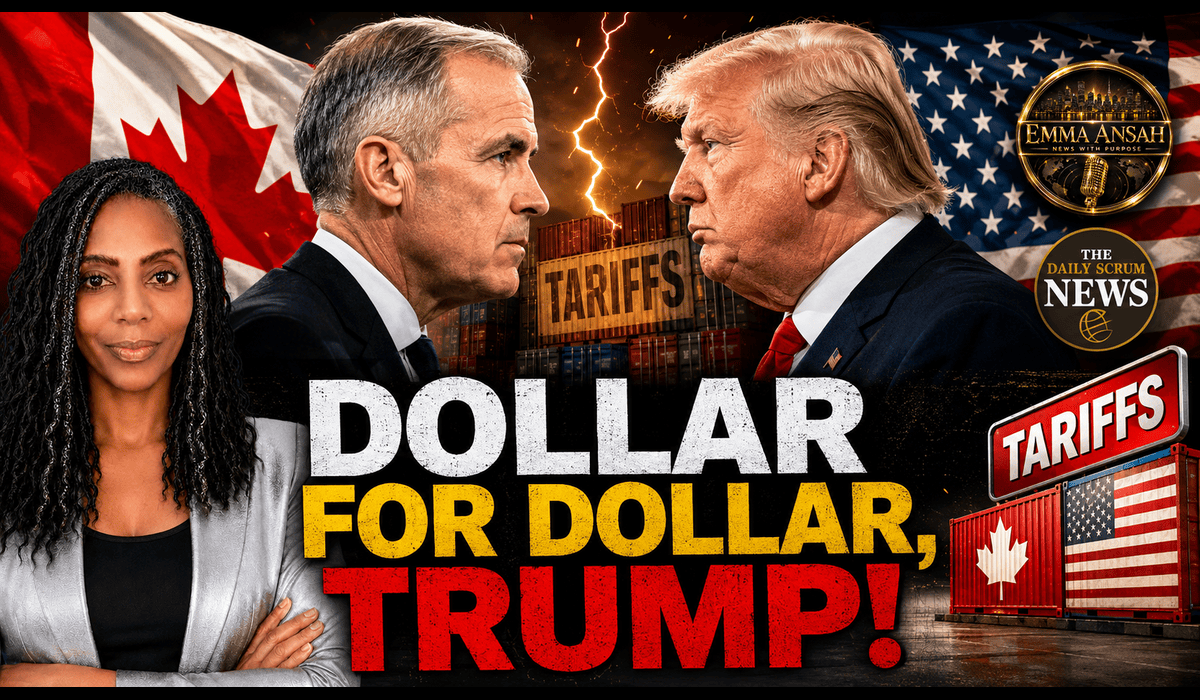
Well, Donald Trump wanted a trade fight with Canada, and now he has one.
Prime Minister Mark Carney has suspended trade negotiations with the United States after talks collapsed at the eleventh hour, triggering President Donald Trump’s new 50 per cent tariffs on approximately US$20 billion worth of Canadian goods. Canada is now preparing to respond exactly where the Trump administration understands it best: the pocketbook. Carney says Canada will retaliate “dollar for dollar,” matching the value of the American tariffs with tariffs of our own.
And frankly, Canada should hit the Trump administration hard economically, because there comes a point when diplomacy without consequences becomes permission.
Carney says Canada negotiated in good faith, but last-minute changes from Washington were unfair, economically unacceptable and raised serious questions about whether any agreement with the Trump administration could be relied upon. American officials tell a different story and accuse Canada of seeking additional concessions at the last minute. What is undeniable is that the two countries appeared close to an agreement that could have reduced tariffs on steel, aluminum and automobiles before everything fell apart.
The sticking points included steel, aluminum, automobiles and softwood lumber, with Washington also raising long-standing complaints about Canadian dairy policies and restrictions affecting American products. But this fight has become about much more than a few products crossing the border. It is about how much economic sovereignty Canada is prepared to surrender in exchange for continued access to the American market.
Trump has repeatedly used tariffs as a hammer against Canada while talking about this country as though we are economically helpless without the United States. That strategy ignores one rather important detail: America needs Canada too.
Canada is a major supplier of energy and other critical commodities to the United States. Canadian oil feeds American refineries, Canadian materials support American manufacturing and deeply integrated supply chains mean Canadian and American businesses often depend on one another. The United States and Canada traded approximately US$376 billion worth of goods during just the first half of 2026. This is not some tiny trading relationship Washington can disrupt without consequences at home.
There is also the elephant sitting in the room wearing a red, white and blue hat: Canada’s natural resources.
The United States has enormous strategic interest in secure access to Canadian energy and resources, and Trump has recently floated reviving the Keystone XL pipeline while Canada is simultaneously looking at ways to move more of its energy toward other international markets. Canada should be extremely cautious about any arrangement that leaves Washington with greater control or preferential access to Canadian resources without Canada receiving a fair and reliable deal in return.
If the Trump administration wants greater access to Canadian oil, energy, minerals, lumber and other resources, then it cannot simultaneously treat Canada like an economic punching bag. You do not get to insult the neighbour, threaten the neighbour, slap tariffs on the neighbour’s products and then expect the neighbour to hand you the keys to the pantry.
Canada’s natural resources belong to Canada, and any access to them should benefit Canadians first.
Trump’s tariff strategy is also hurting the very Americans he claims to be protecting. A tariff on Canadian goods entering the United States is not a bill that Ottawa receives in the mail from Washington. American importers pay those tariffs, and those additional costs can be absorbed by businesses, passed along through supply chains or ultimately land on American consumers through higher prices. Products affected by the latest 50 per cent tariffs range from Canadian dairy and alcohol to hockey equipment, clothing, construction materials and other goods.
So when Trump tells Americans that tariffs are making another country pay, somebody needs to explain the receipt.
American businesses importing Canadian goods can suddenly find themselves paying substantially more for those products. Companies relying on Canadian inputs can face higher operating costs. Retailers can raise prices. Manufacturers can see margins squeezed. Consumers can end up paying more. That is not Canada attacking American consumers. That is the predictable consequence of the Trump administration imposing massive tariffs on one of America’s largest trading partners.
Canada’s dollar-for-dollar retaliation will create pain too, and Canadians should not pretend otherwise. Canadian tariffs on American goods can raise costs here at home, particularly for businesses and consumers dependent on U.S. products. A trade war between two economies this integrated does not produce a clean winner because both sides end up taking hits.
But there is a difference between accepting economic pain because somebody else initiated a fight and volunteering to be economically bullied because fighting back might be uncomfortable.
Canada cannot spend the next several years negotiating with a metaphorical tariff gun sitting on the table.
Carney walking away sends Washington an important message. Canada is willing to negotiate, but negotiation does not mean capitulation.
The bigger mistake the Trump administration may be making is assuming Canada has nowhere else to go. Roughly three quarters of Canadian exports have historically gone to the United States, which gives Washington enormous leverage, but Trump’s repeated tariff threats are also giving Canada an enormous incentive to change that reality. Canada has increasingly pursued diversification toward Europe and Asia, including energy infrastructure designed to give Canadian resources greater access to Asian markets.
Trump may therefore accomplish something Canadian governments have talked about for decades but struggled to actually do: force Canada to break its economic dependence on the United States.
Canada should be aggressively building new markets, strengthening domestic manufacturing, expanding interprovincial trade, processing more of our own resources and creating infrastructure that allows Canadian energy and commodities to reach customers around the world. If Washington wants Canadian resources, America should have to compete for them like everyone else instead of assuming permanent preferential access simply because we share a border.
That is where this trade fight could eventually backfire spectacularly on the Trump administration.
The more unpredictable Washington becomes, the stronger the argument becomes for Canadian businesses to diversify. The more Trump weaponizes access to the American market, the more incentive Canada has to develop alternatives. The more Washington threatens Canadian industries, the harder it becomes for any Canadian government to justify building the country’s entire economic future around keeping one American president happy.
And Americans should be asking some questions too. How exactly does making Canadian materials more expensive help an American manufacturer that needs them? How does increasing costs for American importers help American families already watching their household budgets? How does destabilizing trade with one of America’s closest economic partners strengthen American businesses?
Those are not anti-American questions. They are economic questions.
Trump’s political brand has always been built around appearing to dominate the negotiating table, but international trade is not a reality television boardroom. Canada is a sovereign country, not an employee waiting outside Trump’s office hoping not to hear the words “you’re fired.”
There is nothing wrong with the United States negotiating aggressively for American interests. That is exactly what an American president should do. Canada should be doing precisely the same thing for Canadians. The problem comes when economic pressure turns into an expectation that Canada should surrender simply because Washington is bigger.
That cannot be the relationship.
If Trump wants a mutually beneficial trade agreement, Canada should be sitting at that table tomorrow morning. If the Trump administration wants economic submission, unlimited leverage over Canadian resources and a deal that can be rewritten whenever Washington decides it wants more, Canada should walk away.
Trump wanted to play hardball. Fine.
Canada can play too.
But the Trump administration should remember something before escalating this fight further: when you throw economic punches at your neighbour, some of them eventually land in your own backyard.
Connect with me:
YouTube: https://youtube.com/@emmaansahnewswithpurpose?si=_AKfUa_vhGIhM7eh
https://www.instagram.com/emmaa_ansah?igsh=MWl3cXh6dms2dmkzZg%3D%3D&utm_source=qr
Facebook.
https://www.facebook.com/share/1FNmmRizad/?mibextid=wwXIfr
TikTok
https://www.tiktok.com/@eanewswithpurpose?_r=1&_t=ZS-95sQSggVaXU
About The Author