Buy, Use, Toss, Repeat: Your Next Purchase Will Likely be a Mistake
- Nick Kossovan
- Culture
- Tiger's Eye Advisory Group - Trending News
- May 14, 2026
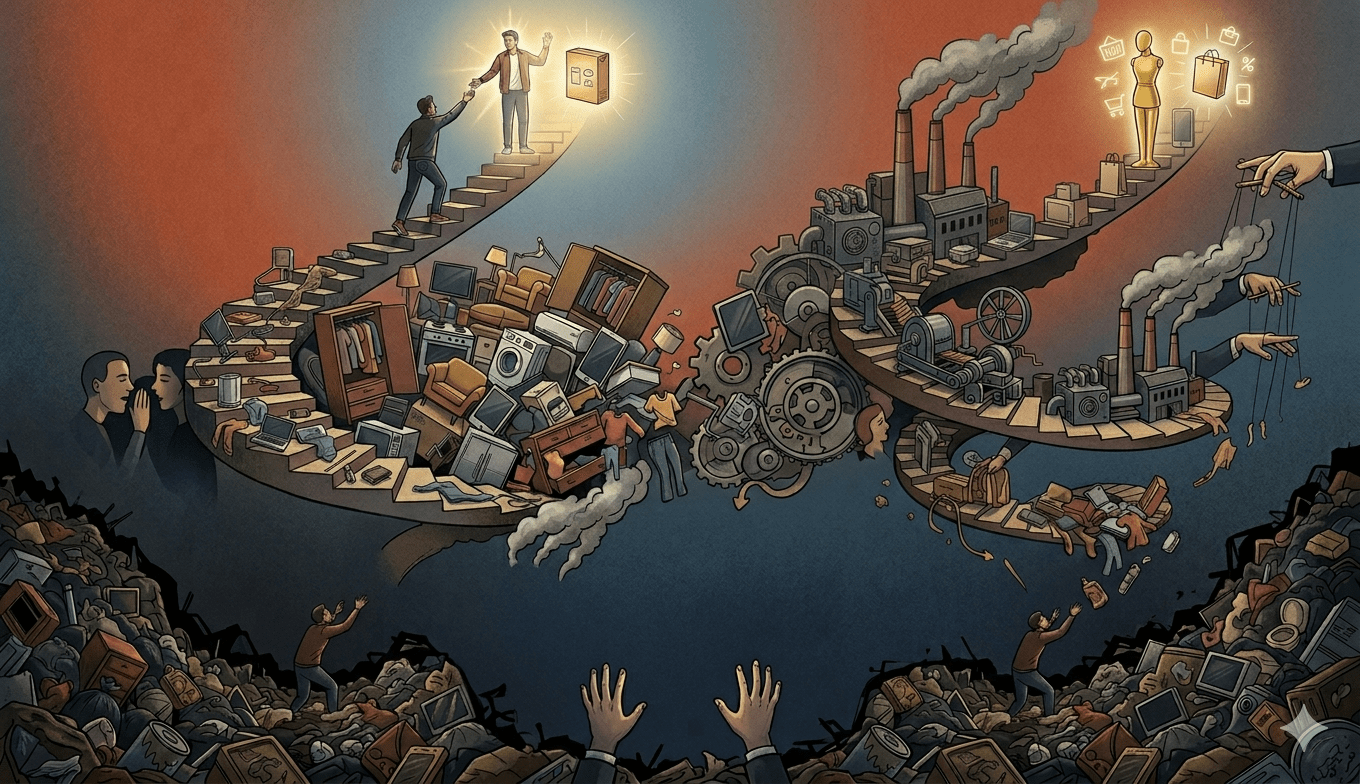
My closets, storage locker, kitchen drawers, bookcases, car trunk, and the nooks of my condo are an allegory for the adage “a fool and their money are soon parted.” Like many, I’m suffocating under a pile of objects meant to patch the structural cracks in my well-being, but they now serve as forensic evidence of a financial crime committed, ironically, against myself. My living space has become a museum of dead intentions—a gallery of promised “solutions” to problems I never actually had, purchased with money I should have kept.
Go back to the 1920s, and you’ll find the diagnostic moment that turned “needs” into “wants.” For the better part of a century, we’ve been methodically re-engineered from creatures of purpose into marketing-driven conduits. It’s been a slow-motion hijacking of the human spirit, a transition that’s left us as nothing more than biological wallets for an economy that demands a level of consumerism irresponsible to our financial health and the environment. Sometime in the mid-50s—I’m ballparking—we started to stop living and began processing inventory.
By the dawn of the 1920s, the Industrial Revolution had become a victim of its own efficiency. Machines were producing furniture, clothing, and automobiles faster than people needed them, prompting corporate boardrooms to a panicked realization: Market Saturation. If a stove lasted twenty years, the factory was essentially building its own demise. In order to keep the chimneys smoking, business leaders realized they couldn’t just sell products; they had to rewire the human psyche and lobotomize the concept of ‘enough.’ They needed to figure out which psychological tricks they could use to shift people from buying based on actual need to buying based on desire.
If today’s consumerism has a “Ground Zero,” it’s the work of Sigmund Freud’s nephew, Edward Bernays, often called the Father of Public Relations. Bernays didn’t just invent public relations; he weaponized his uncle’s psychoanalytic theories to pioneer a form of psychic strip-mining. Before Bernays, ads were honest and dull, merely listing specs and prices. However, Bernays realized that by bypassing the conscious mind, the human ego could be treated like a ventriloquist’s dummy. By shifting from peddling products to harvesting insecurities, Bernays successfully grafted our social identity onto our possessions; thus, by altering human contentment, he changed the concept of marketing.
In 1929, the American Tobacco Company hired Bernays to open an untapped market: women. Public smoking was a gendered taboo. Bernays didn’t market cigarettes’ taste; he marketed them as symbols of female empowerment and independence, which became known as “torches of freedom.” Bernays proved that you could sell anything if you convinced the buyer that it would make them the person they wanted to be.
Post-World War II, the Western world found itself sitting on a mountain of war-surplus infrastructure and a tide of returning soldiers who needed jobs. To avoid a sequel to the Great Depression, the powers that be didn’t rebuild the old world; they built the “Consumer Republic,” a socio-economic bait-and-switch that sold the Greatest Generation on the belief that it was their patriotic duty to shop. The battlefields were traded for shopping malls; the collective psyche became convinced that the only way to save democracy was to be consumers of Tupperware and tailfins.
In 1955, retail analyst Victor Lebow laid out, in the Journal of Retailing, with clinical precision, the blueprint for a strategic strike on our wallets:
“Our enormously productive economy… demands that we make consumption our way of life, that we convert the buying and use of goods into rituals, that we seek our spiritual satisfaction, our ego satisfaction, in consumption.”
“Planned Obsolescence,” the deliberate design of products to wear out or become “out of style” quickly, was pioneered by General Motors through its annual model changes. It’s a strategy that keeps consumers on a Ponzi-scheme-like buying treadmill. Since nothing stays functional—or fashionable—for long, our relationship with “stuff” has shifted from utilitarian to existential. We aren’t just buying what we need; we’re buying attempts to purchase a version of ourselves that remains perpetually out of reach. Marketing propaganda has convinced us that our current selves are inadequate, that we’re “beta” versions in need of constant software updates.
The Marketing Mirage
Everyone wants to be who they’re not.
Think of how effortlessly we internalise the consumerist directive of the “aspirational purchase.” Marketers have sold us the delusion that identity is something you can add to a shopping cart. Marketing, and its byproduct “advertising,” passes for a vicious funhouse mirror; it doesn’t reflect our realities but instead teases us with high-definition “potentials” of what we could be if we own and use the right product. You aren’t merely buying high-altitude technical gear; you’re renting a rugged, frontiersman persona, buying the costume of a person who possesses the freedom to disappear into the wild, while you perform the theatre of productivity inside a fluorescent-lit cubicle, having filed for spiritual bankruptcy years ago.
We are witnessing the total collapse of the “Middle Distance.” A few generations ago, acquiring a significant object—a sturdy wool coat, a mahogany writing desk, an automobile—was the destination. The act of making the purchase was a form of closure; you’d arrived at “the finish line.” Today, the retail abyss, and certainly the digital strip malls, have vaporized the vital human pause between desire and delivery. We’ve been conditioned into a state of pre-emptive nostalgia, where the dopamine hit of checking out an item or clicking the “Check Out” button is incinerated by the shadow of the next upgrade. The Middle Distance—that period of anticipation while scrimping and saving, followed by years of grateful utility—has been compressed into a frantic, high-frequency loop of consumption. We no longer own our things; we merely host them on their way to the landfill, while sprinting on a gold-plated hamster wheel that marketers make sure never comes to a full stop.
The Financial and Environmental Crime
The environmental toll of this “Buy, Use, Toss, Repeat” cycle isn’t just staggering—it’s ecological insolvency. Look at the ultra-fast fashion behemoths like Shein and Temu. By 2024, these giants were hemorrhaging nearly a million packages a day into North America, bypassing traditional retail channels and flooding our borders with low-grade rags designed to last only 3 to 5 wears before being interred in landfills. Every time a credit card is swiped, the person is financing a landfill.
Furthermore, our outsourcing of conscience, a delusional attempt to ease the guilt of a lifestyle that’s causing irreversible environmental wreckage, has reached a fever pitch. We buy the “eco-friendly” bamboo alternative, willfully ignoring that it was hauled halfway across the globe on a diesel-belching freighter. This “ethical consumerism” is nothing more than a brand-led corporate hoodwink, a sedative that keeps us feeling virtuous while we maintain the same ruinous levels of consumption. We’re rearranging deck chairs on the Titanic, only the chairs are made of recycled ocean plastic, cost 250 dollars apiece, and come with a “carbon-neutral” sticker that’s about as factually grounded as a “low-calorie” sticker on a bucket of lard.
The Psychology of the “Latest and Greatest”
Why do we do this? Why do we keep falling for the “new and improved” trap? The psychological tether runs deeper than mere vanity. In a 2024 interview, Dr. Bruce Hood, a professor of developmental psychology and author of The Self Illusion: How the Social Brain Creates Identity, noted that our drive to consume is often a misguided attempt at social signalling and self-stabilization.
“We don’t buy things because we need them; we buy them because of what they say about our status and our belonging. In an increasingly fragmented world, the ‘latest and greatest’ serves as a temporary tether to a community we feel we’re losing. We’re trying to purchase a sense of security in an insecure economy.”
We’re harvesting objects for social capital. We don’t experience our possessions; we curate them. We’re buying the artisanal sourdough starter kit not to bake, but to belong to the class of people who bake. We’re consuming the idea of a life rather than life itself.
The Radical Act of Refusal
There is a profound “Void of the After-Purchase”—the psychological comedown when you realize that the new gadget or the “life-changing” skincare routine has failed to fill the hole it promised to address. Consumerism has evolved into a secular religion, complete with its high-gloss cathedrals of malls and flagship stores and performative rituals of “unboxing.” However, it’s a religion without a sabbath; there’s no rest, only the relentless grind of earning money to buy the next “new and improved.” We’re bowing before an altar of planned obsolescence, clutching our receipts as proof that we’re seeking salvation, which never arrives.
To stare at our cluttered lives and overflowing storage units is to realize that “enough” isn’t a number or a minimalist aesthetic you can buy at Ikea. In a world engineered by marketing-driven hunger, being satisfied is a radical act of refusal. Your next purchase won’t make you smarter, faster, or more loved; it’ll simply be more evidence of the ongoing financial crime you’re committing against yourself and of your participation in the planet’s gutting for a dopamine hit.
About The Author