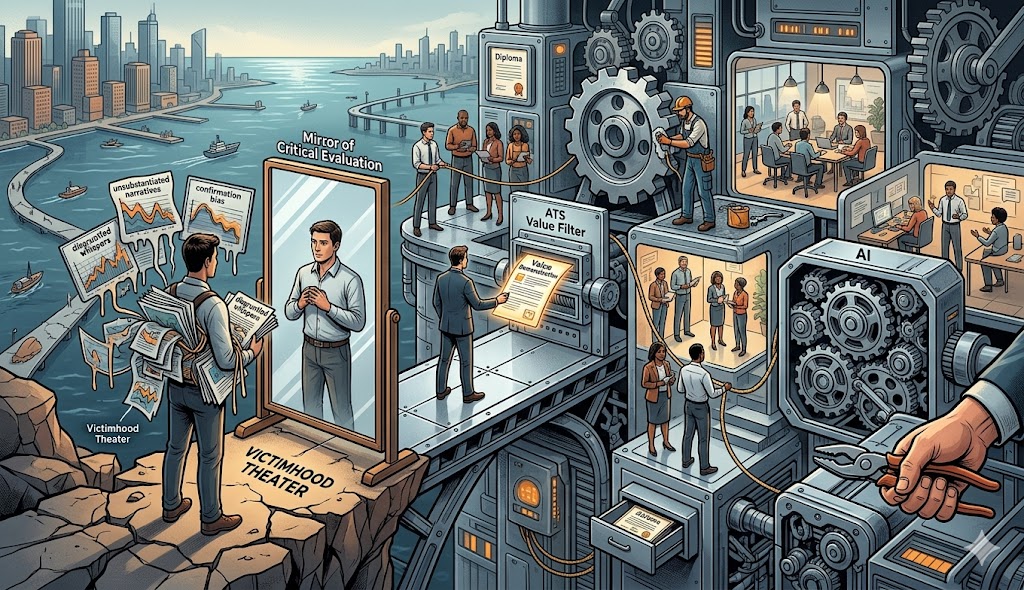
The job market, like all business activities, operates as a transactional machine. Yet many job seekers treat it as victimhood theatre, broadcasting unsubstantiated narratives to convince the world that their lack of success isn’t their fault. It’s a classic case of confirmation bias: gravitating toward data, statistics and opinions that validate their frustration and anger while dismissing any suggestion that they should look in the mirror.
Job seekers have become experts at quoting “truths” with the structural integrity of a wet paper towel. They conveniently ignore that anecdotal hearsay—the “I read it on Reddit,” “my friend’s cousin said,” or a LinkedIn post from a self-proclaimed career coach whose client allegedly told them something—isn’t empirical data. It’s convenient fiction.
Empirical data is verifiable, observable, and statistically significant. Anecdotal hearsay, especially from struggling job seekers, is just a collection of disgruntled whispers. The “survey industry” and the media exacerbate confirmation bias by bombarding job seekers with headlines claiming “70% of hiring managers do X,” based on a survey of 750 HR professionals. Do those 750 speak for the hundreds of thousands of hiring managers across North America? Absolutely not. It’s a statistical mirage.
“When a statistic surprises you, ask yourself the following questions: Who collected it? Is the source reliable? Was the sample unbiased? In an era of misinformation, not every number deserves your trust.” — Statistics Canada, Expert advisory on critical thinking (February 2026)
Most data is manipulated to serve the organization paying for the narrative. As the saying goes: “If you torture the data long enough, it’ll confess to anything.” British philosophical entertainer Alan Watts noted, “Most people are living on second-hand knowledge.” For job seekers, that second-hand knowledge is often statistics and data manipulated to trigger emotions, rather than providing an accurate picture.
There are five narratives that job seekers frequently use as excuses, despite there being no empirical evidence supporting them.
1. The “ATS is Filtering Out Strong Candidates” Myth
The loudest whine among job seekers: “The ATS rejected me!” Job seekers often make veiled threats that employers using ATS software and AI to sift through the avalanche of resumes they receive are “missing out” on strong candidates.
Where’s the empirical evidence for this claim?
Every day, employers are hiring amazing candidates. Are job seekers implying that employers aren’t hiring the best candidates for their business? Are job seekers themselves better than those being hired?
No CEO has ever told shareholders, “Profits are down because our ATS filtered out a strong candidate in June.” If your resume doesn’t trigger the employer’s ATS, you haven’t demonstrated value. “Strong candidate” is a self-declared title; only the employer defines what a “strong” candidate is.
2. The “Ghosting Hurts the Employer Brand” Delusion
Job seekers soothe their egos by insisting that ghosting will damage a company’s brand and bottom line. This is purely emotional. There’s no empirical evidence that failing to send a “No Thanks” email harms a company’s profits.
Career expert Liz Ryan noted: “The belief that companies owe every applicant a curated experience is a relic of a labour market that no longer exists; efficiency has replaced etiquette.” Unhired candidates aren’t assets. Ghosting isn’t “unprofessional” or “rude”—it’s a ruthless allocation of time to revenue-generating activities.
3. The “Overqualified is Code for Ageism” Assumption
Unless a hiring manager looks you in the eye and says, “You’re too old,” assuming ageism is laziness. “Overqualified” usually means your skills have depreciated while your salary expectations haven’t, or that you’ll be difficult to manage.
Without fiduciary proof of discriminatory intent, “ageism” is an unproven argument that deflects from a critical branding problem: your 20 years of experience are being perceived as one year repeated 20 times. Believing you’re a victim of your birth year is simpler than critically evaluating your employability.
4. The “Ghost Jobs” Paranoia
Job seekers see a job posted for 30 days and, with 100% certainty, conclude it’s a ghost job, nonexistent, and therefore not worth applying for.
I’ve yet to see a job seeker prove unequivocally that a posted job is nonexistent.
Are you reviewing their internal HR logs? Are you tracking their interview pipeline? Many alleged “ghost jobs” are simply roles for which the employer hasn’t found anyone who can demonstrate they can solve the problem the job is meant to solve. Claiming a job is fake without evidence is counterproductive. It’s a juvenile approach to lowering your application output while still giving the impression of effort.
5. The “No One Reads Cover Letters” Laziness
Not including a cover letter is lazy. I don’t know a hiring manager who hires “lazy.” Job seekers claim that because “some” recruiters and hiring managers don’t read cover letters, “none” do, thereby justifying their decision not to put in the effort to write one.
What if the hiring manager gatekeeping your dream job values prose and personality? By omitting a cover letter, you’re missing an opportunity to explain how your skills and experience align with the position. It’s like a salesperson refusing to leave a voicemail because “nobody checks them.” You only need it to work once to be successful.
As a job seeker, what evidence are you using to support your beliefs?
About The Author