Germany’s Industrial Reckoning Collides With Geopolitics
- Kingston Bailey
- Breaking News
- Europe
- April 30, 2026
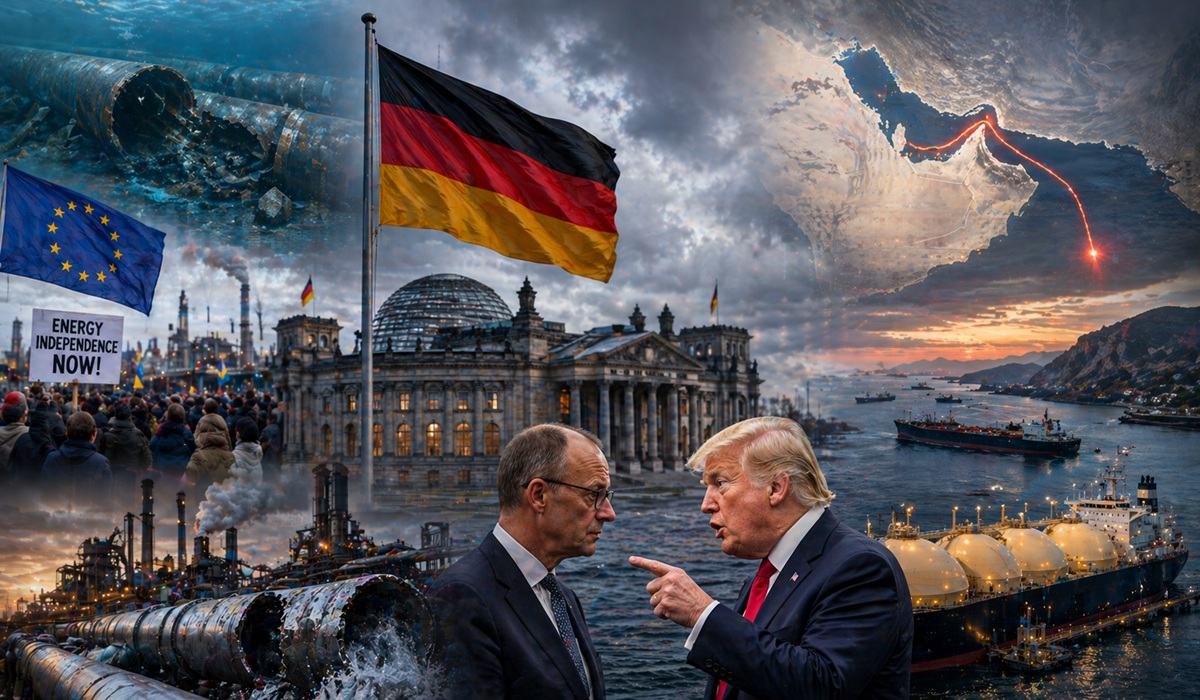
Germany’s industrial slowdown cannot be understood as a simple story about rising energy prices or post-pandemic adjustment. What is unfolding is a geopolitical and economic collision that has fundamentally altered how Europe’s largest economy powers itself, trades, and plans for the future. The turning point was the Russian invasion of Ukraine, which triggered a cascade of sanctions targeting Russian oil, crude exports, natural gas flows, and refined energy products. For Germany, which had built its industrial dominance on stable and relatively cheap Russian energy, the consequences were immediate and profound.
Before the war, German industry relied heavily on pipeline gas flowing directly from Russia, providing predictable pricing that allowed energy-intensive sectors such as chemicals, steel, and automotive manufacturing to thrive. When sanctions were imposed and flows were reduced, that system effectively collapsed. The destruction of the Nord Stream pipelines removed any realistic near-term path to restoring that supply route. The cause of that explosion remains disputed in public discourse, with competing narratives and no universally accepted conclusion, but the outcome is indisputable: Germany lost its primary energy artery overnight.
In the absence of Russian supply, Germany and much of Europe were forced to pivot rapidly toward liquefied natural gas. A significant portion of that LNG has come from the United States, where production capacity expanded in response to global demand. However, LNG is structurally more expensive than pipeline gas due to the costs associated with liquefaction, transportation, and regasification. German firms that once operated with a cost advantage suddenly found themselves paying materially higher prices for the same energy input. That shift has reshaped balance sheets across entire sectors.
This is where the economic story intersects directly with geopolitics. The reliance on U.S. LNG has deepened transatlantic ties in one sense, but it has also introduced friction. German policymakers have expressed concern about the price differential, arguing that European buyers are effectively paying a premium compared to domestic U.S. consumers. That tension has surfaced more openly in recent months, particularly as industrial output data shows continued weakness and investment decisions begin to shift outward.
The situation is further complicated by global energy chokepoints. The Strait of Hormuz remains one of the most critical corridors for global oil shipments, and any instability in that region has immediate implications for energy pricing worldwide. Germany may no longer be directly dependent on Middle Eastern oil in the same way it once relied on Russian gas, but global price benchmarks still dictate input costs. When tensions rise in the Gulf, European industries feel the impact almost instantly through higher crude and refined product prices.
At the same time, domestic political pressure within Germany is intensifying. Industrial leaders are warning that prolonged high energy costs are not sustainable, particularly when competitors in North America benefit from lower input prices. Some companies are already shifting production capacity abroad, not as a temporary measure but as a long-term strategic decision. This is not deindustrialization in the dramatic sense, but it is a slow reallocation of where industrial activity makes economic sense.
Overlaying all of this is a growing political strain between Berlin and Washington. The relationship between the government of Germany and the administration of Donald Trump has become more openly contentious, particularly on issues of trade, defense spending, and energy policy. Public exchanges between U.S. officials and the German chancellor have highlighted disagreements over economic strategy and geopolitical priorities. These are not isolated diplomatic moments; they reflect a broader divergence in how each side views the balance between security, economic independence, and alliance obligations.
Germany now finds itself navigating a complex reality. It is transitioning toward renewable energy, investing heavily in wind, solar, and hydrogen infrastructure, but those systems are not yet capable of fully replacing the scale and reliability of the energy sources they are meant to displace. In the interim, the country is caught between higher-cost imports, geopolitical dependencies, and the need to maintain industrial competitiveness.
The long-term outcome will depend on how quickly Germany can stabilize its energy mix and whether it can do so without permanently eroding its industrial base. What is clear is that the era of cheap, predictable energy is over. In its place is a far more complex and politically charged system where economics and geopolitics are inseparable, and where every decision carries consequences that extend well beyond national borders.
About The Author