By: Donovan Martin Sr, Editor in Chief
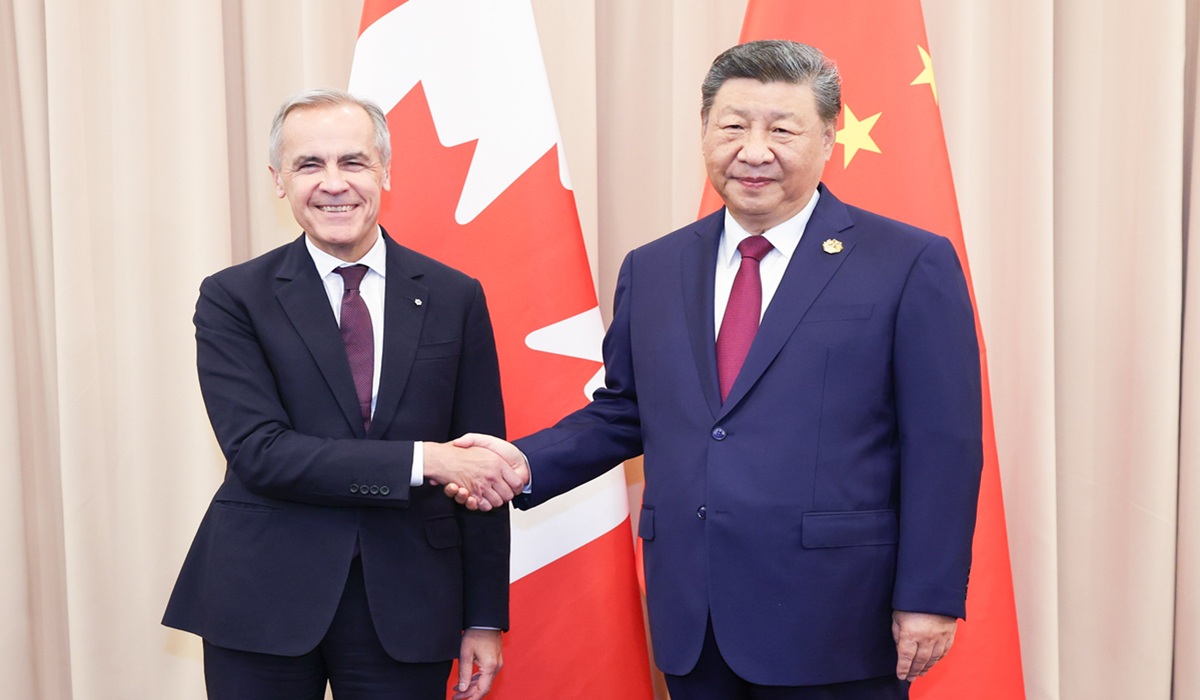
In the quiet historical city of Gyeongju, Republic of Korea, an important diplomatic shift unfolded on October 31, 2025. On the margins of the APEC Leaders’ Meeting, Prime Minister Mark Carney sat down with Chinese President Xi Jinping — a meeting widely viewed as a turning point in a relationship strained by years of geopolitical tension, trade disputes, and mistrust. For the first time in years, there was no icy tone, no carefully rehearsed diplomatic sidestepping. Instead, the two leaders spoke openly about restoring trust and rebuilding a partnership grounded in pragmatism, respect, and measurable progress.
Canada and China marked 55 years of diplomatic relations in 2025, a milestone that arrived without celebration but with quiet recognition of both shared history and missed opportunities. The tone of this latest meeting suggested a mutual desire to reverse the cooling trend. Carney has made clear that Canada’s new economic vision hinges on diversifying trade beyond traditional partners. China, with its enormous consumer base, industrial strength, and growing role in global technology and clean-energy markets, remains a country Canada cannot afford to ignore. Xi, for his part, welcomed dialogue after a period during which bilateral communication had largely stalled.
To understand the significance of this reset, one must acknowledge how strained the Canada-China relationship became under the Trudeau era. What began as diplomatic tension escalated into full-blown deterioration, fuelled by a foreign-policy posture at times widely perceived as too closely aligned with Washington’s priorities. Many Canadians felt as though Ottawa had surrendered its strategic independence, allowing U.S. political winds to dictate Canada’s approach with China. That impression — whether fully accurate or not — eroded trust and confidence domestically, and weakened Canada’s position internationally.
With global geopolitical lines hardening and President Trump once again occupying the White House, Canadians expect a government that will act independently — charting policy in the interests of Canadians first, not blindly following U.S. direction. This moment demands sovereign decision-making, economic courage, and dignity in diplomacy. Carney is under no illusions: Canadians are not interested in cheerleaders or partisan performances; they expect sober leadership, strategic discipline, and relationships built on results, not posturing. The relationship with China should have never deteriorated to this extent, and while this reset is welcome, it is also overdue. Canadians remain cautiously hopeful because win-win outcomes strengthen both nations, benefiting workers, families, and businesses across both societies.
Both leaders framed their engagement as a careful, deliberate rebuilding — not a hasty rapprochement. They pointed to recent engagements as signs of momentum already forming, from Carney’s conversation with Premier Li at the UN General Assembly to visits to Beijing from Foreign Affairs Minister Anita Anand and the Premier of Saskatchewan. These moves signalled an emerging approach grounded in strategic calm, rather than rhetorical escalation.
Trade dominated the discussions. Long-standing irritants around canola, seafood, and other agri-food products were addressed, as were evolving issues surrounding electric vehicles and clean-tech supply chains. Both leaders acknowledged sensitivities while signalling a problem-solving mindset. For the first time in a long time, the mood was constructive rather than confrontational.
The leaders also discussed a modernised framework for cooperation encompassing clean and traditional energy, high-value manufacturing, agriculture, climate policy, and international finance. Canada brings innovation capacity and critical natural resources; China brings industrial scale, investment power, and rapidly expanding clean-tech expertise. In a world shifting toward economic blocs and technological competition, the two sides made it clear they see room — and need — for pragmatic engagement.
Symbolically, Xi extended an invitation for Carney to visit China, which the Prime Minister accepted. It would mark the first Canadian prime ministerial visit to Beijing since 2017 — a long gap that reflects the troubled chapter both countries are now attempting to move past. Timing remains open, but officials suggest the visit could occur as early as late this year or very early in the new year, depending on urgency and follow-through.
Carney emphasised that disengagement was not a strategy that served Canadians, stating:
“Distance is not the way to solve problems; it’s not the way to serve our people. Our people deserve cooperation, stability, and people-centric growth.”
Xi echoed the constructive tone, declaring in Mandarin:
“China is willing to work together with Canada to push China-Canada relations back onto a healthy, stable and sustainable correct track at an early date, so as to better benefit the people of our two countries.”
Wang Di, China’s Ambassador to Canada, called the meeting “very productive,” and expressed optimism about a dramatic increase in trade, even speaking openly about ambitions to potentially triple exports between both countries — a sign that Beijing sees more upside than risk in the relationship going forward.
This meeting did not erase history, nor did it dissolve outstanding challenges. But it shifted the tone — and tone often precedes policy. It offered farmers, exporters, innovators, and everyday Canadians reason to hope that pragmatic statecraft may finally return to the centre of Canadian foreign policy. It challenged diplomats to pursue interests confidently and constructively. And it reminded the world that Canada intends to engage, compete, and secure prosperity for its people in a rapidly changing global economy.
If 2017 marked the last era of meaningful engagement, 2025 may be remembered as the moment the ice began to thaw. What happens next — in trade missions, diplomatic follow-ups, and the eventual moment Carney steps off a plane in China — will determine whether today’s cautious optimism becomes tomorrow’s renewed prosperity.
For now, one thing is clear: dialogue is back, ambition is back, and Canada is attempting to re-enter the global arena with a quieter confidence, guided not by loyalty to any foreign capital — but by service to Canadians.
About The Author